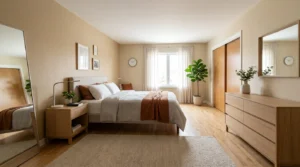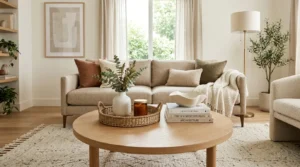
These minimalist bedroom ideas start from a simple definition: minimalism is not an empty room, it is a deliberate room. Every object earns its place; everything else leaves. Done right, the result is not stark or cold — it is the calmest room in the house, the one where visual noise drops to zero and the mind can actually rest.
This guide breaks down 27 minimalist bedroom ideas into a complete system: how to declutter decisively, how many pieces of furniture a bedroom actually needs, the color-palette rules that keep things calm, storage strategies that hide the rest of life, and the maintenance habits that keep the room minimalist long after the initial overhaul.
What Minimalism Actually Means in a Bedroom
Minimalist bedrooms fail in two opposite ways: stripped so bare they feel sterile, or “curated” with so many beige objects they are just clutter in a neutral palette. True minimalism sits between — deliberate restraint. Four principles govern it:
- Fewer objects, each chosen. A bedroom needs surprisingly little: a bed, one or two nightstands, a dresser, lighting, and a handful of textiles. Everything beyond that list must justify itself.
- A restrained palette. Two to three tones, repeated consistently, so the eye never has to resolve visual conflict.
- Hidden storage. Minimalism is not about owning nothing; it is about keeping what you own out of sight.
- Breathing room. Empty floor, clear surfaces, and negative space on walls are design elements, not wasted space.
1. Declutter With a Forced, Honest Reset

Minimalist styling cannot take hold on top of accumulated clutter. The most effective reset: empty the room nearly entirely, then sort every item into keep, donate, or relocate piles. The physical act of handling each object forces honest decisions that tidying around them never does.
For borderline items, use the 90-day box: seal them in a box, date it, and store it out of sight. Anything unneeded after 90 days leaves without a second debate. Then institute one-in-one-out — every new item entering the bedroom requires one to leave — which prevents the slow refill that undoes most decluttering efforts within months.
2. Limit Furniture to the Genuine Essentials

A calm bedroom typically needs four to five pieces: bed, one or two nightstands, a dresser, and optionally a single chair or bench. Before any piece enters, it should pass a simple test: does the room fail to function without it? “Might need it someday” is not a pass.

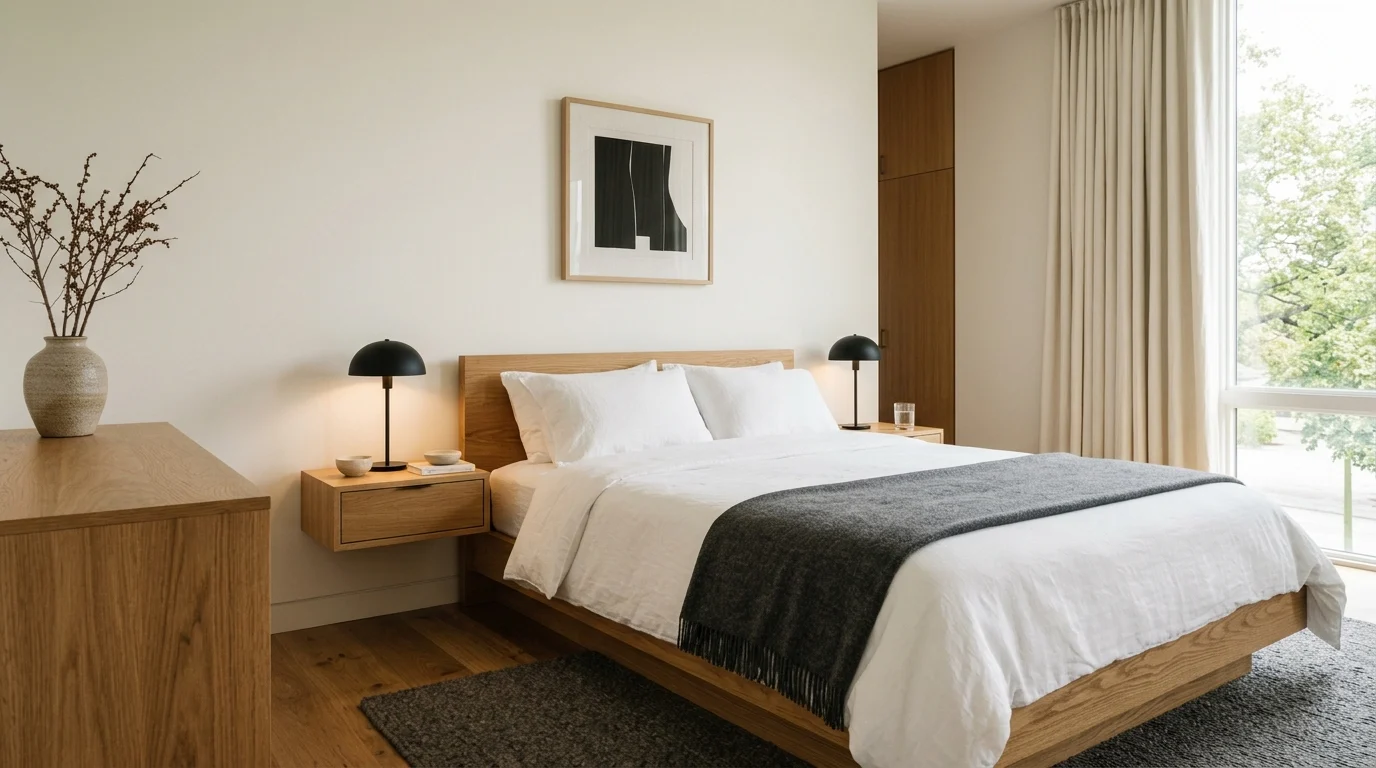
Choose a low platform bed with clean lines and no ornamental detailing — the low, simple silhouette makes the whole room read as more open. Favor pieces with slim visible legs over flush solid bases; the glimpse of floor beneath furniture reduces visual weight measurably. A slim dresser with flat drawer fronts holds the same volume as a bulky one while leaving more open floor around it.

3. Commit to a Two-to-Three-Tone Palette

Paint the walls a single neutral — a soft warm white, not a stark blue-white — and resist accent walls entirely. One calm backdrop lets the few remaining objects stand out instead of competing with the room itself.

Beyond the walls, allow exactly two additional tones — for example, warm oak and soft charcoal — repeated consistently across furniture and textiles. Apply a rough 60-30-10 distribution: 60 percent dominant neutral, 30 percent secondary tone, 10 percent accent. Any candidate purchase must fit the palette or it does not enter the room. This single rule eliminates the largest source of visual noise: unrelated colors accumulating one by one.
4. Choose Solid, Unpatterned Bedding

The bed is the room’s largest visual mass, so its dressing sets the tone. Solid, unpatterned bedding in a warm white or soft neutral keeps that mass calm — even subtle patterns add visual activity the eye must process. Washed linen or a simple cotton percale in a solid tone reads as both minimal and inviting.

Warmth without busyness comes from a single textured element: one wool or chunky-knit throw at the foot of the bed. One texture reads as intentional; three competing textures read as clutter, however neutral the colors.
5. Hang One Piece of Art — and Mean It

Five small frames competing on a wall create exactly the visual chatter minimalism removes. Keep one well-placed piece — above the bed or dresser, roughly two-thirds the width of the furniture below it — and let it carry the whole wall. A single print in a simple frame has more presence in a quiet room than a gallery wall ever could, because nothing competes with it.
6. Keep Nightstands Nearly Bare

Limit each nightstand surface to two or three items: a lamp, one book, and optionally one small personal object. Even a beautifully styled surface with five objects reads as cluttered in a minimalist room, where restraint matters more than display.

Everything else — charging cables, lip balm, reading glasses — belongs in the nightstand drawer, ideally with a small organizer tray so the drawer itself does not become a junk drawer. Floating nightstands amplify the effect: wall-mounted at mattress height, they free the floor beneath and make the room feel larger.
7. Hide Storage Everywhere It Fits

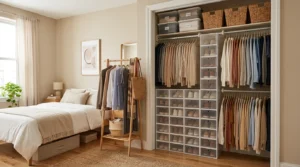
Minimalism is a storage strategy disguised as an aesthetic. Under-bed bins or drawers swallow off-season clothing and spare linens; drawer dividers keep dresser interiors functional so surfaces stay clear; and a simple rod-and-basket system inside the closet contains everything behind closed doors.

Keep closet doors fully closed — an open, visibly stuffed closet undermines the room’s calm as thoroughly as surface clutter. If the closet lacks doors, a simple ceiling-mounted curtain in the wall color conceals it for under $50.
8. Enforce a Clear-Surface Policy

Decide what lives on each surface — ideally one object, such as a single ceramic vase — and give everything else a drawer, bin, or hook. Daily-use items (jewelry, spare change, keys) accumulate fastest, so assign each a specific home inside closed storage from day one. A dresser top that stays clear except for one intentional object is the difference between a room that looks minimalist and one that actually is.

9. Simplify Lighting to Essentials

Two to three light sources cover a minimalist bedroom: an overhead fixture and one bedside lamp per sleeper. Keep them in the same finish — matching metals and shades remove another small source of visual noise. A simple linen drum pendant or flush mount, plus matching bedside lamps, delivers full function with zero decorative sprawl. Put the overhead on a dimmer so one fixture serves both bright mornings and dim evenings. For a deeper dive into warm, layered light that still suits a quiet room, see these bedroom lighting ideas.
10. Keep Window Treatments Quiet

Solid, unpatterned curtains in a tone close to the walls — hung from a slim, unobtrusive rod — give light control and an unbroken visual field along the window wall. Mount the rod 4–6 inches above the frame and wide enough that panels stack clear of the glass.

The even quieter alternative: plain linen Roman shades, which stack into a slim fold and nearly disappear when raised. Either option works; the rule is one treatment per window, solid color, no valances or layered fussy hardware.
11. Keep the Floor Plane Clear

An empty, unobstructed floor is one of the fastest visual signals of calm — and the first thing to erode, as benches become clothing dumps and corners collect “temporary” piles. Protect it deliberately: no furniture that serves as a horizontal surface without a job, and a nightly two-minute reset that returns strays to their homes.

One rug in a solid, neutral tone grounds the bed without adding pattern noise. Size it to extend 18–24 inches beyond the bed’s sides and foot; anything smaller looks like an afterthought and breaks the calm floor plane.
12. Match Hardware and Finishes Throughout

Replace mismatched drawer pulls, lamp finishes, and curtain rods with one consistent finish — brushed nickel, matte black, or unlacquered brass — across every piece. Individually trivial, collectively these micro-inconsistencies are a real source of visual noise. One afternoon and $30–$60 of hardware ties the whole room together.

13. Remove the Television (and Tame Cables)

A TV is a large black rectangle that dominates even when off — plus its tangle of cables. Moving it out of the bedroom removes the room’s single busiest object in one step, with well-documented sleep benefits as a bonus. Give the screen a proper home with these TV room design ideas instead. If it must stay, wall-mount it inside a closed cabinet and route every cable through a cord cover painted the wall color.
14. Keep Personal Objects Few and Meaningful

Minimalism does not mean impersonal — it means each personal item carries more weight. One framed photo on the nightstand, one piece of art, one meaningful object on the dresser. A single image chosen with intention says more than a gallery of twelve, because in a quiet room, the eye actually stops to look at it.
15. Keep Scent Simple and Singular

One unscented or very lightly scented candle — not a collection of competing fragrances — supports the same uncomplicated calm the visuals aim for. Scent is part of the room’s sensory palette; keep it to a single quiet note, like the visual equivalent of the two-tone color rule.
16. Maintain It: The Quarterly Reset and the 30-Day Rule

Minimalism is maintenance, not a one-time project. Every quarter, walk the room looking for what crept back in — unread book piles, stray cables, the chair that became a wardrobe — and evict it. For new purchases, apply the 30-day rule: wait a full month before buying any decor item. Most impulses dissolve; the few that survive the wait are usually worth keeping.

Favor timeless over trendy for anything that does enter — simple oak, plain linen, classic shapes — so the room never needs a style overhaul, only the occasional edit.
Minimalist Bedroom Layouts: Three Floor Plans That Work
Furniture count means little without a layout that protects open space, and the right arrangement depends on the room’s shape. Three proven minimalist bedroom ideas for layouts cover nearly every bedroom:
- The centered bed (square rooms, 12×12 and up): bed centered on the longest wall, a nightstand on each side, dresser on the opposite wall. Symmetrical, calm, and the easiest to keep balanced.
- The corner anchor (narrow rooms): bed tucked into a corner with the headboard on one wall — acceptable in minimalism when space demands it — freeing one long, clear run of floor along the opposite side.
- The floating zone (large rooms): bed pulled away from walls with a low bench or the rug defining the sleep zone, dresser on the far wall. Prevents a big room from feeling like furniture pushed to the edges of an empty field.
Whichever layout fits, keep 24–30 inches of clear walkway on every used side of the bed, and never block the window wall with tall furniture — daylight is part of the calm, and a dresser silhouetted against the window reads as visual noise.
Small-Space Minimalism: When the Room Is Tiny
Small bedrooms are minimalism’s natural habitat — fewer square feet means fewer decisions, and every minimalist bedroom idea in this guide works harder in tight quarters. Adapt with space-saving swaps: one nightstand instead of two (or a floating shelf in its place), a bed with built-in drawers instead of a separate dresser, and wall-mounted sconces instead of table lamps to reclaim surface area.
Keep the palette at its lightest — warm white on every wall, a single wood tone — since dark colors compress small rooms visually. Hang a mirror opposite the window to double daylight, and choose the lowest-profile furniture that still functions: a 10-inch platform bed and a slim dresser preserve precious floor area. In rooms under 100 square feet, apply the strictest test of all: every piece must do two jobs or leave.
What to Do With Sentimental Clutter
The hardest decluttering category is the sentimental one: gifts you never chose, heirlooms you feel guilty about, children’s artwork by the box. These minimalist bedroom ideas handle it without heartlessness. First, the memory box: one box per person, and whatever does not fit gets photographed and released — the limit forces the real treasures to surface. Second, photograph-then-donate for bulky keepsakes: the memory lives in the photo, not in the object occupying closet space. Third, display one and rotate: keep a single meaningful item visible and swap it seasonally, so each piece gets genuine attention instead of competing in a crowded display.
Minimalism never requires discarding meaning — it concentrates meaning where it can actually be seen and appreciated, which is kinder to the memories than burying them in a closet.
Minimalist Bedroom Ideas by Budget: Three Price Plans
- Around $100: the full declutter (free), a gallon of warm-white paint, matching hardware for existing furniture, under-bed storage bins, and drawer organizers. Restraint costs almost nothing.
- Around $800: solid linen bedding set, a low platform bed frame, a slim dresser, and one quality wool throw — the core furniture swap.
- Around $2,000: everything above plus a closet organization system, blackout curtains or Roman shades, and matching lighting in one finish.
Minimalist Mistakes to Avoid
- Editing to sterility — removing all texture and warmth leaves a room that feels like a showroom, not a bedroom. Keep the wool throw and the wood tones.
- Hidden clutter instead of less clutter — cramming everything into closets without decluttering first just relocates the problem.
- Trendy “minimalist” purchases — beige clutter is still clutter. Every object must earn its place functionally.
- Ignoring the closet — open, chaotic storage undoes the whole room. Doors closed, systems inside.
- Treating it as one-and-done — without the quarterly reset and one-in-one-out, entropy wins within months.
Frequently Asked Questions
Does a minimalist bedroom have to feel cold or empty? No. One or two warm textural elements — a wool throw, warm oak tones, soft warm-white walls — keep the room inviting while the overall restraint stays intact. Cold minimalism is usually just minimalism without any natural materials.
How often should I declutter a minimalist bedroom? A quarterly walkthrough catches small accumulations before they become real clutter. Daily, a two-minute reset — surfaces clear, closet doors shut — maintains the baseline.
Is minimalist design expensive? It is one of the cheapest approaches: most of the work is removing, not buying. A full transformation can cost under $100 in paint, bins, and hardware if the furniture is already serviceable.
Can a minimalist bedroom still feel personal? Yes — restraint gives each personal item more weight. One meaningful photo, one piece of art, one object with a story will register more than a dozen competing mementos.
What colors work best in a minimalist bedroom? Warm whites, soft greiges, and natural wood tones form the classic calm base. Add at most one deeper tone (charcoal, olive, clay) as the 10-percent accent. Avoid stark blue-whites, which read as clinical.
How do I keep a minimalist bedroom minimalist with kids or a partner? Give every person closed storage of their own, agree on the clear-surface rule together, and make the two-minute nightly reset a shared habit. Systems beat willpower.
How do I start a minimalist bedroom in a single weekend? Day one: declutter decisively with the keep/donate/relocate sort, using the 90-day box for maybes. Day two: repaint if needed, reset every surface to the bare rule (lamp plus book per nightstand), and install drawer organizers and under-bed bins. The room will not be finished, but it will be calm — refinement happens in the quarterly resets.
What is the difference between minimalist and just empty? Intention. An empty-feeling room usually lacks the warm layer — natural wood, one textured throw, warm-white walls — that makes restraint feel inviting rather than barren. These minimalist bedroom ideas keep that warm layer deliberately: minimalism edits objects, never comfort.
Final Thoughts
A minimalist bedroom is an ongoing practice of restraint, not a single finished look: declutter honestly, commit to a narrow palette, hide the storage, and reassess quarterly. Done well, it does not feel empty — it feels like the one room in the house where your mind can finally stop working.