When I bought my current house, the kitchen floor was easily the most disappointing part of the entire space, a dated, peeling sheet vinyl in a strange faux-terracotta pattern that had clearly been there since sometime in the early 2000s. I lived with it for almost a year, telling myself I’d get around to fixing it eventually, until a particularly stubborn wine stain finally pushed me to actually research and replace it properly.
That research turned into a much bigger education than I expected. I assumed flooring was flooring, pick a material, install it, done. What I actually learned is that kitchen flooring involves a genuinely complicated set of tradeoffs, water resistance, comfort underfoot, maintenance, cost, and how a material actually performs over years of daily cooking, spills, and foot traffic, not just how it looks in a showroom. I ended up going through several rounds of samples, a couple of contractor consultations, and a fair amount of research before landing on my final choice.
Since then, I’ve helped a couple of friends navigate their own kitchen flooring decisions too, each with different budgets and priorities, which gave me a broader, more practical sense of what actually works well across different situations. Here’s what I learned, organized by budget and style, to help make sense of what is honestly an overwhelming number of options.
Understanding What Actually Matters in Kitchen Flooring
Before getting into specific materials, it’s worth understanding the practical factors that matter most in a kitchen specifically, more than in almost any other room in the house. Water resistance is critical, since kitchens deal with spills, dishwasher leaks, and general moisture far more than bedrooms or living rooms. Durability matters too, kitchen floors endure heavy foot traffic, dropped pots and dishes, and the general wear of daily cooking.
Comfort underfoot is something I underestimated initially. Standing at the stove or sink for extended periods on a genuinely hard, unforgiving surface, like some tile or stone options, can actually become uncomfortable over time, which is worth considering if you cook often. Finally, maintenance requirements vary enormously between materials, some need regular sealing or specific cleaning products, while others are essentially wipe-and-go.
With those factors in mind, here’s a breakdown of the best kitchen flooring options across different budgets and style preferences.
Budget-Friendly Options (Under $3 Per Square Foot)
Sheet Vinyl
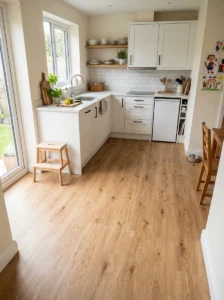
Despite my own bad experience with the dated sheet vinyl I inherited, modern sheet vinyl has actually improved significantly in both appearance and durability. When I helped a friend on a tight renovation budget choose flooring for her small kitchen, we went with a higher-quality sheet vinyl in a realistic wood-look pattern, and the result looked far better than either of us expected for the price point.
Sheet vinyl is fully waterproof, relatively easy to install, and comfortable underfoot compared to harder materials, which made it a genuinely practical choice for her budget. The main downside is that lower-quality versions can look obviously fake up close, so it’s worth spending slightly more within this category for a more realistic, higher-resolution pattern rather than choosing the cheapest option available.
Laminate Flooring
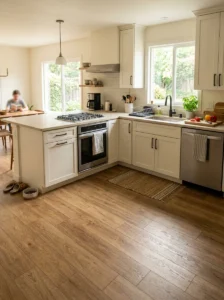
Laminate remains one of the most popular budget options, and for good reason, it offers a wide range of realistic wood and stone-look patterns at a fraction of the cost of the real materials. I considered laminate for my own kitchen before ultimately choosing something else, but I have genuine respect for how far the appearance quality has come in recent years.
The main consideration with laminate in a kitchen specifically is water resistance. Standard laminate can warp or swell if water sits on it for extended periods, so I’d recommend specifically seeking out water-resistant or waterproof laminate options, which cost slightly more but perform significantly better in a kitchen’s inevitable spill-prone environment.
Basic Ceramic Tile
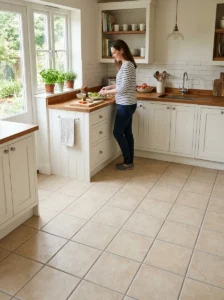
Simple, standard ceramic tile in common sizes remains one of the most affordable genuinely water-resistant options available. A friend used basic 12-by-12-inch ceramic tile in a simple neutral tone throughout her kitchen renovation, keeping costs low by avoiding any elaborate pattern or custom layout that would have increased both material and labor costs.
Ceramic tile is durable and fully water-resistant, though it can feel cold and hard underfoot, and grout lines require periodic cleaning and occasional resealing to prevent staining over time, a maintenance step that’s easy to underestimate when budgeting for this option.
Mid-Range Options ($3 to $8 Per Square Foot)
Luxury Vinyl Plank (LVP)
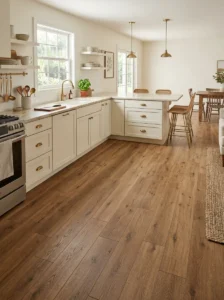
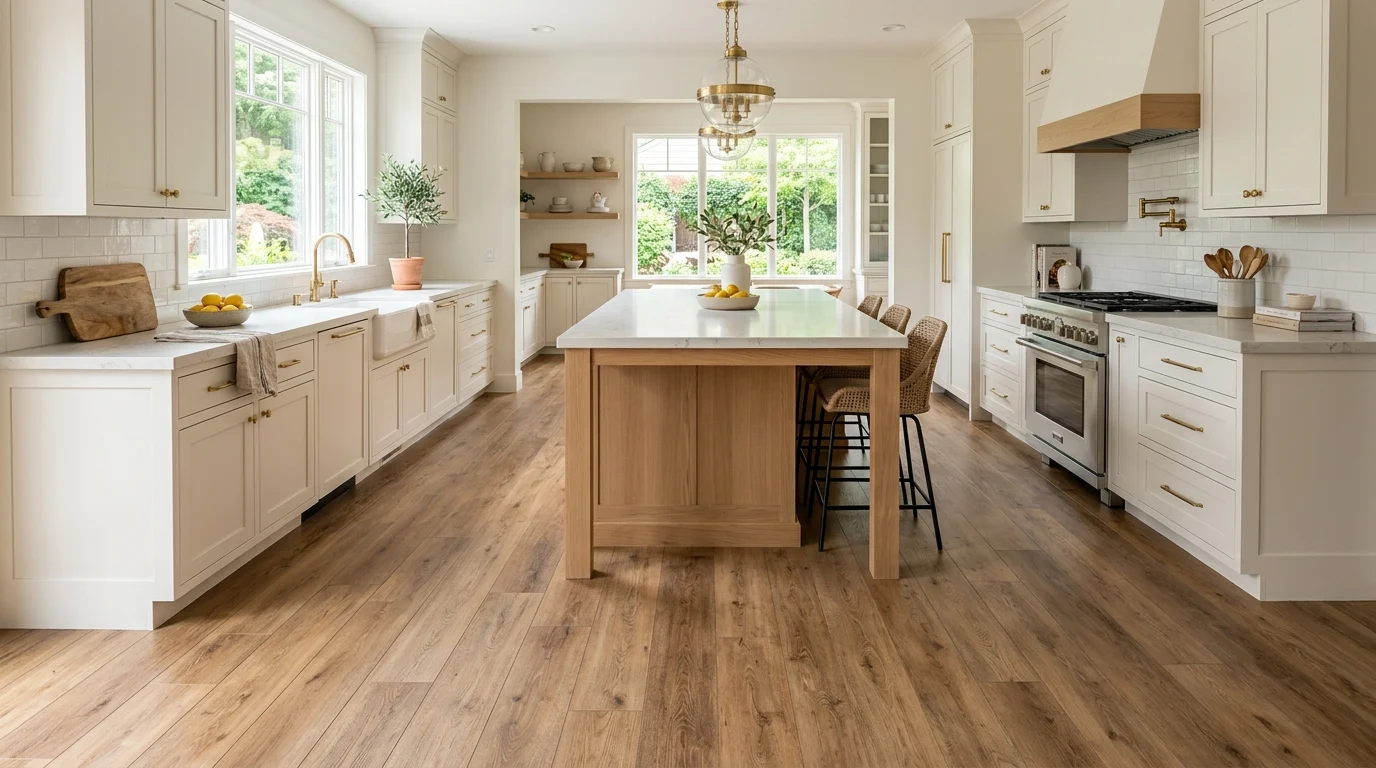
This ended up being my own final choice after months of research, and I’ve been genuinely happy with it. Luxury vinyl plank offers a realistic wood-look appearance with full waterproofing, something that actual hardwood simply can’t provide in a kitchen setting, along with a comfortable, slightly cushioned feel underfoot that’s noticeably more pleasant than tile or stone during long cooking sessions.
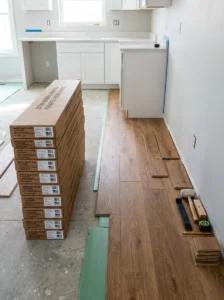
I chose a wide-plank style in a warm, medium oak tone, and the realistic texture, including subtle embossing that mimics real wood grain, has fooled more than a few visitors who assumed it was actual hardwood until I mentioned otherwise. Installation was also more straightforward than I expected, many LVP products use a simple click-lock system that doesn’t require adhesive, which made it a more approachable DIY project than I’d initially anticipated.
The main tradeoff, based on what I’ve read and experienced, is that lower-quality LVP can show wear over time in high-traffic areas, so investing in a thicker wear layer, ideally 20 mils or more, makes a meaningful difference in long-term durability, particularly in a busy kitchen.
Porcelain Tile
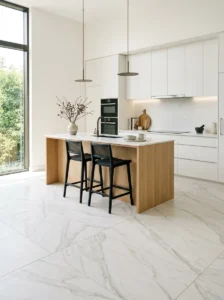
Porcelain offers similar aesthetic versatility to ceramic tile but with significantly improved durability and water resistance, making it a popular mid-range choice for kitchens specifically. A friend used large-format porcelain tile in a subtle marble-look pattern throughout her kitchen renovation, achieving a high-end appearance at a considerably lower cost than actual marble.
Porcelain’s density makes it more resistant to chipping and staining than standard ceramic, and it holds up well even in consistently high-moisture, high-traffic kitchen environments. Like ceramic, it does remain a hard, cold surface underfoot, and larger-format tiles, while visually striking with fewer grout lines, do require a very level subfloor for proper installation, which can add to labor costs if your existing subfloor needs leveling work first.
Engineered Hardwood
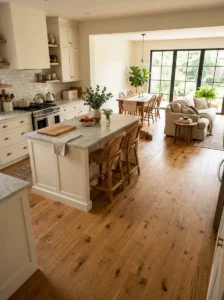
For anyone wanting genuine wood character without the extreme moisture vulnerability of solid hardwood, engineered hardwood offers a reasonable middle ground. It consists of a real wood veneer layer over a more stable plywood base, which handles humidity and minor moisture better than solid wood, though it’s still not fully waterproof and requires more careful maintenance than vinyl or tile options.
A friend used engineered hardwood in her kitchen, which flows seamlessly into her adjacent open-concept dining and living areas, all finished in the same material for a cohesive look throughout the connected spaces. She’s been diligent about wiping up spills promptly and avoiding excessive standing water, which has kept the floor in good condition, though she acknowledges this material requires more day-to-day care than a fully waterproof alternative would.
Higher-End Options ($8 and Up Per Square Foot)
Natural Stone Tile
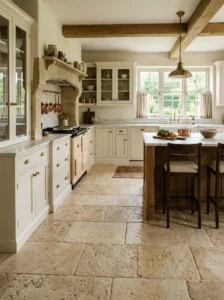
Materials like marble, travertine, and slate offer a genuinely luxurious, high-end appearance that’s difficult to fully replicate with any manufactured alternative. I considered natural stone briefly during my own research phase, drawn to the unique veining and natural variation that no two stone tiles share, before ultimately deciding the cost and maintenance requirements didn’t fit my particular situation.
Natural stone does require regular sealing to prevent staining and moisture absorption, and certain stones, marble in particular, can etch or stain from acidic spills like wine or citrus juice, a real consideration in a room where those exact spills happen regularly. For anyone drawn to this option specifically for its unmatched natural beauty, I’d recommend factoring in the ongoing sealing maintenance as a genuine, recurring cost and time commitment rather than a one-time installation consideration.
Solid Hardwood
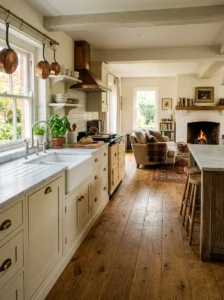
Genuine solid hardwood flooring offers unmatched warmth and character, and for kitchens that flow directly into hardwood-floored living spaces, maintaining that same solid wood throughout can create a beautifully cohesive look. That said, solid hardwood is the most moisture-vulnerable option on this entire list, which makes it a genuinely risky choice specifically for kitchens, where spills and moisture exposure are simply part of daily life.
A friend with solid hardwood throughout her main floor, including her kitchen, has managed it successfully for years, but she’s meticulous about immediately wiping any spills and has had to refinish the floor once already due to water damage near her sink area. I’d only recommend this option for kitchens with an existing hardwood floor extending from adjacent rooms where matching consistency matters more than practical water resistance, rather than as a first choice for a dedicated kitchen renovation.
Large-Format Porcelain Slabs
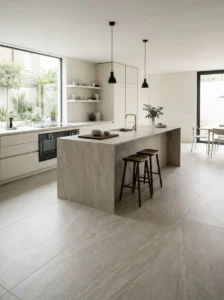
At the higher end of the tile category, large porcelain slabs, sometimes several feet in each dimension, offer an incredibly seamless, high-end look with minimal grout lines. A friend used these slabs for both her kitchen floor and a matching waterfall-edge island countertop, creating a striking, cohesive design throughout the entire space.
This option requires specialized installation expertise due to the size and weight of the slabs, which increases labor costs significantly beyond the material cost itself. For anyone with the budget and access to a qualified installer experienced with large-format porcelain specifically, though, the resulting seamless, modern look is genuinely difficult to achieve with any other flooring option.
Matching Flooring to Your Kitchen’s Style
For a Modern, Minimalist Kitchen
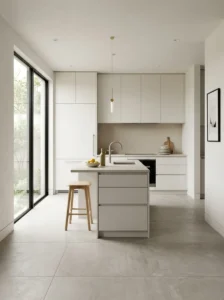
Large-format tile, whether porcelain or natural stone, in a simple, monochromatic tone tends to suit modern kitchen designs particularly well, minimizing visual grout lines and maintaining the clean, uncluttered aesthetic that defines this style. Light gray, warm white, or subtle concrete-look finishes all pair well with the simple cabinetry and minimal ornamentation typical of modern kitchen design.
For a Farmhouse or Traditional Kitchen
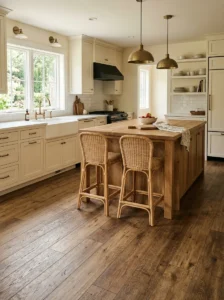
Wide-plank wood-look flooring, whether genuine engineered hardwood or a realistic luxury vinyl plank alternative, tends to suit farmhouse and traditional kitchen styles best, adding warmth and a sense of history that harder, more uniform materials don’t quite replicate. I’ve noticed this style often pairs particularly well with a slightly distressed or hand-scraped texture, which adds character consistent with the overall farmhouse aesthetic.
For a Coastal or Beach-Inspired Kitchen
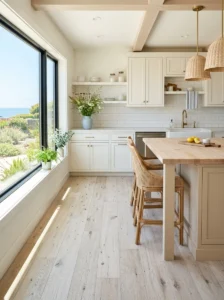
Light, whitewashed wood-look flooring or pale, sandy-toned tile both work well for coastal-inspired kitchens, echoing the light, airy palette typical of this style. When I helped a friend plan her coastal-themed kitchen renovation, we chose a whitewashed oak-look luxury vinyl plank specifically because it maintained that light, beachy feel while still providing the waterproof practicality her busy kitchen genuinely needed.
For an Industrial-Style Kitchen
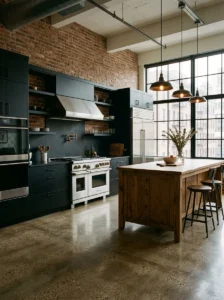
Polished or stained concrete, along with dark, large-format tile, tends to complement the raw, utilitarian aesthetic typical of industrial kitchen design. This style often intentionally embraces harder, less traditionally “cozy” materials as a genuine design choice rather than a compromise, which makes some of the harder flooring options on this list, generally less popular for typical kitchens, work particularly well within this specific aesthetic.
Practical Lessons From My Own Flooring Project
Beyond the material research itself, a few practical lessons stood out from actually going through this renovation process myself. First, always order more material than your calculated square footage, I ordered exactly what I measured initially and ended up short after accounting for cuts and waste, requiring an annoying second order and installation delay while I waited for it to arrive.
Second, subfloor preparation matters enormously and is easy to underestimate when budgeting a flooring project. My contractor found some minor subfloor unevenness that needed leveling before the new flooring could be properly installed, an unplanned cost that pushed my project slightly over my original budget.
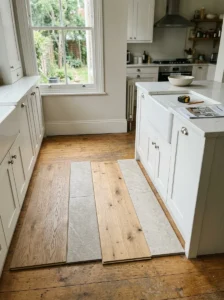
Finally, living with actual physical samples in your specific kitchen’s lighting for at least a few days, rather than relying on how a material looks in a showroom or online photo, made a genuine difference in my final decision. My chosen flooring looked noticeably different, warmer and richer, in my kitchen’s actual lighting compared to how it appeared under the showroom’s fluorescent lights.
Frequently Asked Questions

What’s the most waterproof kitchen flooring option? Luxury vinyl plank and sheet vinyl are among the most fully waterproof options, along with porcelain and ceramic tile, all of which handle spills and moisture significantly better than any wood-based flooring, including engineered hardwood.
Is it worth spending more on higher-end flooring for a kitchen? It depends on your priorities and how long you plan to stay in the home. Higher-end materials often add resale value and longevity, but several budget and mid-range options, particularly quality luxury vinyl plank, now offer excellent durability and appearance without the higher price tag.
Can I install kitchen flooring myself? Some options, particularly click-lock luxury vinyl plank and laminate, are genuinely approachable DIY projects for someone comfortable with basic home improvement tasks. Tile and natural stone typically require more specialized skills and are often better left to a professional installer.
How do I choose between tile and vinyl for a kitchen? Tile generally offers superior long-term durability and a more premium look but comes with a harder, colder feel underfoot and higher installation costs. Vinyl offers excellent water resistance and comfort at a lower price point, with modern options closing much of the visual gap that used to separate the two materials.
Final Thoughts
Replacing that dated, peeling sheet vinyl in my own kitchen turned into a far more educational process than I initially expected, but it left me with a genuine appreciation for how many good options actually exist across every budget level. The right choice really depends on your specific priorities, water resistance, comfort, budget, aesthetic, rather than any single universally “best” material. Take the time to actually live with physical samples in your own kitchen’s lighting before committing, and don’t underestimate the value of proper subfloor preparation, a lesson I learned the slightly expensive way during my own renovation.