My dining room used to be the most neglected room in my house — a table we used maybe twice a year, surrounded by mismatched chairs I’d never gotten around to replacing. It took hosting one particularly memorable dinner party, where a guest actually asked if I’d hired a designer, for me to realize how much thought had quietly gone into that room over the years without me even fully noticing. Since then, I’ve kept refining it, picking up ideas from designers, friends, and plenty of my own trial and error. Here are 24 of them, everything from big investments to small, almost free adjustments that genuinely transform how a dining room feels when it’s time to entertain.
1. Invest in a Statement Dining Table
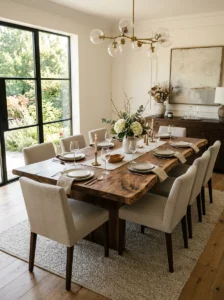
Your dining table is the single largest piece of furniture in the room, and it deserves more thought than most people give it. I held off buying a “real” table for years, using a hand-me-down that never quite fit the space, until I finally invested in a solid wood table with a live edge, and it completely changed how the whole room felt.
Material matters enormously for both durability and visual impact. I chose a rich walnut finish specifically because it photographs beautifully in both bright daylight and warm evening candlelight, which matters a lot if you’re hosting dinners that stretch from afternoon into evening the way mine often do.
Shape is worth considering carefully too, not just size. I went with a rectangular table for maximum seating flexibility, but I’ve seen round tables work beautifully in smaller, more intimate dining rooms, since they naturally encourage conversation across the whole group rather than splitting people into separate conversations at each end.
Don’t feel pressured to buy new. Some of the most beautiful dining tables I’ve seen were refinished antiques, picked up secondhand and given new life with a bit of sanding and oil. I’d rather have one substantial, well-made table with real character than several cheaper pieces replaced every few years.
2. Choose Upholstered Dining Chairs
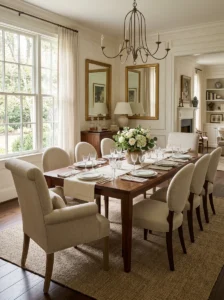
Swapping my old wooden chairs for upholstered ones was, without exaggeration, the single change that made my dining room feel genuinely elegant rather than just functional. There’s something about fabric or leather seating that instantly reads as more considered and comfortable than bare wood, even in an otherwise simple room.
I went with a neutral linen fabric on the seats and backs, since it’s versatile enough to work with whatever else I change in the room over time, while still adding real softness and texture to the overall look. Velvet is a gorgeous option too if you want something a bit richer, though it does require more careful cleaning with kids or red wine around.
Mixing chair styles at the head of the table versus the sides is a trick I picked up from a designer friend that adds subtle visual interest without looking mismatched. I use two slightly more substantial upholstered armchairs at each end, with simpler upholstered side chairs filling the rest, and it creates a nice rhythm down the table.
If reupholstering an entire set feels like too big a project, even swapping just the seat cushions on your existing chairs to a nicer fabric can achieve a similar elevated feeling for a fraction of the cost of buying an entirely new set of chairs.
3. Hang a Dramatic Chandelier
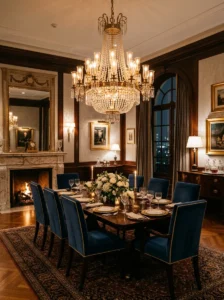
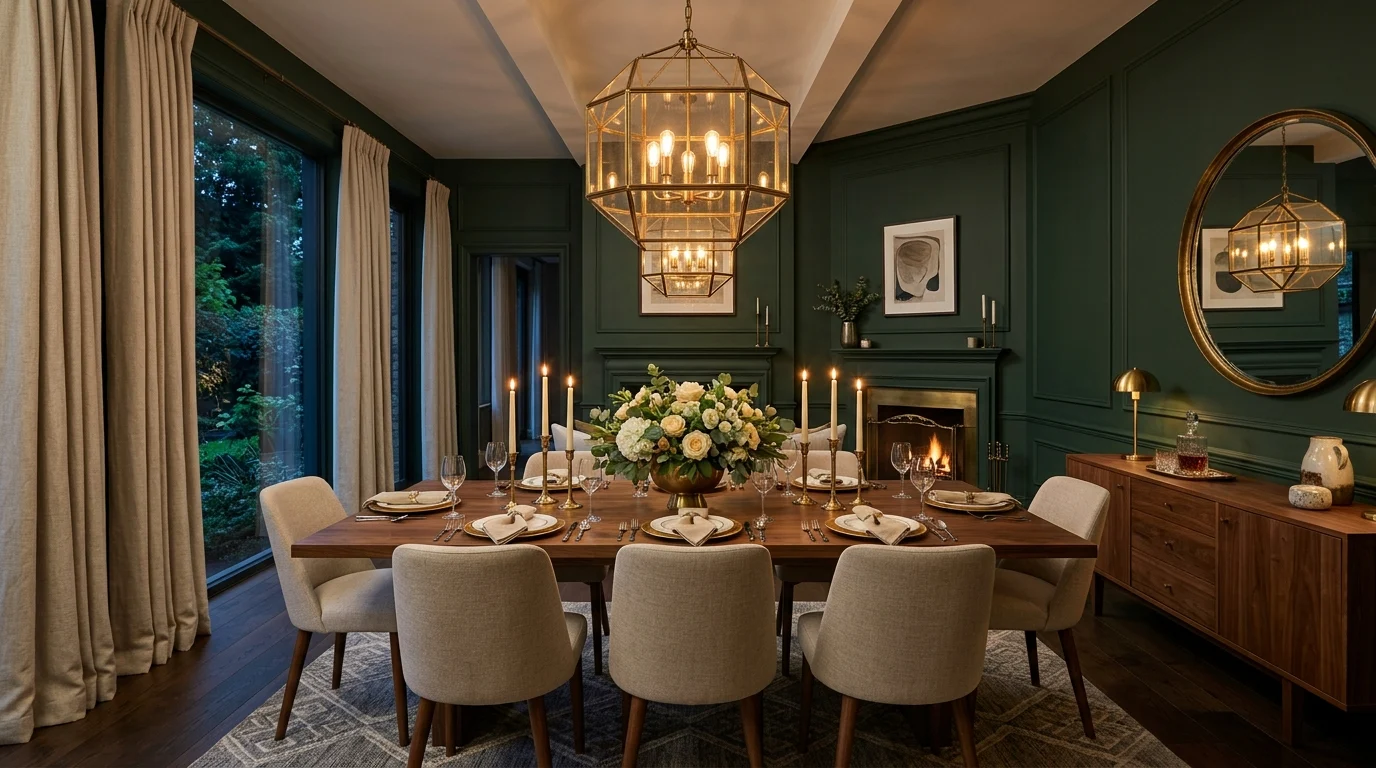
Nothing signals “this room means business” quite like a genuinely dramatic light fixture hanging above the table. I replaced my builder-grade flush mount with a substantial brass and glass chandelier, and it remains the single compliment I get most consistently from anyone who sees my dining room for the first time.
Sizing your chandelier correctly matters more than people expect. As a general guideline, the fixture’s diameter should be roughly half the width of your table, and it should hang about 30 to 34 inches above the table surface for a standard 8-foot ceiling, adjusting up slightly for taller ceilings.
I’d encourage going a bit bolder here than feels instinctively comfortable. A dining room chandelier is one of the few places in a home where genuinely dramatic scale works beautifully, since it’s viewed from a distance while seated rather than up close, and a too-small fixture tends to just look underwhelming and forgotten.
Make sure it’s on a dimmer switch, without question. The ability to shift from bright, functional lighting for a casual family dinner to something warm and low for a formal evening gathering makes an enormous difference in how the room feels, and it’s a relatively inexpensive electrical addition if you don’t already have one installed.
4. Add a Built-In or Freestanding Bar Cart
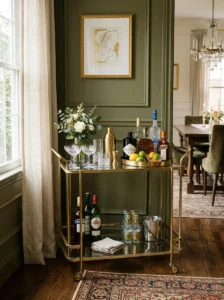
A bar cart brings a level of hospitality and sophistication to a dining room that’s hard to replicate any other way, and it solves a genuinely practical problem too — somewhere to pour drinks without everyone crowding the kitchen during a dinner party. I added a simple brass and glass cart in the corner of my dining room years ago and it’s become a permanent fixture of how I entertain.
Styling it well matters as much as the cart itself. I keep a curated selection of glassware, a few good spirits, and a small tray for garnishes, resisting the urge to cram every bottle I own onto it. A slightly edited, intentional selection looks far more elegant than an overflowing, cluttered cart.
If floor space is tight, a wall-mounted bar shelf or a small bar cabinet tucked into a sideboard achieves a similar function without needing a full rolling cart taking up room. I’ve seen friends do this beautifully in smaller dining rooms where a full cart just wasn’t practical given the space.
Beyond the practical drink-serving function, a bar cart adds a layer of visual interest to the room even when it’s not actively being used, especially if you rotate in seasonal touches like fresh citrus, a small vase of flowers, or interesting glassware you’ve collected over time.
5. Use a Moody, Deep Wall Color
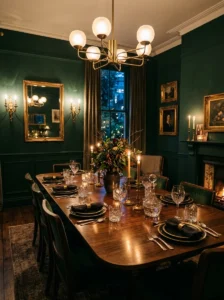
I painted my dining room a deep forest green a few years back, after years of playing it safe with neutral off-whites, and it remains one of the best design decisions I’ve made in my entire house. Dining rooms are typically used in the evening, under warm artificial light, which makes them one of the best rooms to embrace a darker, richer wall color that might feel overwhelming elsewhere.
Deep colors like navy, forest green, charcoal, or oxblood create an enveloping, cocoon-like feeling that genuinely suits the intimacy of a dinner gathering far better than a stark white wall ever could. Candlelight and warm lighting interact beautifully with these darker tones, creating a richness that’s hard to achieve with lighter colors.
If you’re nervous about committing to dark paint on all four walls, start with just one accent wall, or paint only the lower half below a chair rail, keeping the upper portion lighter. I did exactly this in my first attempt before eventually gaining the confidence to paint the entire room a few years later.
Pair a dark wall color with plenty of reflective or metallic elements — a mirror, brass light fixtures, glassware — to keep the room from feeling too heavy or closed in. The combination of deep color and warm metallic accents is what gives a dining room that genuinely elegant, restaurant-like quality.
6. Layer in a Large Area Rug
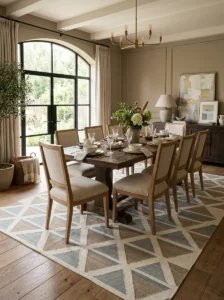
An area rug underneath a dining table does more work than most people realize, both acoustically (softening the clatter of chairs and dishes) and visually, defining the dining area as its own distinct, intentional space rather than just furniture floating in an open room. I added a large wool rug under mine and immediately noticed how much quieter and cozier meals felt.
Sizing is genuinely important here. I made the mistake early on of buying a rug too small, which meant chair legs constantly caught the edge every time someone pulled out their seat. The rule I follow now is leaving at least 24 to 30 inches of rug beyond the table’s edge on all sides, so chairs stay fully on the rug even when pulled out.
Material matters enormously for a dining room specifically, given the inevitable spills. I chose a flat-weave wool rug over anything with a thick pile, since it’s far easier to clean and doesn’t trap crumbs the way a plush rug would, which has saved me considerable stress over the years of hosting messy family dinners.
Pattern and color should complement rather than compete with your table and chairs. I went with a subtle geometric pattern in muted tones, which adds texture and interest underfoot without pulling attention away from the table setting itself, which is really where the eye should land in a dining room.
7. Add Wainscoting or Millwork
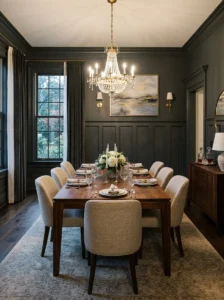
Wainscoting was an investment I hesitated on for a long time, mostly because I assumed it would be prohibitively expensive or complicated to install, until I discovered that simple peel-and-stick or lightweight MDF panel kits have made this far more accessible for anyone willing to spend a weekend on it. Adding it to my dining room instantly gave the space an architectural quality it was missing before.
I chose a simple board-and-batten style rather than anything overly ornate, painted the same color as the walls above it for a cohesive, monochromatic look that still reads as detailed and intentional up close, rather than flat and plain the way the room felt before.
This is one of those upgrades that photographs particularly well and genuinely elevates the perceived value of a room, which matters if you’re thinking about resale down the line, but even if you’re not, the texture and shadow lines it creates add real depth that flat drywall simply can’t replicate.
If a full wainscoting project isn’t in the budget or timeline right now, even a single picture rail or a simple trim detail around the room’s perimeter gives a hint of the same architectural interest, and it’s a project that can realistically be completed in a single afternoon by most reasonably handy homeowners.
8. Display Fine China in a Glass Cabinet
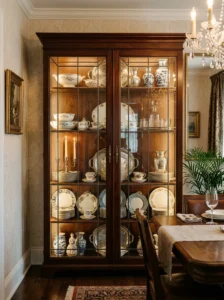
A glass-front cabinet displaying beautiful dishware turns your dining room into a room that tells a story, rather than one that only comes alive when food is actually on the table. I inherited my grandmother’s china years ago and it sat in a box until I finally got a proper cabinet to display it, and now it’s one of the focal points of the entire room.
Styling the cabinet thoughtfully matters as much as having nice pieces to put in it. I arrange mine with some pieces stacked and others displayed flat and facing forward, mixing in a few decorative objects like small vases or candlesticks between the dishware rather than filling every shelf edge to edge with plates.
You don’t need inherited heirloom china to make this work. Thrifted or vintage dishware in a cohesive color palette, even mismatched patterns united by a similar era or color story, can look just as intentional and beautiful displayed this way, and it’s often far more affordable than buying a matched new set specifically for display.
Lighting inside the cabinet, if it has that capability, makes a genuinely significant difference in the evening. A small interior light left on during dinner parties adds a warm glow that draws the eye and makes the whole room feel more layered and considered, even after the sun goes down.
9. Use Floor-to-Ceiling Curtains
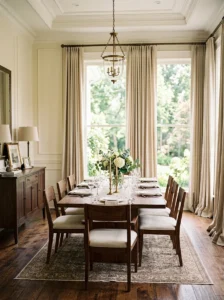
Hanging curtains from ceiling height rather than just above the window frame is a trick that instantly makes a dining room feel taller and more grand, even if your actual ceiling height hasn’t changed at all. I made this switch in my own dining room and the difference in perceived scale was honestly dramatic for such a simple adjustment.
I chose a heavier linen fabric in a warm neutral tone, which adds softness and helps absorb some of the room’s acoustics during dinner parties, something I hadn’t considered until I noticed how much quieter conversations felt once the curtains were up compared to bare windows before.
Mounting the curtain rod as close to the ceiling as possible, rather than directly above the window frame, is the actual trick that creates the height illusion. I’d recommend going at least 4 to 6 inches above the window frame if you can’t mount at the true ceiling line, since even that smaller gap adds noticeable visual length.
Let the curtains puddle slightly on the floor rather than hemming them to hit exactly at floor level. That small extra length adds a sense of luxury and softness that a precisely tailored, floor-skimming hem simply doesn’t achieve in the same way, especially in photos taken during evening dinner parties.
10. Add Wall Sconces for Layered Lighting
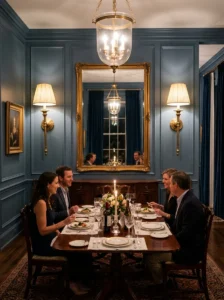
Relying solely on an overhead chandelier leaves most dining rooms feeling a bit flat and one-dimensional once the sun goes down. Adding a pair of wall sconces flanking a buffet or mirror gave my dining room genuine depth and warmth that the chandelier alone never quite achieved on its own.
I chose brass sconces with fabric shades specifically to soften and warm the light, since bare bulb sconces can feel a bit harsh and modern for the more classic, elegant feeling I was going for throughout the rest of the room’s design.
Positioning matters here. I mounted mine at roughly eye level when seated, about 60 inches from the floor, flanking a large mirror on the far wall, which also has the added benefit of bouncing extra light back into the room and making the whole space feel brighter and more expansive.
Put your sconces on the same dimmer circuit as your chandelier, or on a separate one if your electrical setup allows, so you can adjust the balance of light sources depending on the mood you’re going for. A dinner party benefits from sconces low and chandelier dimmed, while everyday family meals might call for the reverse.
11. Incorporate a Statement Mirror
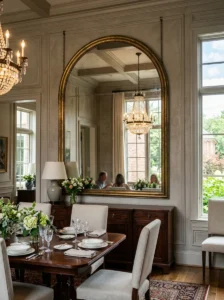
A large, well-chosen mirror does double duty in a dining room — it amplifies light and makes the space feel considerably larger, while also serving as genuine wall art in its own right. I hung an oversized arched mirror on the wall opposite my window, and it reflects the natural light beautifully throughout the entire afternoon and into early evening.
Frame style matters a lot for setting the overall tone of the room. I went with an antiqued brass frame to tie into the other metallic accents throughout the space, but I’ve seen equally stunning results with ornate vintage gilded frames for a more traditional look, or simple black frames for something more contemporary and minimal.
Scale is where people most often go wrong with dining room mirrors, choosing something too small for the wall it’s meant to anchor. I’d recommend going at least 36 inches in the shortest dimension for a genuine statement piece, since a small mirror on a large wall can look like an afterthought rather than an intentional focal point.
Position the mirror to reflect something worth reflecting, whether that’s a window, a chandelier, or an interesting piece of art on the opposite wall. I specifically hung mine to catch the chandelier’s reflection, which doubles the sense of sparkle and light in the room during evening dinners.
12. Choose Elegant Table Linens
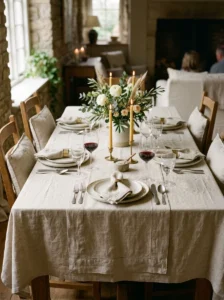
Investing in genuinely good table linens — real linen or cotton rather than synthetic blends — changed how my dining room felt at every single meal, not just special occasions. There’s a tactile quality to good fabric that guests notice even if they couldn’t necessarily articulate why the table feels more elevated.
I keep a small rotating collection: a neutral everyday tablecloth, a couple of seasonal runners, and several sets of cloth napkins in varying textures and colors. Having options on hand means I can quickly adjust the formality level of any given dinner without needing to shop for something new each time.
Ironing linens properly makes a bigger visual difference than most people expect. I used to skip this step entirely, and the wrinkled, slightly rumpled look genuinely undermined an otherwise well-set table. Now I press my tablecloths and napkins before any dinner that matters, and it takes maybe fifteen extra minutes for a noticeably more polished result.
Don’t be afraid of investing a bit more in fewer, better pieces here rather than accumulating a large collection of cheaper linens. I’d rather have three genuinely beautiful tablecloths I rotate through regularly than ten mediocre ones that all look slightly tired after a few washes.
13. Add Fresh Florals as a Centerpiece
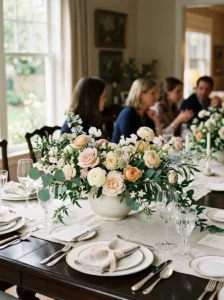
Fresh flowers on the dining table are one of the fastest ways to signal that real thought and effort went into a dinner gathering, and I’ve found that even a simple, loosely arranged bunch achieves this far better than an overly formal, stiff floral arrangement ever could.
I favor low, wide arrangements specifically for dining rooms, since anything too tall blocks sightlines across the table and makes conversation genuinely more difficult, something I learned the hard way at an early dinner party where guests kept leaning sideways to see each other around a too-tall centerpiece.
Seasonal flowers, sourced locally when possible, tend to look more natural and less “arranged” than imported varieties available year-round, and they’re usually considerably more affordable too. I let the season dictate my color palette rather than forcing a specific look that might require flowers out of season.
If fresh flowers aren’t practical for a given week, don’t underestimate greenery alone as a centerpiece option. A simple arrangement of eucalyptus, ferns, or other foliage without any actual blooms can look just as elegant and sophisticated, and it tends to last considerably longer than flowers before needing to be refreshed.
14. Use Mixed Metals in Fixtures and Decor
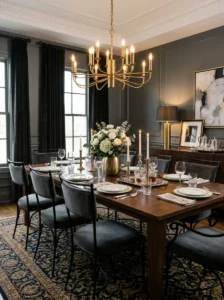
I used to think every metal finish in a room needed to match perfectly, until a designer friend pointed out that mixing brass, black, and a touch of chrome or nickel actually reads as more intentional and collected than a room where every single fixture matches exactly.
My dining room now mixes a brass chandelier, black iron chair frames, and silver flatware, and rather than feeling chaotic, it genuinely reads as more layered and considered than my previous approach of forcing everything into one uniform metal tone throughout the entire space.
The trick to making this work is having one dominant metal that appears most frequently, with the others playing a supporting role. Brass is my dominant tone, showing up in the chandelier, sconces, and some of my serving pieces, while black and silver appear in smaller doses throughout the rest of the room.
Don’t feel like you need to buy all new fixtures to achieve this mixed-metal look either. I kept my existing chrome curtain rod and simply added brass and black accessories around it, which achieved the same layered effect without needing to replace anything that was already working perfectly well in the space.
15. Add Art That Sets the Mood
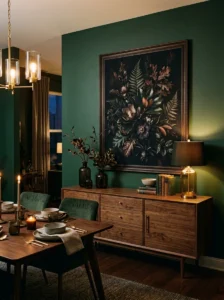
The right piece of art can genuinely define the entire mood of a dining room, and I’ve found that dining rooms specifically benefit from art that feels a bit more evocative or moody than what I’d choose for a bright, cheerful kitchen or living space elsewhere in the house.
I hung a large, dark botanical print above my sideboard, and its rich, saturated colors echo the deep green walls throughout the rest of the room, tying the whole space together into one cohesive feeling rather than a collection of separate design decisions made independently of each other.
Scale matters enormously here, just as it does with mirrors. A single large piece of art tends to have more visual impact in a dining room than a cluster of smaller pieces, especially above a sideboard or buffet where the art needs to hold its own against the furniture beneath it.
Consider how the art will look under your specific lighting conditions too, particularly in the evening when candlelight or warm sconce lighting will be the primary source illuminating the piece. I’ve found that darker, richer artwork tends to glow beautifully under warm evening light in a way that brighter, more pastel pieces simply don’t achieve in the same setting.
16. Create a Gallery of Vintage Frames
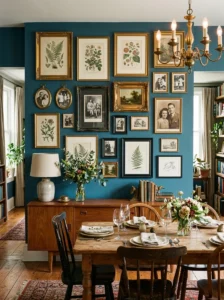
A gallery wall in a dining room offers a wonderful opportunity to tell a more personal story than a single statement piece of art might, especially if you incorporate genuinely vintage or antique frames collected over time from estate sales and thrift shops.
I mixed frames I’ve collected over several years — gilded ornate ones, simple black wood frames, and a couple of unusual shapes — and filled them with a combination of botanical prints, family photos, and a few pieces of actual vintage artwork I found secondhand for very little money.
Consistency in frame color or finish, even with varying shapes and sizes, keeps this kind of eclectic gallery from feeling chaotic. I unified mine loosely around gold and brass-toned frames, which ties back into the metallic accents used elsewhere throughout the dining room’s overall design scheme.
Take your time building this kind of wall rather than trying to complete it all at once. Mine has genuinely evolved over close to three years, and that slow, considered process is part of what makes it feel authentic and collected rather than like something purchased as a complete matching set in a single trip.
17. Add a Sideboard or Buffet for Function and Style
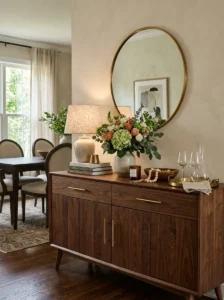
A sideboard is one of those pieces of furniture that seems purely decorative until you actually use it during a dinner party, at which point it becomes genuinely indispensable for extra serving space, storage, and styling opportunities that a dining table alone simply can’t provide.
I found mine secondhand and refinished it with a rich walnut stain, and it now serves as both practical storage for extra dishware and linens, and a styled surface for rotating decor — a lamp, a stack of books, a vase of flowers, changing depending on the season or occasion.
During dinner parties specifically, I use the sideboard surface for serving buffet-style dishes, which frees up considerable space on the main dining table itself for place settings and centerpiece elements rather than cramming serving dishes in among everyone’s plates.
If floor space is limited, even a narrow console table pressed against the wall can serve a similar function at a smaller scale. I’d prioritize this addition if your dining room currently lacks any secondary surface, since the functional benefits during actual entertaining are considerable beyond just the visual improvement it brings to the room.
18. Use Candlelight for Ambience
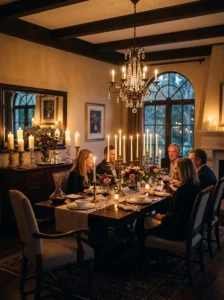
Nothing transforms a dining room from merely nice to genuinely magical quite like candlelight, and I’ve become somewhat religious about lighting candles for any dinner that matters, even smaller family gatherings that aren’t technically a formal occasion at all.
I use a mix of taper candles in varying heights down the center of the table, supplemented by a few pillar candles on the sideboard and windowsill, which creates layers of warm light throughout the whole room rather than just concentrated in one single spot on the table itself.
Unscented candles specifically for the dining table are worth the small extra cost, since scented versions can compete with the aroma of whatever’s being served, a detail I didn’t fully appreciate until a guest mentioned it kindly at a dinner years ago and I switched immediately afterward.
Dimming the overhead chandelier while candles are lit creates a genuinely different atmosphere than either light source alone. I typically bring the overhead lighting down to maybe 20 or 30 percent once candles are lit, letting the warmer, flickering candlelight do most of the actual work of illuminating the room during the meal itself.
19. Choose a Formal Yet Comfortable Seating Arrangement
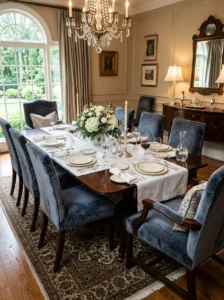
Comfort and elegance don’t have to be at odds with each other, something I learned only after sitting through several beautiful but genuinely uncomfortable dinner parties at other people’s homes over the years. My dining chairs now prioritize both, with proper cushioning and supportive backs beneath their more formal upholstered appearance.
I test-sat in every chair option for at least ten minutes before purchasing mine, which felt excessive in the store at the time but has paid off considerably during dinners that stretch past two hours, which happens more often than I expected once people are genuinely enjoying themselves at the table.
Armless chairs along the sides of the table, paired with a couple of chairs with arms at each head, strikes a nice balance between formal presentation and practical comfort, allowing guests at the ends slightly more room to relax while keeping the sides efficient for maximizing overall seating capacity.
Spacing matters just as much as the chairs themselves. I allow roughly 24 inches of width per person around my table, which feels genuinely comfortable without wasting space, whereas anything tighter starts to feel cramped once everyone’s actually seated with plates, glasses, and elbows all competing for room.
20. Add Texture with Drapery and Upholstery
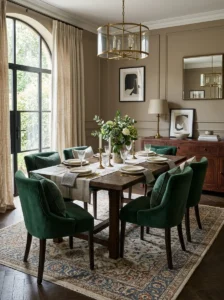
Texture is what separates a genuinely elegant dining room from one that simply has nice furniture arranged correctly, and I’ve come to rely on layering multiple textures throughout the space rather than any single dramatic design element doing all the work on its own.
My room combines linen curtains, velvet dining chair cushions, a wool rug, and a leather-topped sideboard, and the variety of tactile materials creates a richness that a room relying on just one or two textures throughout genuinely can’t replicate, no matter how nice those individual materials might be.
I try to include at least four distinct textures in any given room now, a rule of thumb I picked up from a designer years ago that’s served me well across multiple rooms in my house, not just the dining room specifically, though it’s made the biggest visible difference there.
Don’t feel like every textured element needs to be expensive either. A simple wool throw draped over the back of a sideboard chair, or a woven basket used for storage, adds genuine textural interest for very little cost, working alongside pricier investment pieces like upholstered furniture to round out the overall layered feeling.
21. Incorporate a Statement Ceiling
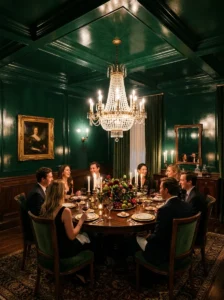
The ceiling is genuinely the most overlooked surface in most dining rooms, and giving it even a small amount of attention creates a sense of intentional design that most guests notice, even if they can’t quite articulate what specifically caught their eye about the space.
I painted my dining room ceiling a deep, glossy version of the same green used on my walls, which creates an enveloping, “wrapped” feeling that makes the whole room feel more cohesive and considered than a standard flat white ceiling ever achieved for me previously.
Wallpaper on the ceiling is an even bolder version of this same concept, and I’ve seen it done beautifully in smaller, more intimate dining rooms specifically, where the ceiling essentially becomes a fifth wall that ties the whole room together into one unified, immersive design statement.
If a full ceiling treatment feels like too much commitment, even adding a simple ceiling medallion around your light fixture, or painting just the crown molding a contrasting color, hints at the same architectural attention without requiring a full repaint or wallpaper installation across the entire ceiling surface.
22. Use Scented Candles or Diffusers for Ambience
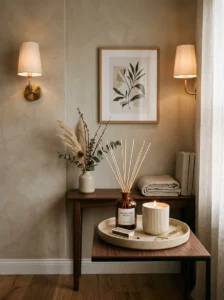
Scent plays a bigger role in how elegant and considered a dining room feels than most people realize, and I keep a reed diffuser in the corner of mine year-round, swapping the fragrance seasonally to keep the room feeling fresh and appropriately matched to the time of year.
I lean toward warm, subtle scents specifically for the dining room — sandalwood or amber in cooler months, something lighter like fig or citrus in warmer seasons — always keeping the intensity subtle enough that it doesn’t compete with whatever’s actually being cooked and served during the meal itself.
For dinner parties specifically, I light a single unscented candle near the entrance rather than throughout the dining table itself, reserving any actual fragrance for the diffuser positioned further from where people are eating, which avoids any conflict between the room’s ambient scent and the food’s aroma.
This detail is subtle enough that most guests won’t consciously register it, but it contributes meaningfully to that hard-to-define feeling of “this room has been thoughtfully considered,” which is really the cumulative effect of dozens of small details like this one working together throughout the space.
23. Add Personal Touches Without Overdoing It
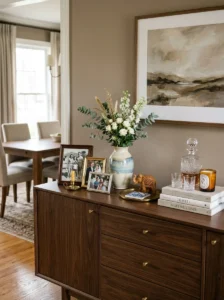
The most elegant dining rooms I’ve been in all share one quality — they feel like someone’s actual home rather than a showroom, achieved through carefully chosen personal touches rather than generic, catalog-perfect styling throughout every single surface.
I keep a small collection of travel souvenirs and family photos on my sideboard, rotating them occasionally, rather than displaying everything I own all at once. A dining room with too many personal objects competing for attention starts to feel cluttered rather than genuinely warm and personal.
Restraint is really the key skill here. I’ve learned to choose maybe three or four personal pieces that mean something specific to me and display them prominently, rather than scattering a dozen smaller items throughout the room where none of them get the attention or visual space they actually deserve.
This balance between polished design and genuine personality is really what separates a dining room that feels sophisticated and elegant from one that feels sterile and impersonal, no matter how expensive or well-chosen the furniture and fixtures throughout the rest of the space might be.
24. Keep the Table Setting Simple When Empty
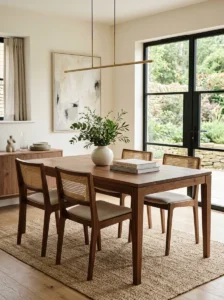
After years of elaborate centerpieces sitting on my table between meals, gathering dust and looking increasingly tired, I’ve settled into keeping a genuinely simple, minimal setting for the table’s default, everyday state, saving the more elaborate styling specifically for when guests are actually coming over.
My everyday table now holds just a single low vase, usually with whatever’s currently blooming in my garden or a simple stem of greenery, plus a stack of two or three books I’m currently reading. This simplicity actually makes the table feel more elegant on an ordinary Tuesday than an overdone arrangement ever did.
This approach also means that when I do dress the table up for an actual dinner party, the transformation feels genuinely special rather than incremental, since guests are seeing a noticeably different, more elevated version of the room compared to how it typically looks day to day.
I’d encourage anyone designing an elegant dining room to think about both states deliberately — the everyday, low-maintenance version and the special-occasion version — rather than trying to maintain full formal styling constantly, which tends to feel exhausting to maintain and, honestly, a little less special once it becomes the everyday norm.