A few years back, I went through a phase of chasing every new trend I saw online for our living room, a specific accent color one season, a particular furniture shape the next. Looking back at photos now, most of those choices already feel dated, while the handful of more classic, timeless decisions we made alongside them, a good wool rug, well-made wood furniture, a properly upholstered sofa, still look just as good today as they did when we chose them. That contrast taught me something I now genuinely believe: classic design isn’t boring or unoriginal, it’s simply design that’s been tested by time and hasn’t needed replacing.
Since then, I’ve become far more intentional about building our own living room, and the rooms I help others design, around pieces and choices that have real staying power, rather than whatever happens to be trending in a given season. Below are 26 classic living room ideas that have genuinely proven themselves over years, even decades, based on real rooms I’ve lived in and worked on rather than fleeting inspiration photos.
1. A Well-Made Chesterfield or Rolled-Arm Sofa
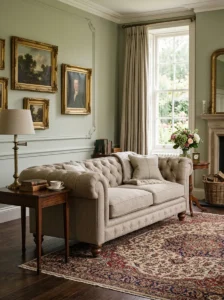
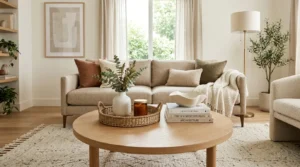
A sofa with a classic silhouette, deep button tufting, rolled arms, substantial turned or block wood feet, is one of the single most important investments in a genuinely timeless living room, since it’s usually the largest and most visually dominant piece in the entire space. I bought a rolled-arm sofa in a neutral wool blend fabric nearly eight years ago, replacing a trendier, low-profile piece we’d purchased just a few years earlier, and it’s held up both structurally and stylistically in a way that earlier piece never did.
The reason classic silhouettes age so well comes down to proportion and craftsmanship. These designs were refined over many decades, and their curves and details are genuinely balanced in a way that trend-driven furniture, often designed to look striking in a single photo rather than to live with daily, frequently isn’t. I’d recommend prioritizing genuine build quality, a solid hardwood frame, proper spring suspension, over a lower price point specifically for this piece, since a well-constructed classic sofa can realistically last decades with reupholstering, while a cheaply made one, however stylish initially, rarely lasts more than a few years before sagging or breaking down structurally.
Fabric choice matters considerably too for long-term versatility. I’d suggest a neutral, durable fabric, a good wool blend, linen, or a quality performance fabric, rather than a bold pattern or trend-driven color, since this lets you refresh the room’s look over the years through pillows, throws, and surrounding decor, without needing to replace the sofa itself simply because your color preferences have shifted.
2. Rich, Warm Wood Furniture
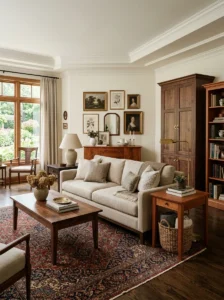
Furniture crafted from genuine wood, particularly warmer tones like walnut, cherry, or mahogany, brings a sense of substance and permanence to a living room that engineered materials or heavily painted finishes rarely achieve in quite the same way. I inherited a solid walnut side table from a family member years ago, and it remains one of the pieces I’m most confident will still look genuinely appropriate in our living room regardless of how our broader style evolves over time.
The appeal of real wood furniture goes beyond just appearance, it develops a genuine patina over years of use, small marks, a slightly deepened color, that actually enhances rather than detracts from the piece’s character, unlike synthetic materials that tend to simply look worn out or dated once damaged. I’d recommend prioritizing solid wood or genuine wood veneer construction over particleboard or MDF specifically for pieces you intend to keep long-term, even if it means purchasing fewer pieces initially to stay within budget.
Mixing wood tones slightly, rather than insisting on an exactly matched set throughout the room, tends to look more collected and genuine than an obviously matching furniture suite purchased all at once. I’d suggest choosing one or two primary wood tones as your foundation, then allowing smaller pieces, a picture frame, a small accent table, some natural variation, which mimics how a genuinely well-curated room accumulates pieces over years rather than all at once from a single furniture set.
3. A Neutral, Warm Color Palette
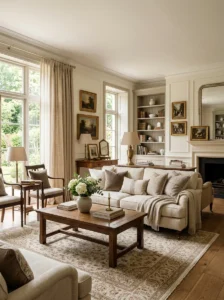
Building a living room’s foundational colors, walls, large furniture pieces, flooring, around warm neutrals, soft whites, warm greys, beiges, taupes, gives the space genuine longevity, since these tones simply don’t go in and out of fashion the way bolder, more specific trend colors tend to. I painted our own living room a warm, slightly greige off-white nearly a decade ago, and I’ve genuinely never felt the urge to repaint it, despite plenty of bolder colors trending in and out of popularity during that same period.
The real advantage of this approach is flexibility over time. A neutral foundation lets you introduce color and personality through more easily and affordably changed elements, pillows, throws, artwork, a few accent pieces, without needing to repaint walls or replace major furniture every time your taste shifts or a new color trend emerges. I’ve refreshed our own living room’s overall feel several times over the years purely through these smaller, more affordable accent changes, while the underlying neutral foundation has remained exactly the same throughout.
I’d recommend testing your specific neutral choice carefully in your actual room’s lighting before committing, since neutrals can shift noticeably cooler or warmer depending on natural light exposure and existing fixed elements like flooring. A neutral that reads as a warm, inviting cream in one room’s lighting might look flat or slightly grey in another, so a proper sample test genuinely matters more with neutrals than it might seem, given how subtle the color differences between options often are.
4. Symmetrical Furniture Arrangement
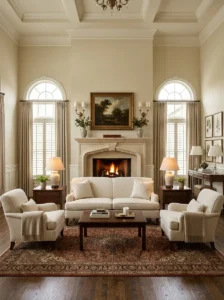
Arranging a living room’s main furniture pieces in a balanced, symmetrical layout, matching armchairs flanking a sofa, a pair of matching lamps on either side of a console, creates a sense of order and formality that has remained a cornerstone of classic interior design for centuries, largely because balanced compositions are simply pleasing to the eye in a way that feels intuitive rather than trend-dependent. I rearranged our own living room around this principle several years ago, replacing a more casual, asymmetrical layout, and the room immediately felt more considered and put-together.
This doesn’t mean every single element needs to be perfectly matched or mirrored, a rigidly symmetrical room can sometimes feel a bit stiff or impersonal if taken to an extreme. I’d recommend applying symmetry primarily to your larger, more foundational pieces, the sofa and its flanking furniture, a fireplace and its surrounding built-ins, while allowing smaller, more personal details, artwork, books, decorative objects, to vary more freely and organically throughout the space.
A symmetrical arrangement also tends to photograph and read well regardless of the specific style details within it, whether your room leans more traditional or has a more relaxed, contemporary edge, meaning this underlying structural principle remains genuinely useful and timeless even as the specific furniture and decor choices layered on top of it evolve over the years.
5. Classic Molding and Trim Details
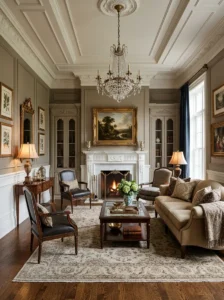
Architectural details like crown molding, picture rail molding, or a paneled wainscoting section bring a sense of craftsmanship and permanence to a living room that few purely decorative additions can match, and these details have remained a hallmark of well-regarded interior design across multiple decades and shifting broader style trends. We added simple crown molding to our own living room during a renovation, and even though it was a relatively modest addition in terms of cost and complexity, it noticeably elevated how finished and considered the whole room felt afterward.
I’d recommend choosing molding proportions appropriate to your specific ceiling height and room scale, rather than assuming a single standard size works universally, since molding that’s too delicate can look insufficient in a room with higher ceilings, while overly substantial molding can feel heavy and overwhelming in a smaller, lower-ceilinged space. Consulting with a contractor about appropriate scale for your specific room is worth the conversation before committing to a particular molding size or style.
This is a detail that genuinely transcends specific decorating trends, since it’s fundamentally architectural rather than purely decorative, meaning it remains appropriate and appealing regardless of whether your furniture and color choices lean more traditional or contemporary at any given point. A well-executed molding detail, once installed, essentially becomes a permanent, positive feature of the room’s underlying structure rather than something that will need updating as trends shift in the years ahead.
6. A Statement Area Rug in a Classic Pattern
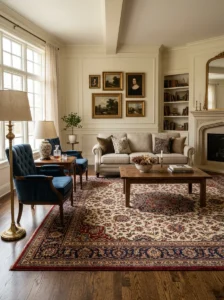
A rug in a traditional pattern, an Oriental or Persian-style design, a classic herringbone, or a timeless trellis or damask motif, anchors a living room with a sense of history and craftsmanship that more trend-driven, purely graphic patterns often lack. I purchased a genuine hand-knotted rug in a traditional pattern for our own living room years ago, a more significant investment than I initially felt entirely comfortable with, but its enduring appeal and genuine durability have more than justified the cost over the years since.
These traditional patterns work particularly well because their intricate, layered designs were refined over generations specifically to hide wear and remain visually interesting for extended periods, unlike simpler, bolder graphic patterns that can start to feel visually tired or dated more quickly, precisely because of how immediately recognizable and singular their design typically is. I’d recommend investing in the best quality rug your budget genuinely allows for this specific piece, since a well-made traditional rug, properly cared for, can realistically last for decades, while cheaper versions tend to show wear and fade considerably faster.
Color palette matters here too for long-term versatility. I’d suggest choosing a rug with a range of colors that can complement several different accent color choices over time, rather than one dominated by a single, very specific trend color, since this flexibility lets the rug remain a cohesive foundation even as your other, more easily changed decor choices evolve over the years ahead.
7. Brass or Antique Gold Hardware and Fixtures
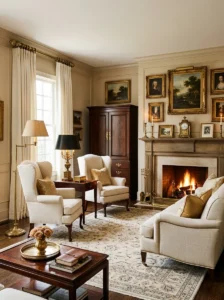
Warm metal finishes, particularly brass or an aged, antique gold tone, have remained a consistent presence in classic interior design for generations, largely because their warmth complements such a wide range of color palettes and furniture styles without ever feeling as visually cold or clinical as chrome or overly bright, polished silver tones can. I gradually replaced most of our living room’s hardware and light fixtures with a consistent brass finish over a couple of years, and the cohesive warmth this brought to the room has genuinely never felt dated, even as specific metal finish trends have shifted several times during that same period.
The specific brass finish matters somewhat for how classic versus contemporary it reads. A slightly aged, antique brass finish leans more traditional and timeless, while a very bright, polished brass can occasionally feel closer to a specific, more recent trend revival rather than a genuinely enduring classic choice. I’d recommend an aged or satin brass finish specifically if genuine, long-term timelessness is your primary goal, rather than the shinier, more reflective brass that’s cycled in and out of specific trend popularity more noticeably over recent years.
I’d suggest applying this warm metal consistently across your living room’s various fixtures, door hardware, light fixtures, curtain rods, picture frames, rather than mixing several different metal tones throughout the space, since this consistency reads as more intentional and considered, a hallmark of genuinely classic design, rather than a room that’s simply accumulated whatever hardware happened to be available or trending at different points over time.
8. Floor-to-Ceiling Curtains in Natural Fabric
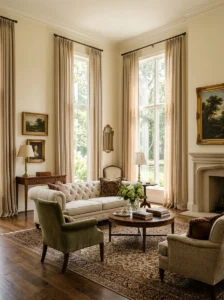
Curtains made from natural fabrics, linen, cotton, or silk, hung floor-to-ceiling regardless of your actual window’s specific height, bring an elegant, formal quality to a living room that has remained a consistent feature of well-regarded interior design across many decades. We hung simple, floor-length linen curtains in our own living room years ago, and this particular detail has genuinely never felt like it needed updating or revisiting, unlike several other, more trend-driven choices we made around the same period.
Natural fabrics specifically tend to age and drape more gracefully over years of use than many synthetic alternatives, developing a soft, slightly relaxed quality that actually suits this classic aesthetic well, rather than looking simply worn out the way a cheaper synthetic fabric might after extended use and exposure to sunlight. I’d recommend linen or a linen blend specifically as a versatile, durable choice that works across a genuinely wide range of classic living room styles, from more formal to a slightly more relaxed, casual traditional look.
Mounting curtains as close to the ceiling as practical, rather than just above the window frame itself, and allowing them to fall fully to the floor, creates a more elegant, elongated line that has remained a consistent hallmark of well-designed, classic living rooms regardless of shifting trends in furniture style or color palette happening elsewhere in the broader design world during any given period.
9. A Coffered or Beamed Ceiling Detail
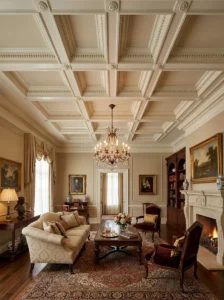
Adding architectural interest to the ceiling itself, whether through a coffered grid pattern or simple exposed or applied beams, brings a genuine sense of craftsmanship and permanence to a living room that few other single additions achieve quite as effectively. A client of mine added a simple coffered ceiling detail to their living room during a broader renovation, and the resulting sense of architectural weight and intentionality elevated the entire room considerably, in a way that’s remained just as appealing several years later as it did immediately after installation.
This kind of ceiling detail requires more significant construction investment than most purely decorative changes, generally involving either genuine structural beams or applied millwork designed to create the coffered grid pattern, along with appropriate paint or stain finishing to complete the look. I’d recommend consulting with a contractor experienced specifically in this kind of millwork detail, since proper proportion and spacing genuinely matter for the final result to look intentional and well-executed rather than slightly awkward or amateur.
While this represents a more substantial investment than many other ideas on this list, a well-executed ceiling detail, once installed, functions much like the molding mentioned earlier, as a permanent architectural feature rather than something that will need updating as broader decorating trends continue to shift in the years and decades following the initial installation.
10. Traditional Wingback or Club Chairs
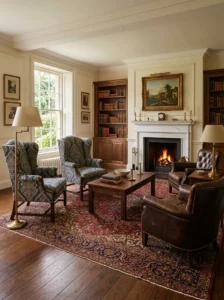
A pair of wingback chairs or classic club chairs, positioned as additional seating alongside a main sofa, brings a sense of gracious, traditional hospitality to a living room that more contemporary, low-profile seating options often don’t quite achieve in the same way. We added a pair of leather club chairs to our own living room several years ago, and they’ve remained a consistently appealing, comfortable addition throughout every subsequent update we’ve made to the rest of the room’s smaller decor details.
These classic chair styles were refined over many decades specifically for comfort during extended sitting, wingback chairs in particular were originally designed to block drafts and provide genuine support for reading or conversation, which is part of why they’ve remained relevant and comfortable long after their original practical purpose became less immediately necessary in most modern homes. I’d recommend prioritizing genuine comfort and quality upholstery specifically for these pieces, since they’re meant to be actually used regularly, not simply displayed as decorative accents within the room.
Leather or a substantial, textured fabric tends to suit these classic silhouettes particularly well, reinforcing their traditional character rather than a very smooth, contemporary fabric that can sometimes feel slightly at odds with the chair’s inherently classic shape. I’d suggest positioning a pair of these chairs at an angle facing the sofa, rather than directly opposite it, creating a more natural, conversational seating arrangement that remains genuinely functional and appealing for actual daily use and gatherings, not just for how the room photographs.
11. A Marble or Stone Fireplace Surround
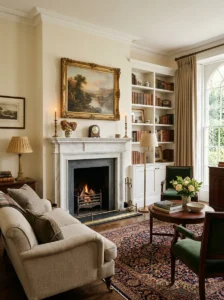
A fireplace finished in natural marble or stone, rather than more contemporary materials like tile or painted brick, brings a genuinely enduring elegance to a living room that has remained a hallmark of classic, well-appointed interior design across generations. We updated our own fireplace surround to a simple white marble with subtle grey veining several years ago, replacing a more dated painted brick surround, and it’s a change that’s continued to feel appropriate and elegant regardless of how our broader decorating choices have evolved since then.
Natural stone’s appeal here comes largely from its inherent, timeless material quality, unlike a painted or tiled surface that can start to feel visually tied to a specific decorating period, natural marble or stone simply reads as classic and substantial regardless of surrounding trends. I’d recommend choosing a relatively simple, classic marble variety with subtle, elegant veining, rather than a very bold, dramatic stone pattern that might itself become more strongly associated with a specific design era or trend moment over time.
While natural stone represents a genuine investment, particularly if it requires professional installation and potentially structural consideration depending on your specific fireplace’s construction, it’s a change that, once made, rarely needs revisiting or updating again, unlike some of the more decorative, easily changed elements elsewhere in a living room that naturally cycle through updates more frequently over the years.
12. Layered Table and Floor Lamps
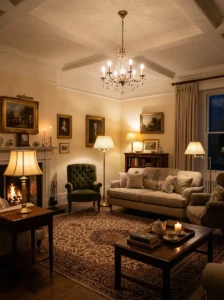
Rather than relying primarily on overhead lighting, layering multiple table and floor lamps throughout a living room creates a warmer, more inviting quality of light that has remained a fundamental principle of well-designed, classic living rooms regardless of shifting trends in specific lamp styles or fixture design happening around this underlying, timeless approach. I’ve gradually added several lamps to our own living room over the years, and this layered approach to lighting has consistently made the biggest difference in how genuinely warm and comfortable the room feels, far more than any single specific piece of furniture or decor.
The specific lamp styles themselves can certainly evolve and update over time without disrupting this underlying principle, I’ve swapped out individual lamp bases and shades several times over the years as my taste has shifted slightly, while the fundamental approach of layered, warm lighting throughout the room has remained exactly the same foundation underneath those smaller, more easily changed updates.
I’d recommend positioning lamps at varying heights throughout the room, a taller floor lamp beside a reading chair, a lower table lamp on a side console, rather than uniform lamp heights throughout, which creates more visual interest and better addresses the room’s actual lighting needs at different points and activities happening throughout the space. Warm bulb temperatures, rather than cool or daylight bulbs, remain essential here too, for the same reasons discussed in other lighting-focused sections throughout this list.
13. Built-In Bookshelves Flanking a Focal Point
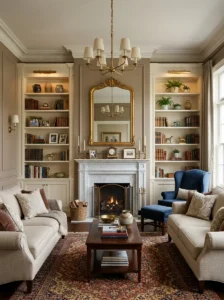
Custom, built-in bookshelves, typically positioned flanking a fireplace or a large window, bring both genuine function and a strong architectural presence to a living room that has remained a consistently appealing design choice across many decades of interior design. We built a version of this around our own fireplace several years ago, and it remains one of the features I’m most confident will continue to look genuinely appropriate and well-considered regardless of how our other, more easily changed decor choices continue to evolve in the years ahead.
Unlike freestanding furniture, built-in shelving becomes a permanent part of the room’s actual architecture, which reinforces its inherently classic, timeless quality, since it reads less as a specific furniture trend and more as a fundamental structural feature of the space itself. I’d recommend working with a carpenter to ensure proper proportion and detailing specific to your room’s existing architectural style, whether that leans more traditional with raised panel detailing, or slightly simpler and more streamlined.
The books and objects displayed on these shelves can, of course, change and evolve continuously over the years, offering ongoing opportunity for refreshing the room’s specific look and personal character, while the underlying built-in structure itself remains a permanent, unchanging foundation that doesn’t require the kind of periodic replacement or updating that freestanding furniture pieces more commonly need over a similar span of years.
14. A Formal Drapery Treatment with Tiebacks
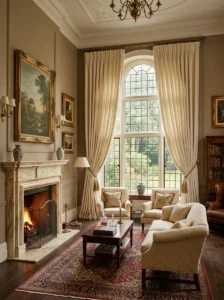
Beyond simple floor-length curtains, a more formal drapery treatment, incorporating tiebacks, perhaps a coordinating valance or cornice, and generous, luxurious fabric fullness, brings an elevated sense of occasion and tradition to a living room’s windows that has remained a hallmark of more formal, classic interior design across generations. A client of mine specifically requested this more elaborate treatment for her formal living room, and the resulting effect brought a genuine sense of gracious, old-world elegance that a simpler curtain treatment wouldn’t have achieved to quite the same degree.
I’d recommend this more elaborate approach specifically for living rooms intended for a slightly more formal use, entertaining guests, hosting special occasions, rather than a more casual, everyday family living space, where a simpler curtain treatment often suits the room’s actual daily function better. Fabric choice matters considerably here too, a substantial fabric with genuine body and drape, silk, a heavier linen, or a quality cotton blend, holds these more elaborate folds and details considerably better than a lighter, thinner fabric would.
Tieback style and positioning affects the overall formality of the final look too, a simple fabric tieback reads as slightly more relaxed than an ornate tassel or a decorative metal tieback holder, letting you calibrate the exact level of formality to suit your specific room and personal taste, while still working within this broadly classic, enduringly appealing drapery approach.
15. A Grand Piano or Music Corner
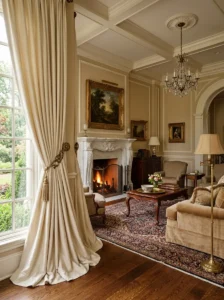
For households with a genuine interest in music, a piano, whether a full grand piano or a more modestly sized upright, positioned as a genuine focal point within the living room brings both function and a distinct sense of classic, cultured elegance that has remained appealing across many decades of interior design history. A friend’s family has kept a beautiful upright piano as the centerpiece of their living room for as long as I’ve known them, and it’s remained a genuinely warm, inviting focal point through several different broader redecorating efforts over the years.
I’d recommend this specifically for households where the piano, or another significant musical instrument, gets genuine regular use, rather than purely for the aesthetic and classic appeal it brings, since an unused, purely decorative piano can start to feel more like an obstacle than a genuine asset within the room over time. For those who do use it regularly, though, positioning it thoughtfully, ideally away from direct sunlight and significant temperature fluctuations that can affect the instrument’s tuning and condition, ensures both its longevity and its continued genuine usability.
A small, curated display of sheet music or a few meaningful musical items nearby adds a personal, lived-in quality to this classic feature, reinforcing that it’s a genuinely used, valued part of the household’s daily life rather than simply an expensive decorative object positioned purely for visual effect within the broader room.
16. Damask, Toile, or Traditional Print Upholstery
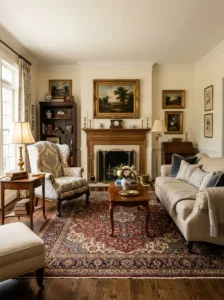
Incorporating a classic patterned fabric, damask, toile, or a traditional stripe, on at least one or two pieces within a living room, an accent chair, a set of throw pillows, brings a layer of pattern and texture that has remained a consistent element of well-regarded classic interior design across many decades, even as the specific colorways and scale of these patterns has evolved somewhat with each design generation. I reupholstered a small accent chair in a traditional toile pattern several years ago, and it’s remained one of my favorite details in the room, adding genuine visual interest without ever feeling tied to a fleeting, more specific trend moment.
I’d recommend using these more traditional patterns in moderation, on one or two key pieces rather than throughout the entire room, since even genuinely classic patterns can start to feel overwhelming if applied too extensively, while a more restrained application lets the pattern read as an intentional, elegant accent rather than the room’s single dominant visual feature. Pairing a patterned piece with otherwise solid, neutral surrounding furniture and walls, as discussed earlier in this list, helps the pattern genuinely stand out and be appreciated as a considered design choice.
Color palette within the pattern itself matters for long-term versatility too, a traditional pattern rendered in classic, somewhat muted tones tends to have more enduring appeal than the same pattern executed in a very bold, saturated, trend-specific color combination, which can feel more strongly associated with a particular design period once that specific color trend has cycled through and moved on to newer trending palettes.
17. A Well-Chosen Grandfather Clock or Antique Clock
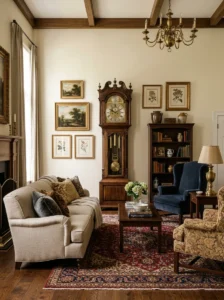
A substantial, well-crafted clock, whether a genuine antique or a well-made reproduction, brings a sense of history and old-world craftsmanship to a living room that few other single decorative objects achieve quite as effectively. My grandmother had a grandfather clock in her living room throughout my entire childhood, and I distinctly remember it as one of the defining, memorable features of that specific room, a piece that never once felt dated or out of place across the many decades she owned it.
I’d recommend sourcing this kind of piece from an antique dealer or estate sale specifically if you’re drawn to a genuinely authentic, aged piece with real history and craftsmanship, since these often carry a level of detail and character that’s difficult to replicate in newer reproductions. If an authentic antique isn’t accessible for your budget, several furniture makers do produce well-crafted reproduction clocks that still bring much of the same classic visual appeal, even without the same genuine age and history behind them.
Placement matters considerably for a piece this substantial, I’d suggest positioning it against a wall with adequate surrounding space, rather than crowding it into a tight corner, allowing the clock’s genuine presence and craftsmanship to be properly appreciated rather than visually competing for attention with too many other nearby furniture pieces or decorative objects within the same immediate area of the room.
18. Traditional Gallery-Style Framed Art
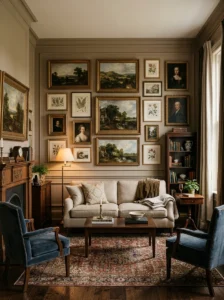
A collection of framed artwork, traditional paintings, botanical prints, or classic portraiture, arranged in coordinated frames throughout a living room brings a sense of curated, cultured taste that has remained consistently appealing across generations of classic interior design. I’ve built a small gallery of traditional landscape paintings in our own living room over several years, sourced gradually from estate sales and antique shops rather than purchased all at once, and the collection has become genuinely meaningful in a way that a single, more contemporary statement piece purchased quickly wouldn’t have achieved.
I’d recommend coordinating your frame choices, even if the artwork itself varies somewhat in subject and specific style, since consistent framing, matching wood tones or a unified gold or black finish, ties a varied collection together as a single, cohesive gallery rather than a random, mismatched assortment of individually framed pieces. Building this kind of collection gradually over time, rather than purchasing everything at once from a single source, also tends to result in a more genuinely personal, meaningful display that reflects your own evolving taste and interests.
Traditional subject matter, landscapes, still life paintings, classic portraiture, tends to have more enduring, broad appeal than very specific, trend-driven contemporary art choices, though this is genuinely a matter of personal taste, and a well-curated collection of pieces that authentically appeal to you personally will always read as more considered and appropriate than art chosen purely because it fits a particular classic design template.
19. A Skirted Sofa or Slipcovered Furniture
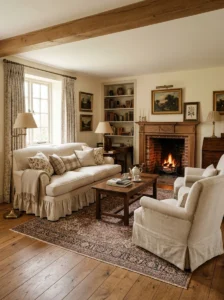
Furniture with a fabric skirt extending to the floor, concealing the legs entirely, brings a soft, traditional, gracious quality to a living room that has remained a hallmark of classic, comfortable interior design across many decades, particularly within more traditional country or cottage-style classic interiors. I had our own sofa reupholstered with a simple box-pleated skirt several years ago, replacing its original exposed wood legs, and the resulting softer, more traditional silhouette suited our overall room’s classic direction considerably better than the previous exposed-leg design had.
This detail works particularly well in living rooms leaning toward a softer, more traditional or cottage-inspired classic aesthetic, rather than a more formal, tailored classic direction, where exposed, well-turned wood legs might actually suit the room’s specific character better. I’d recommend considering your room’s overall style direction carefully before choosing between these two classic approaches, since both are genuinely timeless within their respective aesthetic categories, but they do suit somewhat different overall moods and broader style directions.
Slipcovers specifically, rather than a fixed upholstered skirt, offer the additional practical benefit of being removable for cleaning, a genuinely useful feature for households with children or pets, without sacrificing this classic, softened silhouette. I’d suggest a natural fabric, cotton or linen, for slipcovers specifically, since these tend to hold their shape and launder more successfully over repeated washing than some synthetic alternatives might over years of regular use and cleaning.
20. A Formal Dining or Entertaining Corner
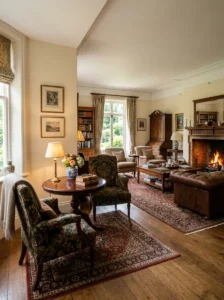
For larger living rooms, incorporating a small, formal seating or entertaining corner, perhaps a pair of chairs around a small round table, specifically designed for card games, tea service, or intimate conversation, brings a sense of gracious, purposeful hospitality that has remained a consistent feature of well-appointed, classic living rooms across generations. A family member’s home has maintained a small card table corner in her living room for decades, and it remains one of the most genuinely used and appreciated corners of her entire home, regularly hosting everything from actual card games to simply an intimate spot for tea and conversation with a visiting friend.
I’d recommend this specifically for larger living rooms with adequate space to accommodate a secondary seating area without the room feeling overcrowded or the primary seating arrangement feeling compromised by the addition. A round table specifically tends to suit this kind of intimate, secondary seating arrangement particularly well, since it doesn’t have the more formal, directional quality of a rectangular table, better suiting genuinely relaxed, conversational use.
This kind of dedicated corner also offers a natural, ready-made space for displaying a few classic decorative objects, a small collection of playing cards, a decorative box, perhaps a small vase, reinforcing the room’s overall sense of considered, gracious hospitality throughout even its smaller, secondary details and corners, not just its primary, most immediately visible seating arrangement.
21. A Classic Chandelier or Formal Ceiling Fixture
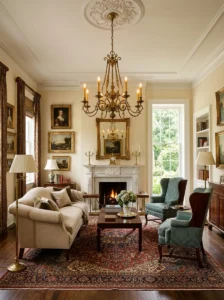
A chandelier with a traditional silhouette, whether crystal, wrought iron, or a classic brass design, brings genuine formality and elegance to a living room’s overhead lighting that more minimal, contemporary fixture styles often don’t quite achieve to the same degree. We installed a simple, classic brass chandelier in our own living room several years ago, replacing a more basic, builder-grade overhead fixture, and it’s remained a consistently appealing focal point throughout every subsequent update we’ve made to the rest of the room’s furniture and decor.
I’d recommend choosing a chandelier scaled appropriately to your specific room’s dimensions and ceiling height, since an undersized fixture can look somewhat insufficient and lost within a larger room, while an oversized fixture can feel overwhelming in a smaller space. Consulting general sizing guidelines based on your room’s square footage, or working with a lighting professional for a more precise recommendation specific to your particular space, helps ensure the final fixture genuinely suits your room’s actual proportions.
As discussed in earlier lighting-focused sections, this formal overhead fixture works best as part of a broader, layered lighting approach, providing genuine ambient illumination and a strong visual focal point, while additional table and floor lamps handle the room’s more functional, everyday lighting needs at a lower, more human height throughout the actual living and seating areas of the room.
22. Traditional Needlepoint or Tapestry Pillows
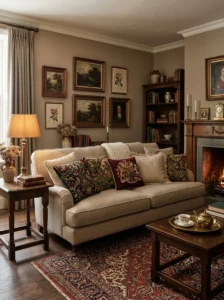
Throw pillows featuring traditional needlepoint designs or woven tapestry patterns bring a layer of genuine craftsmanship and classic detail to a living room’s seating that more simply printed or solid fabric pillows don’t quite achieve to the same degree. I’ve collected several needlepoint pillows over the years, some purchased from antique shops, a couple actually stitched by family members, and they’ve become some of the most genuinely meaningful and visually rich small details throughout our entire living room.
I’d recommend mixing a couple of these more detailed, textured pillows with simpler solid or textured pillows throughout your seating arrangement, rather than using needlepoint or tapestry exclusively throughout, since this variation prevents the overall look from becoming visually overwhelming while still incorporating this classic, detailed element as a genuine highlight within the broader pillow arrangement.
Sourcing genuinely antique or vintage needlepoint pieces specifically, whether from estate sales, antique shops, or family pieces passed down over generations, tends to bring more authentic character and history to this detail than a newer, mass-produced needlepoint-style pillow might achieve, though well-made contemporary versions can certainly still bring genuine visual appeal and classic character to a room, even without quite the same layer of authentic, inherited history behind them.
23. A Well-Stocked Bar Cart or Cabinet
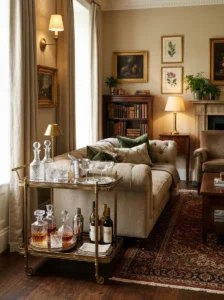
A dedicated bar cart or a small bar cabinet, stocked with a curated selection of glassware and spirits, brings a sense of gracious, classic hospitality to a living room that has remained a consistently appealing feature across many decades of entertaining-focused interior design. I’ve kept a simple brass bar cart in our own living room for several years now, and beyond its genuine practical use when hosting guests, it’s become a consistently appealing decorative feature even when not actively in use for serving drinks.
I’d recommend choosing glassware and bar accessories with a classic, timeless design specifically for this display, rather than trend-driven, overly specific pieces, since these items are genuinely on display much of the time, not tucked away in a cabinet, meaning their specific style choices matter considerably for the room’s overall long-term appeal. A simple collection of crystal or cut-glass tumblers and glasses tends to have more enduring visual appeal than very specifically shaped, trend-driven glassware designs that might feel more strongly tied to a particular decorating period.
Positioning this bar cart or cabinet within easy reach of your main seating area, but not directly obstructing natural traffic flow through the room, ensures it remains genuinely convenient and functional for actual regular use and entertaining, rather than purely decorative, reinforcing the room’s overall sense of genuine, considered hospitality throughout its various details and features.
24. A Classic Herringbone or Parquet Wood Floor
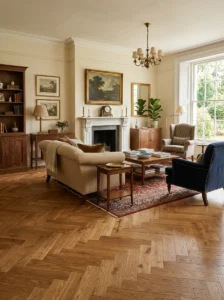
Flooring laid in a traditional herringbone or parquet pattern brings genuine craftsmanship and visual interest underfoot that has remained a hallmark of well-appointed, classic interior design across many generations, distinguishing a room’s foundation from the more simply laid straight-plank flooring found in a large proportion of more standard, contemporary homes. We installed herringbone-pattern wood flooring in our own living room during a more significant renovation several years ago, and it remains one of the features visitors most consistently comment on and admire, regardless of how our other, more easily changed decor choices have continued to evolve since that initial installation.
This kind of patterned flooring installation requires more skilled labor and generally costs more than standard straight-plank installation, given the additional precision and material cutting involved in creating the pattern correctly. I’d recommend working specifically with an installer experienced in this particular pattern style, since improperly executed herringbone or parquet flooring can look noticeably uneven or amateur, undermining the elegant, considered effect this classic flooring choice is meant to achieve.
A warm, medium wood tone tends to suit this pattern particularly well, allowing the geometric detail of the pattern itself to remain the primary visual interest, rather than an unusual or very dark stain competing for attention alongside the pattern’s inherent visual complexity. This flooring choice functions much like the built-in shelving and molding details discussed earlier, as a permanent architectural investment that continues to pay dividends in the room’s overall classic appeal for many years, even decades, following the initial installation.
25. A Traditional Fireside Seating Arrangemen
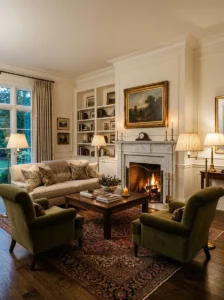
Arranging your living room’s primary seating specifically around a fireplace, rather than positioning it toward a television or another focal point, reinforces one of the most enduringly classic living room layouts, one centered around genuine conversation and gathered warmth rather than passive media consumption. We reorganized our own living room several years ago specifically to prioritize this fireside arrangement, moving our television to a secondary position rather than the room’s main visual focus, and the resulting layout has genuinely encouraged more actual conversation and gathering among family and guests than our previous, television-centered arrangement did.
I’d recommend positioning your main sofa directly facing the fireplace, with flanking chairs angled slightly inward on either side, creating a genuinely intimate, conversation-focused seating cluster that has remained a consistently appealing classic layout across many generations of interior design, largely because it prioritizes actual human connection and gathering over passive entertainment consumption as the room’s primary organizing principle.
If a television remains an important part of your living room’s function, as it genuinely does in most contemporary households, I’d suggest positioning it to one side rather than directly opposite the fireplace, allowing both focal points to coexist without one completely overshadowing or competing with the other for the room’s primary visual and functional attention, striking a practical balance between this classic, fireside-focused layout and genuinely contemporary household needs and daily habits.
26. Genuine Antique or Vintage Furniture Pieces
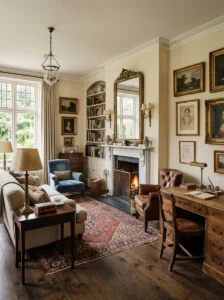
Incorporating at least a few genuinely antique or vintage furniture pieces throughout a living room, rather than an entirely new furniture collection purchased all at once, brings authentic history and character that reproduction or purely contemporary pieces, however well-made, simply cannot fully replicate. Our own living room includes several pieces collected gradually over years from estate sales and antique shops, a side table, a small writing desk, a decorative mirror, alongside newer furniture, and this genuine mix has consistently felt more considered and personally meaningful than an entirely matched, newly purchased furniture set would have.
I’d recommend starting this kind of collection gradually, rather than trying to source every antique piece for a room all at once, both for budget reasons and because a genuinely collected feel, pieces gathered over months or years as you come across ones that authentically speak to you, tends to result in a more meaningful, cohesive final result than an attempt to purchase an entire antique collection in a single shopping trip.
When sourcing antique or vintage pieces specifically, I’d suggest prioritizing genuine structural soundness, solid joints, stable legs, functional drawers and hardware, over purely cosmetic perfection, since minor surface wear and age generally add to a piece’s authentic character within this classic aesthetic, while genuine structural problems can be costly and difficult to properly repair. This blend of authentic antique pieces alongside newer furniture and decor is, in many ways, the truest expression of genuinely classic design, a living room that reflects accumulated history and personal taste developed gradually over years, rather than a single, uniform style statement purchased and assembled all at once.
Final Thoughts
Looking back across every classic living room I’ve helped design or lived in myself, the common thread running through all of them was never a single specific decorating formula, but rather a consistent prioritization of genuine quality, thoughtful proportion, and details that were refined over generations rather than invented for a single passing trend cycle. These choices simply don’t require the periodic overhauls that more trend-driven decorating decisions inevitably demand every few years as tastes and popular styles continue shifting.
If you’re building a living room with this kind of lasting appeal in mind, I’d suggest prioritizing your investment in the foundational elements from this list, quality furniture construction, a neutral color palette, genuine architectural details, before layering in the more easily changed decorative accents that let you continue personalizing and refreshing the space over the years ahead. Classic design isn’t about avoiding personality or genuine style, it’s simply building that personality and style on a foundation genuinely designed to last.