I first came across the apothecary kitchen look almost by accident, browsing photos of an old pharmacy in Europe with its rows of labeled glass jars, dark wood cabinetry, and worn brass fittings, and something about it stuck with me long after I closed the tab. When I eventually redid a section of our own kitchen with this style in mind, I realized it wasn’t really about recreating a pharmacy at all, it was about bringing back a sense of craftsmanship and quiet ritual to a room that had otherwise become purely functional. Glass jars filled with actual ingredients, wood that shows its grain, brass that’s allowed to age naturally, these details make a kitchen feel like it has history, even in a brand new home.
Since that first small project, I’ve leaned further into this aesthetic in our own kitchen and helped a couple of friends bring elements of it into theirs too. Below are 18 apothecary kitchen ideas based on real spaces I’ve worked on, focused on genuine old-world charm rather than a costume version of the look.
1. Rows of Labeled Glass Apothecary Jars
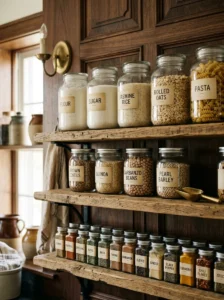
Nothing defines this aesthetic quite as immediately as a row of matching or near-matching glass jars, each holding a specific dry good and labeled clearly in simple, uniform lettering. I started my own collection with just five jars for flour, sugar, rice, oats, and pasta, sourced gradually from secondhand shops rather than bought as a matching set, and the slight variation in jar shape and glass thickness between them has ended up adding more character than a perfectly uniform set would have.
The labeling itself matters more than people initially expect. Simple, consistent lettering, whether hand-painted, stenciled, or a printed label with a slightly aged or vintage-style font, ties even a mismatched collection of jars together as one cohesive display. I used a basic paint pen for mine, keeping the lettering small and centered on each jar’s front, and resisted the urge to make each label more decorative than necessary, since restraint here is genuinely part of what makes the display read as authentic rather than overly styled.
I’d recommend prioritizing jars with proper airtight seals for anything you’re actually using regularly, cork-stoppered jars look wonderful but don’t always keep dry goods fresh as effectively as a rubber-gasket clamp lid. Reserve the more decorative, looser-lidded jars for items you go through quickly, or for purely visual dried goods like whole spices or dried citrus, where a perfect seal matters less than the overall look.
2. Dark, Rich Wood Cabinetry
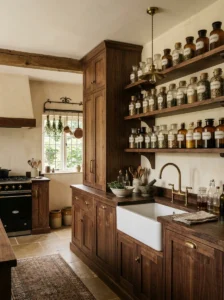
Cabinetry in a deep, warm wood tone, walnut, dark oak, or a rich mahogany stain, forms the backbone of an authentic apothecary kitchen, echoing the substantial wood cabinets found in genuine old pharmacies and general stores. We refinished our own kitchen’s existing cabinets in a deep walnut stain during a smaller renovation, replacing a much lighter original wood tone, and the shift in the room’s entire character was more dramatic than I expected from what was, technically, just a stain change rather than a full cabinet replacement.
The specific wood grain and finish matter considerably for authenticity here. A slightly matte or satin finish, rather than a high-gloss lacquer, reads as more genuinely old-world and less like modern, mass-produced furniture. I’d recommend requesting a finish sample on a piece of scrap wood before committing to a full cabinet refinish, since stain color can shift noticeably once applied over your cabinets’ specific existing wood type, sometimes reading warmer or cooler than the sample chip alone suggested.
If refinishing existing cabinets isn’t practical for your situation, sourcing a few individual dark wood pieces, an open shelf, a small hutch, a freestanding cabinet, lets you introduce this same rich, grounding tone in a smaller, more budget-friendly way, without needing to commit to a full kitchen renovation just to achieve the aesthetic’s foundational wood tone throughout the space.
3. Brass Hardware with a Natural Patina
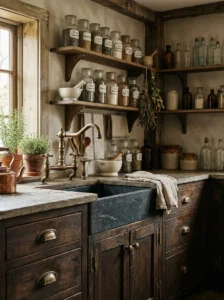
Brass hardware, cabinet pulls, hinges, faucet fixtures, brings a warm, aged quality to an apothecary kitchen that chrome or brushed nickel simply can’t replicate, particularly once the brass is allowed to develop its natural patina over time rather than being kept artificially polished and shiny. I switched all our cabinet hardware to unlacquered brass a few years ago, specifically choosing the unlacquered variety because it tarnishes and develops character naturally with use and time, unlike lacquered brass, which stays permanently shiny and, to my eye, considerably less interesting.
The tarnishing process happens gradually through simple everyday contact, oils from hands touching the hardware regularly, occasional exposure to moisture, and I genuinely enjoy watching this transformation happen slowly over months and years rather than trying to prevent or reverse it. If you prefer a faster result, some brass hardware can be intentionally aged using simple household methods, though I’d recommend researching this carefully and testing on a single, less visible piece first, since over-aging can sometimes look artificial rather than genuinely worn.
I’d suggest sourcing at least some pieces secondhand specifically for this aesthetic, since genuinely old brass hardware often carries an authentic patina that’s difficult to fully replicate on new hardware, however you age it. Antique shops and architectural salvage yards are excellent sources for this kind of detail, often at a fraction of the cost of new brass hardware from a standard home goods retailer.
4. A Freestanding Butcher Block or Prep Table
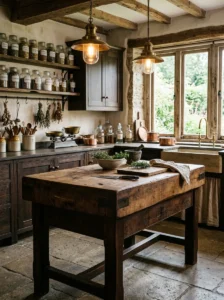
A substantial, freestanding wood prep table, ideally with a butcher block top, echoes the sturdy, well-used work surfaces found in old pharmacies and general stores, and brings genuine function alongside its old-world visual appeal. I added a secondhand butcher block table to the center of our kitchen a couple of years ago, and beyond how well it suits the overall aesthetic, it’s become our primary prep surface for actual daily cooking, genuinely earning its keep rather than serving as purely decorative furniture.
Sourcing this kind of piece secondhand is, in my experience, considerably more successful than buying new specifically for this aesthetic, since older prep tables tend to already carry visible knife marks, worn edges, and a general sense of having been genuinely used for years, exactly the kind of authentic character that’s difficult to fake convincingly on a brand new piece. I’d recommend checking any secondhand butcher block carefully for stability and level legs before purchasing, since older wood furniture can sometimes develop warping or wobbling that’s more difficult to correct than simple surface wear.
Regular oiling with a food-safe mineral oil keeps a butcher block surface both hygienic and visually rich, deepening the wood’s natural color over time rather than letting it dry out and appear dull. I’d suggest this maintenance step roughly once a month for a table in regular use, more often if you notice the surface starting to look particularly dry or pale compared to when it was freshly oiled.
5. Open Shelving with Mixed Ceramic and Glass Storage
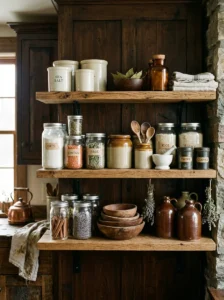
Open shelves, displaying a genuine mix of ceramic crocks, glass jars, and simple wooden bowls rather than a uniform, matching storage set, capture the accumulated, gathered-over-time quality that’s central to authentic apothecary styling. I built a section of open shelving in our own kitchen specifically for this mixed display, sourcing pieces gradually from secondhand shops and a couple of local pottery makers rather than purchasing everything from a single retailer at once.
The visual variety here is genuinely the point, rather than a shortcoming to correct. A cream-colored ceramic crock beside a clear glass apothecary jar beside a simple turned wood bowl creates natural texture and interest that a uniform, matching storage set simply doesn’t achieve, however coordinated and tidy that matching set might look at first glance. I’d recommend grouping items loosely by function, dry goods together, serving pieces together, rather than by material or color, which tends to look more genuinely functional and less like a purely decorative styling exercise.
I’d suggest resisting the urge to fill every shelf completely, leaving some genuine breathing room between groupings lets each piece actually be seen and appreciated individually, rather than blurring together into an overcrowded, visually busy display that undermines the intentional, curated character this aesthetic depends on.
6. Vintage Scale or Measuring Tools as Decor
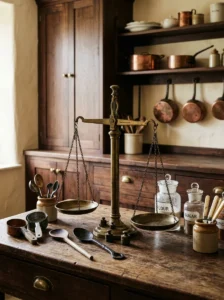
An old balance scale, a vintage set of measuring scoops, or a genuinely antique kitchen tool displayed as a decorative object brings a distinctly apothecary, old-world quality to a kitchen countertop or shelf that purely modern kitchen tools don’t achieve. I found a small brass balance scale at an antique market a few years back, and it’s remained one of my favorite objects in our kitchen, both for its genuine history and for how naturally it fits the overall aesthetic we’ve built the room around.
These pieces work best as functional-looking, if not always fully functional, objects rather than purely abstract decorative items, since the whole appeal comes from evoking a genuine sense of old-world craftsmanship and daily use. I’d recommend antique shops, estate sales, and specialty vintage tool dealers as your best sources for authentic pieces, since these tend to carry more genuine age and character than reproduction versions, however well-made those reproductions might be.
I’d suggest positioning a piece like this somewhere it can genuinely be appreciated up close, a countertop, an open shelf at eye level, rather than tucked into a high or dim corner where its details go largely unnoticed. A single well-chosen vintage tool often makes more of a visual and thematic impact than several scattered throughout the kitchen, so I’d recommend curating carefully rather than trying to accumulate a large collection all at once.
7. A Farmhouse Sink with Vintage-Style Fixtures
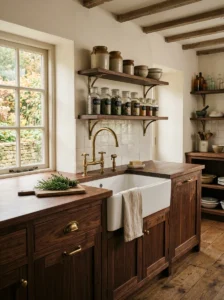
A deep, apron-front farmhouse sink, paired with a vintage-style bridge faucet in an aged brass or bronze finish, brings genuine old-world character to what’s often a kitchen’s most frequently used fixture. We installed this combination during our own kitchen renovation, and the sink area has become one of the most visually cohesive spots in the entire room, tying together the wood cabinetry, brass hardware, and overall aesthetic direction in one functional, everyday feature.
Farmhouse sinks are typically deeper than standard undermount or drop-in sinks, which offers genuine practical benefit beyond the visual appeal, more room for washing larger pots and pans, less splashing during regular use. I’d recommend confirming your existing cabinetry can accommodate this sink style’s specific mounting requirements before committing, since farmhouse sinks generally need cabinet modifications that a standard sink replacement wouldn’t require, particularly if you’re retrofitting into existing cabinets rather than building new ones specifically designed around the sink.
A bridge-style faucet, with its exposed pipework connecting the two separate hot and cold handles, reinforces this vintage, apothecary-adjacent character particularly well, echoing the kind of plumbing fixtures found in genuinely old buildings. I’d suggest choosing a faucet finish that matches or closely complements your other brass or bronze hardware throughout the kitchen, maintaining the consistent metal tone that ties this whole aesthetic together as a cohesive whole rather than a collection of individually chosen, mismatched details.
8. Dried Herbs and Botanicals Hanging to Dry
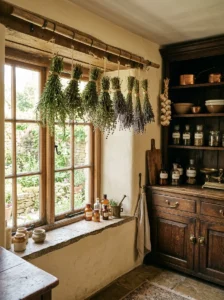
Bundles of dried herbs, lavender, rosemary, thyme, hung upside down in small clusters near a window or along an open shelf, bring genuine fragrance and old-world charm to an apothecary kitchen, echoing the dried botanicals that would have lined the shelves of a genuine historical apothecary or pharmacy. I started hanging small bundles from a simple wood dowel mounted near our kitchen window, partly for the visual appeal and partly because I genuinely use several of these herbs regularly in cooking, giving the display real practical function alongside its decorative charm.
I’d recommend choosing herbs and botanicals you’ll actually use, rather than purely decorative dried flowers, since this dual function, beautiful display plus genuine cooking ingredient, suits the practical, working character of an authentic apothecary kitchen particularly well. Simple twine for tying bundles, rather than anything more elaborate or colorful, keeps the overall look understated and genuine rather than overly styled or precious.
These bundles do need occasional refreshing as they age and lose potency or visual fullness over many months, I’d suggest replacing them every four to six months if you’re using them for cooking, since dried herbs genuinely do lose flavor over extended time, even though they might still look reasonably attractive as purely visual decor for considerably longer than that.
9. A Vintage Apothecary Cabinet with Small Drawers
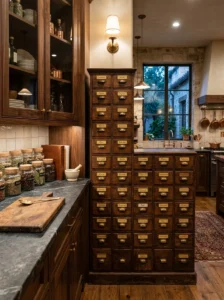
An authentic or reproduction apothecary cabinet, characterized by its many small, uniform drawers originally designed for organizing herbs, remedies, and small ingredients, is perhaps the single most direct nod to this aesthetic’s actual historical origin. I sourced a genuine antique apothecary cabinet for our kitchen a few years back, considerably smaller than a full pharmacy piece but with roughly twenty small drawers, and it’s become both a genuinely useful spice and small ingredient storage solution and the most immediately recognizable feature of our kitchen’s overall style.
Authentic antique pieces vary considerably in price depending on age, condition, and the specific number and craftsmanship of the drawers, and I’d recommend budgeting generously if you’re set on a genuine antique rather than a reproduction, since well-preserved original pieces have become increasingly sought after and correspondingly expensive in recent years. Small original brass drawer labels or label holders, if present on an antique piece, are genuinely worth preserving rather than replacing, even if the specific historical labeling no longer matches your actual use for each drawer.
For those working with a smaller budget, several furniture makers now produce reproduction apothecary-style cabinets that capture much of the same visual character at a considerably lower cost than an authentic antique. I’d suggest prioritizing genuine wood construction and smoothly functioning drawers over more decorative details if choosing between reproduction options, since a piece with sticking or poorly fitted drawers will quickly become a source of daily frustration rather than genuine charm.
10. Chalkboard Labels for Fresh Ingredients
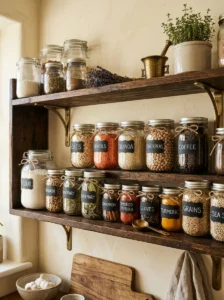
Small chalkboard labels or a section of chalkboard paint, used to note what’s currently stored in a jar or bin, bring a hands-on, slightly rustic charm to an apothecary kitchen while offering genuine practical flexibility that a permanent printed label doesn’t. I added small chalkboard tags to several of our jars specifically for ingredients that rotate seasonally, allowing me to update the label as contents change without needing to remove or replace anything permanently affixed to the jar itself.
I’d recommend simple, small chalkboard tags attached with twine or a small metal ring, rather than a large chalkboard label covering an entire jar’s front, since a more understated approach suits this aesthetic’s overall restraint better than something that reads as overly crafted or trend-driven. A basic white or cream chalk marker, rather than standard chalk, tends to write more cleanly and legibly on these small surfaces, and holds up considerably better against the occasional smudge or accidental brush of a hand while reaching for the jar.
This detail works particularly well combined with the glass jar storage discussed earlier, giving you the flexibility to relabel jars as their contents genuinely change throughout the year, rather than committing to permanent labels for ingredients you might not always keep stocked in exactly the same jars from season to season.
11. Cast Iron and Copper Cookware on Display
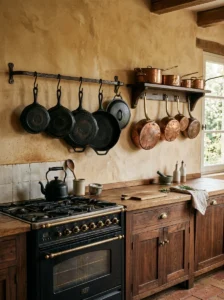
Displaying well-used cast iron pans and copper pots, either hung from a rail or arranged on open shelving, brings genuine functional beauty to an apothecary kitchen, echoing the well-worn, actually-used cookware you’d expect to find in a genuinely old, working kitchen rather than a purely decorative, staged one. We hang our cast iron skillets from a simple wall-mounted rail above the stove, and beyond the practical convenience of having them within easy reach, their dark, well-seasoned surfaces genuinely complement the room’s overall dark wood and brass palette.
Copper cookware specifically develops a beautiful, warm patina over time, similar to the brass hardware discussed earlier, and I’d recommend allowing at least some pieces to age naturally rather than keeping everything meticulously polished, since a slightly tarnished copper pot reads as more authentically old-world than one maintained in a permanently bright, mirror-like shine.
I’d suggest reserving this kind of display specifically for cookware you actually cook with regularly, rather than purchasing pieces purely for decoration, since genuinely used cookware develops the kind of authentic wear and character that’s central to this aesthetic’s overall appeal, something that’s difficult to fake convincingly with brand new, never-used pieces kept purely for show.
12. Warm, Dim Pendant Lighting Over Work Areas
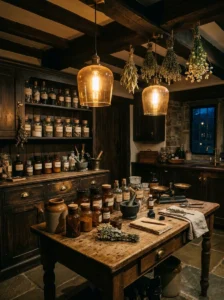
Lighting plays a significant role in how convincingly an apothecary kitchen achieves its intended mood, and pendant fixtures with warm, amber-toned glass shades or exposed filament bulbs cast a genuinely old-world quality of light that brighter, more clinical modern fixtures simply don’t replicate. We installed two simple pendant lights with amber glass shades above our prep table, and the warm, slightly dim quality of light they cast in the evening genuinely transforms the mood of that whole section of the kitchen compared to our brighter, more standard overhead lighting elsewhere in the room.
I’d recommend exposed filament or Edison-style bulbs specifically for this aesthetic, since their visible, warm-glowing filament adds genuine visual interest and character even when the fixture itself is fairly simple, echoing the kind of early electric lighting you might associate with a genuinely old pharmacy or general store from the early twentieth century.
Practically speaking, I’d suggest keeping this warmer, dimmer pendant lighting specifically over areas used for less detail-focused tasks, general kitchen ambiance, a prep table, rather than relying on it as your only light source for tasks genuinely requiring brighter, more precise illumination, like detailed food preparation or reading a recipe closely. Supplementing with brighter, more functional task lighting elsewhere in the kitchen ensures the space remains genuinely practical, not just atmospheric.
13. A Deep Farmhouse Table for Dining
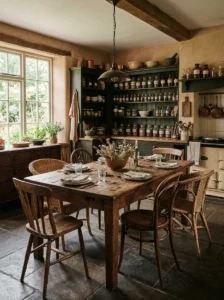
If your kitchen includes space for dining, a substantial, deep-toned wood farmhouse table extends this aesthetic’s warm, old-world character beyond the cooking and storage areas into the room’s actual gathering space. We added a reclaimed wood farmhouse table to our kitchen’s dining area a few years ago, and its solid, slightly imperfect surface, complete with a few genuine knots and small variations in the wood grain, has held up beautifully to years of actual daily family meals.
Reclaimed or genuinely secondhand wood tends to suit this aesthetic particularly well, carrying visible history and character that new, uniformly finished wood doesn’t quite achieve in the same way. I’d recommend checking any secondhand table carefully for structural stability specifically, since a table’s daily function depends on genuinely sturdy legs and joints, unlike some purely decorative pieces where minor structural quirks matter less.
Pairing this kind of table with simple, sturdy wood or wicker chairs, rather than more modern or minimalist seating styles, maintains the overall old-world cohesion throughout the dining area. I’d suggest allowing some genuine mismatch in your seating too, a couple of different but complementary chair styles around the same table, rather than a perfectly uniform matching set, echoing the same gathered-over-time character discussed earlier with open shelf storage.
14. Vintage Advertising Signs or Apothecary Labels
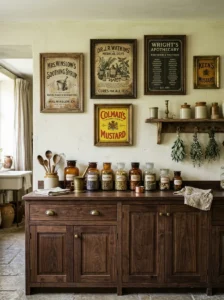
Small, vintage-style advertising signs or reproduction apothecary product labels, framed and displayed on a wall or propped on an open shelf, add a layer of genuine visual storytelling to this aesthetic that’s easy to source affordably compared to some of the larger furniture-focused ideas on this list. I found a couple of genuine antique tin advertising signs at a flea market years ago, and they’ve remained some of my favorite smaller decorative details throughout our kitchen’s overall styling.
I’d recommend seeking out signs and labels with a genuine connection to food, herbs, or general goods, rather than entirely unrelated vintage advertising, since staying thematically consistent with the kitchen’s actual function reinforces the aesthetic’s authenticity rather than feeling like a random assortment of old objects gathered without any real connecting thread.
For those unable to source genuine antique pieces, reproduction prints of historical apothecary labels or vintage advertisements, properly framed, achieve a similar visual effect at a considerably lower cost and with less concern about an original piece’s condition or preservation over time. I’d suggest limiting this kind of signage to just a few well-chosen pieces rather than covering an entire wall, since restraint here, as with several other ideas throughout this list, tends to read as more genuinely considered and authentic than an overly dense, cluttered display.
15. Muted, Earthy Wall Colors
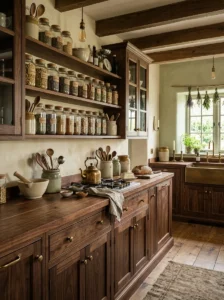
Wall colors in muted, earthy tones, warm cream, soft sage, dusty terracotta, provide a fitting backdrop for this aesthetic’s dark wood, brass, and glass details, without competing for visual attention against these more textural and material-focused elements. We painted our own kitchen walls a soft, warm cream several years ago, deliberately choosing a muted, slightly aged-looking tone over anything brighter or more stark, and it’s provided a genuinely versatile, unobtrusive backdrop for the room’s other details ever since.
I’d recommend avoiding very bright whites or cool-toned neutrals specifically for this aesthetic, since these tend to feel more clinical and modern, working against the warm, aged character that apothecary styling generally depends on throughout its other elements. A slightly warmer, more muted paint choice, even within a broadly neutral palette, makes a genuine difference in how cohesive the overall room feels once your wood cabinetry, brass hardware, and glass storage are all in place.
For those wanting a bit more drama, a deeper, richer wall color, a dusty forest green or deep terracotta, can work beautifully too, particularly on a single accent wall or in a smaller kitchen where a fully saturated color throughout wouldn’t feel overwhelming. I’d suggest testing any color choice directly in your kitchen’s actual lighting before committing to a full repaint, since both warm and cool artificial lighting can shift how a specific paint color reads considerably compared to how it appeared as a small sample or on a screen.
16. A Vintage Ladder for Reaching High Shelves
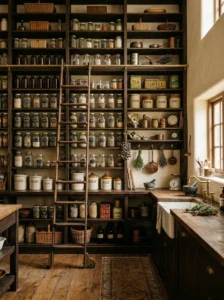
For kitchens with genuinely tall shelving, a simple wood library-style ladder, mounted on a rail or simply leaned against a shelving unit, brings both practical function and old-world charm, echoing the kind of ladder you might find in a genuinely old general store or pharmacy stocked floor to ceiling with goods. I added a rolling wood ladder to our kitchen’s tallest shelving section, and beyond the practical necessity of actually reaching our highest shelves, it’s become a detail several guests have specifically commented on and admired.
I’d recommend a proper rolling track system for genuinely frequent use, since this provides more reliable, secure access than simply leaning a ladder against the shelving each time, particularly important given the genuine safety considerations involved in regularly climbing on any ladder within a busy, frequently used kitchen space.
For kitchens without shelving quite tall enough to justify a full rolling ladder system, a simple, sturdy step stool with an old-world wood finish achieves a similar aesthetic nod at a considerably smaller scale and investment, still fitting the overall theme without the cost and installation complexity of a full ladder and rail system.
17. Hand-Thrown Ceramic Crocks and Containers
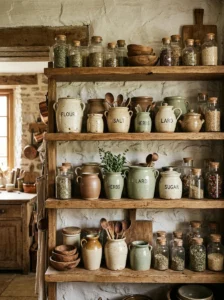
Hand-thrown ceramic crocks, with their naturally slightly irregular shapes and visible glaze variations, bring a genuinely artisanal, old-world quality to kitchen storage that mass-produced, perfectly uniform containers simply don’t achieve in the same way. I’ve slowly built a small collection of these from local pottery makers over the past several years, using them for everything from utensil storage to holding kitchen towels, and their individual, slightly imperfect character has become one of my favorite details throughout the whole kitchen.
I’d recommend seeking out local potters or small-scale ceramic makers specifically for these pieces, both to support genuinely handmade craftsmanship and because locally made pieces often carry a stronger, more authentic connection to actual old-world pottery traditions than mass-produced ceramics attempting to mimic that same handmade look.
A muted, earthy glaze, cream, soft brown, deep sage, tends to suit this aesthetic considerably better than a bright, glossy, uniformly colored glaze, which can read as more modern and mass-produced regardless of the piece’s actual handmade origin. I’d suggest mixing a few different crock sizes and slightly varying glaze tones throughout your collection, rather than seeking out an exactly matching set, reinforcing the same gathered-over-time character that runs throughout several other ideas on this list.
18. A Genuine, Well-Used Quality to Every Detail
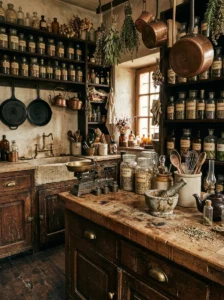
Beyond any single specific item or fixture, what ultimately makes an apothecary kitchen feel authentic rather than like a themed costume version of the style is a consistent commitment to genuine use and gradual accumulation over time, rather than assembling every element at once from a single shopping trip. I’ve come to think of our own kitchen’s aesthetic as something that’s still slowly evolving, years after the initial renovation, rather than a finished, static look completed on a single specific date.
I’d recommend resisting the temptation to purchase every element on this list simultaneously in pursuit of an instantly complete apothecary kitchen, since the aesthetic’s core appeal genuinely depends on a sense of accumulated history and personal, considered choices made gradually, something that’s difficult to fully replicate through a single, rushed shopping trip regardless of how carefully each individual item might be chosen.
Instead, I’d suggest starting with one or two foundational elements, perhaps the wood cabinetry tone and a small collection of glass jars, and allowing the rest of the aesthetic to develop naturally over subsequent months and years, as you genuinely come across pieces at antique shops, local makers, and secondhand sources that authentically speak to the overall direction you’re building toward, rather than simply checking items off a predetermined list all at once.
Final Thoughts
Every apothecary-inspired kitchen I’ve genuinely enjoyed living in or helping design shared this same underlying quality, a sense that the space had actually been used and gradually built up over real time, rather than staged for a single photograph and then left untouched. The dark wood, aged brass, and glass jars matter, certainly, but what truly makes the aesthetic feel authentic is choosing pieces you’ll genuinely use and allowing them to age and accumulate naturally, rather than trying to manufacture instant history all at once.
If you’re drawn to this style for your own kitchen, I’d suggest starting small, a handful of labeled jars, a piece of aged brass hardware, and building outward gradually from there, letting your own kitchen’s specific version of this old-world charm develop authentically over the months and years ahead, rather than all at once.