When my sister and her husband finished building their addition a few years back, the family room was the space they’d spent the most time planning, more than the kitchen, more than the primary bedroom, because it was going to be the room where their kids actually grew up. I got pulled into that planning process fairly deeply, spending several weekends helping measure, test furniture arrangements, and talk through what “family room” actually meant beyond just a slightly bigger, more casual living room.
That project taught me that a genuinely successful family room requires different thinking than a formal living room or an adult-focused entertaining space. It needs to accommodate a wider range of ages and activities simultaneously, a toddler playing on the floor, a teenager doing homework, adults trying to have an actual conversation, sometimes all within the same hour. Getting that balance right took real trial and error, and I’ve since applied those lessons to a couple of other family room projects for friends, each with their own specific family dynamics and space constraints.
Here are 17 family room ideas, based on real projects and real families actually living in these spaces daily, all designed around genuine comfort and togetherness rather than just how a room photographs.
1. Choose a Sofa Built for Durability and Comfort
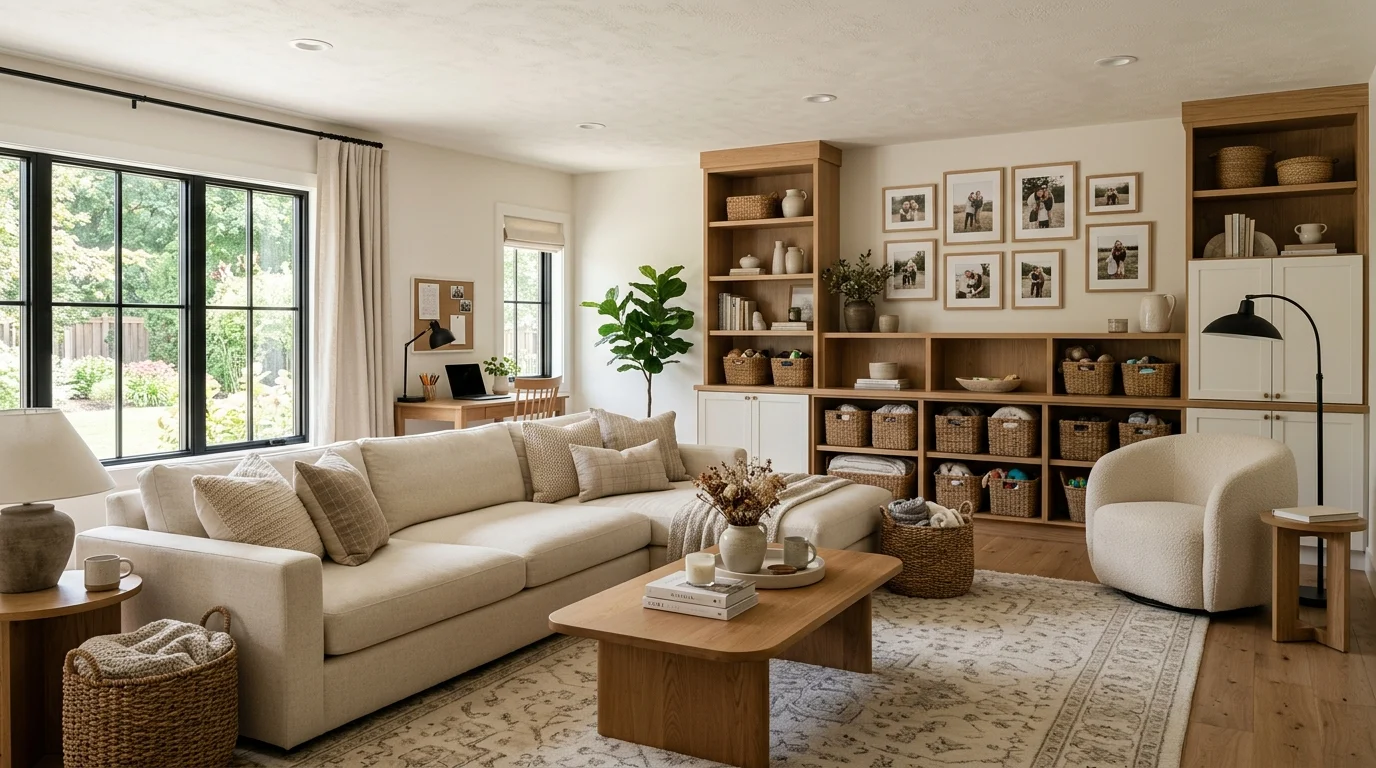
The single most important furniture decision in my sister’s family room was her sofa choice, and she specifically prioritized a performance fabric, stain-resistant and easy to clean, over a more delicate material she’d initially been drawn to, recognizing early on that a family room sofa needs to survive spilled juice, muddy shoes, and general rough daily use in a way a purely formal living room piece wouldn’t need to withstand.
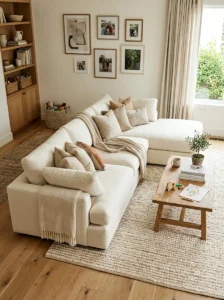
She chose a deep, generously cushioned sectional rather than a more structured, formal sofa silhouette, prioritizing genuine lounging comfort for the whole family to pile onto together during movie nights or lazy weekend mornings, over a more visually sleek but less comfortable alternative. This decision, comfort and durability over pure aesthetics, ended up shaping several other choices throughout the room, establishing a practical, family-first priority that carried through the rest of the space’s design.
I’d recommend, for anyone furnishing a genuine family room specifically, testing sofa fabric samples against your actual anticipated use, spilling a small amount of juice or coffee on a fabric swatch to see how it cleans up, rather than choosing purely based on how a fabric looks or feels in a showroom, since this practical durability testing genuinely matters more in a family room than in almost any other room in a typical home.
2. Add a Large, Durable Area Rug
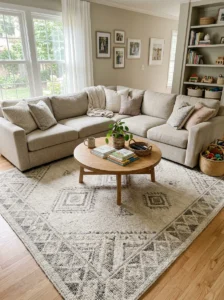
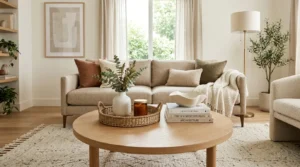
Beyond the sofa, my sister chose a large, low-pile wool rug for her family room floor, specifically selecting a material and weave durable enough to handle heavy daily foot traffic, toy play, and occasional spills, while still providing genuine comfort for kids playing directly on the floor, which happens constantly in an actively used family room.
She chose a subtle pattern rather than a solid color specifically to help hide the inevitable minor stains and wear that heavy daily family use would bring, a practical consideration that a purely aesthetic-focused living room rug choice might not have prioritized as heavily. This pattern-for-practicality approach is something I’ve since recommended to other friends furnishing similarly high-use family spaces, since a solid, light-colored rug in a heavily used family room shows every mark almost immediately, while a subtle pattern provides genuine visual forgiveness for the realistic wear a family room floor covering will inevitably experience.
Sizing mattered considerably too, she chose a rug large enough to extend well beneath her sectional’s front legs and provide ample open floor space for kids’ floor play beyond just the seating area itself, recognizing that floor space itself is a genuine functional need in a family room in a way it might not be prioritized as heavily in a more purely adult-focused living space.
3. Create Distinct Zones for Different Activities
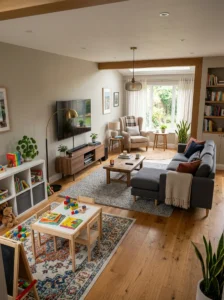
Rather than one undifferentiated open space, my sister’s family room includes a few loosely defined zones, the main sectional and TV area for group viewing, a smaller reading nook with a single comfortable chair, and an open floor area near a low storage bench specifically left clear for kids’ floor play and building projects.
This zoning approach, similar in principle to open-concept living space planning I’ve worked on elsewhere, helps a family room accommodate several different simultaneous activities without everyone needing to compete for the exact same space and furniture. A parent can read in the designated nook while kids build with blocks on the open floor area nearby, all within the same room but each activity having its own reasonably defined space.
I’d recommend, for anyone planning a family room specifically, thinking through your family’s actual typical activities, homework, floor play, movie watching, casual crafting, before finalizing furniture placement, and deliberately designating rough zones for each anticipated activity rather than simply filling the room with furniture without this more intentional functional planning guiding the overall layout.
4. Include Ample, Accessible Storage for Toys and Games
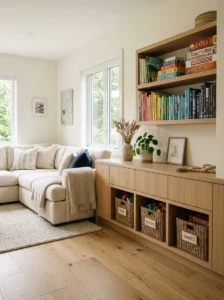
A genuinely practical addition that’s made an enormous daily difference in my sister’s family room is a low, open storage bench specifically designed for toy storage, positioned within easy reach for her younger kids to access and, ideally, put away toys themselves without needing an adult’s help every time.
She specifically chose storage with a mix of open bins for frequently used toys and a couple of closed compartments for items that needed to stay more protected or less immediately accessible, balancing genuine everyday accessibility with some organizational structure that helps keep the room from feeling completely overwhelmed by visible toy clutter at all times.
This kind of accessible, child-height storage genuinely matters for actual daily family room function, kids are considerably more likely to participate in tidying up when the storage system is designed at their own scale and skill level, rather than requiring adult assistance for every single cleanup, which becomes a genuine daily practical consideration in a room actually used by young children rather than just decorated for their occasional presence.
5. Choose a Large, Sturdy Coffee Table
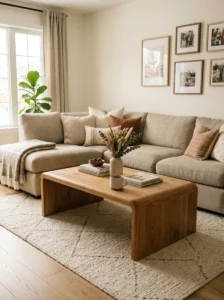
Rather than a delicate glass coffee table, which felt like an obvious hazard given her young kids’ typical activity level, my sister chose a large, sturdy wood coffee table with rounded corners, providing a genuinely functional surface for game nights, homework, and casual snacking, while minimizing injury risk from the sharp edges a more angular table design might present.
She also specifically avoided a table with a lower shelf easily accessible to younger kids for climbing, recognizing this as a genuine safety consideration beyond just the tabletop surface itself. This kind of safety-forward furniture selection, rounded edges, sturdy construction, thoughtful consideration of how kids might actually interact with a piece beyond its intended use, matters considerably more in a genuine family room than it might in a more adult-focused living space.
I’d recommend, for anyone furnishing a family room with young children specifically, prioritizing this kind of safety-conscious furniture selection early in the planning process, rather than choosing purely based on aesthetic preference and only considering safety concerns after an actual incident highlights an oversight in the original furniture choices.
6. Add Comfortable Floor Seating for Kids
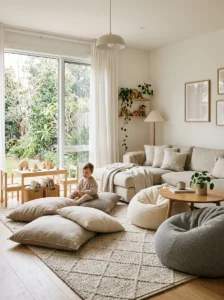
Beyond the main sofa seating, my sister added a couple of oversized floor cushions and a small kid-sized bean bag chair, providing additional, genuinely comfortable seating options specifically scaled and positioned for her children’s own independent use, rather than expecting them to always share or compete for space on the main adult-scaled sofa.
This kind of dedicated, kid-appropriate seating gives children genuine ownership over a portion of the shared family space, rather than the room feeling entirely designed around adult furniture and adult-scaled comfort with children simply accommodated as an afterthought. Her kids specifically gravitate toward these floor seating options during family movie nights, often preferring them over the main sofa despite having that option readily available too.
I’d recommend this kind of dedicated, appropriately scaled seating specifically for families with younger children, since it genuinely increases how invested and comfortable kids feel within the shared family space, rather than assuming children will simply adapt happily to purely adult-scaled furniture throughout the entire room without any consideration for their own specific comfort and scale needs.
7. Incorporate Warm, Layered Lighting
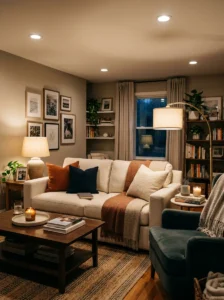
Similar to lighting lessons I’ve applied throughout several other room projects, my sister’s family room includes multiple light sources, a floor lamp beside her reading chair, a table lamp on a side table, and dimmable overhead lighting, rather than relying on a single bright overhead fixture for all the room’s varied lighting needs throughout different times of day and different activities.
This layered approach allows the room’s lighting to shift appropriately between bright, functional illumination for daytime activity and homework, and a dimmer, warmer setting for evening movie nights or simply winding down together as a family before bedtime. The flexibility this provides genuinely matters in a room used across such a wide range of different times and activities throughout each day.
I’d recommend, for anyone planning a family room’s lighting specifically, prioritizing this kind of layered, adjustable approach over a single fixed lighting solution, since a genuine family room’s lighting needs shift more dramatically throughout a typical day than almost any other room in a home, given the wide range of ages and activities the space needs to comfortably accommodate.
8. Choose Washable, Stain-Resistant Fabrics Throughout
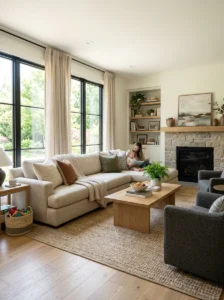
Beyond just the main sofa, my sister extended her stain-resistant, easily cleanable fabric priority to her throw pillows, any additional seating, and even her window treatments, recognizing that spills and marks in an actively used family room aren’t isolated to just the primary seating piece but can happen genuinely anywhere throughout the space.
She specifically sought out performance fabrics, originally developed for outdoor furniture use but increasingly available for indoor pieces as well, which resist staining and clean easily with just soap and water in most cases, rather than requiring professional cleaning or careful, cautious use that would feel impractical for a room meant to be genuinely, comfortably lived in by young children.
I’d recommend, for anyone furnishing a family room specifically, researching these performance fabric options for any textile element likely to see heavy daily contact, throw pillows, upholstered furniture, even certain window treatment fabrics, rather than assuming this practical consideration only applies to the room’s largest, most obvious furniture pieces like the main sofa itself.
9. Add a Designated Homework or Study Corner
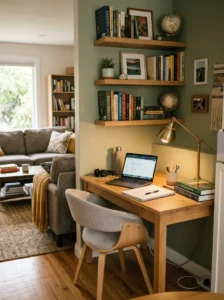
For her older child specifically, my sister carved out a small desk area within the family room, rather than isolating homework entirely to a separate bedroom, recognizing that many kids genuinely prefer doing homework within earshot of family activity rather than in complete isolation, while still needing a dedicated, functional workspace distinct from the room’s more casual lounging areas.
She positioned this small desk in a corner somewhat removed from the main TV sightline, reducing direct visual distraction while still keeping her daughter within the same general shared family space rather than sending her to a separate room entirely for this specific activity. This kind of thoughtful positioning, functionally separate but not physically isolated, reflects a broader principle I’ve noticed works well in genuine family rooms, accommodating individual needs within the shared space rather than assuming every different activity requires its own entirely separate room.
I’d recommend this kind of dedicated but integrated workspace specifically for families with school-age children, since it provides genuine functional value for daily homework routines while still supporting the family room’s broader togetherness goal, rather than requiring kids to retreat to an isolated bedroom every time they need to focus on schoolwork.
10. Choose a TV Size and Placement That Works for Everyone
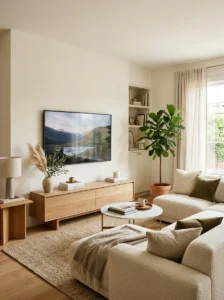
Rather than defaulting to the largest television her budget allowed, my sister specifically measured her family room’s actual seating distances and researched appropriate screen sizing guidelines before choosing her TV, recognizing that an oversized screen relative to her room’s actual seating distance would create an uncomfortable viewing experience for the whole family during shared movie nights.
She also prioritized mounting the TV at a height comfortable for viewing from both the main sofa and the lower floor seating areas her younger kids often use, rather than positioning it purely based on adult standing eye-level, which wouldn’t account for the room’s actual range of different seating heights and positions used by family members of varying ages throughout typical family viewing time.
I’d recommend, for anyone planning family room TV placement specifically, considering your room’s full range of actual seating options, not just the main sofa, when determining appropriate height and size, since a family room genuinely needs to accommodate comfortable viewing from multiple different seating positions and heights simultaneously, unlike a more single-purpose adult media room designed around one primary, consistent seating arrangement.
11. Include a Cozy Blanket and Pillow Storage Solution
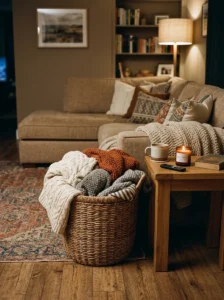
Similar to the blanket basket concept I’ve used in other living room projects, my sister added a large, sturdy basket specifically for extra throw blankets and pillows, kept within easy reach of her main sofa, encouraging genuine daily use of these cozy elements for family movie nights and lazy weekend mornings rather than these items sitting unused in a closet elsewhere in the house.
She chose a basket with a wide opening and no lid, making it genuinely easy for even her younger children to access and put away blankets independently, rather than a more decoratively closed storage solution that might look nicer but create more friction for actual daily family use and cleanup participation from her kids.
This kind of practical, easily accessible comfort storage matters more in a genuine family room than a more style-focused decorative basket might in a purely adult living space, since the whole point of a family room is genuine, comfortable daily use by family members of all ages, which means prioritizing accessibility and ease of use over purely aesthetic storage solutions throughout the room.
12. Add Personal Family Photos and Artwork
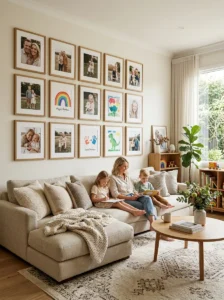
Beyond more generic decorative art, my sister filled a significant portion of her family room’s wall space with actual family photos and her kids’ own artwork, rather than purely purchased, impersonal decorative pieces, creating a genuine sense of the room belonging specifically to her family rather than looking like a generic, could-belong-to-anyone showroom space.
She rotated her children’s artwork regularly, using simple, inexpensive frames that made swapping in new pieces easy as her kids created new work, rather than committing to permanently framing and displaying only a fixed, unchanging selection. This ongoing rotation kept the display feeling current and genuinely reflective of her children’s actual ongoing interests and abilities, rather than becoming a static, eventually outdated snapshot from one particular point in time.
I’d recommend this kind of genuine personalization specifically for family rooms, more so than in a formal living room primarily used for hosting guests, since a family room’s core purpose is really about the family’s own daily life and connection, which personal photos and children’s own creative work reinforce in a way that purely purchased decorative art, however beautiful, simply can’t replicate to the same degree.
13. Choose Furniture Arrangement That Encourages Conversation
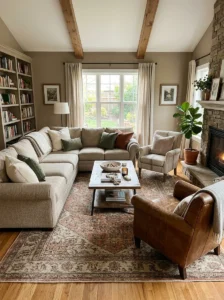
Rather than arranging all seating to face the television as the room’s singular focal point, my sister positioned her sectional at an angle that allows for comfortable conversation among family members while still providing a good TV viewing angle, avoiding the common trap of a family room where all furniture points rigidly toward a screen with no consideration for actual face-to-face interaction and conversation.
She added a couple of additional chairs positioned to complete a more conversational circle with the main sectional, providing seating options that face family members directly rather than only facing the television, which supports the room’s broader togetherness goal beyond just shared screen-watching time specifically.
I’d recommend, for anyone planning family room furniture arrangement, consciously considering both television viewing and genuine conversation as equally important functional priorities, rather than defaulting to a purely screen-centric furniture arrangement that, while fine for movie nights specifically, doesn’t support the broader range of family interaction and connection a genuinely well-designed family room should accommodate throughout its daily use.
14. Add a Game Storage and Display Solution
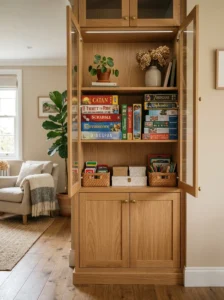
For family game nights specifically, my sister incorporated a dedicated cabinet for board games and puzzles, positioned within her family room specifically rather than stored elsewhere in the house, making these activities more spontaneously accessible and, by extension, more likely to actually happen regularly rather than requiring extra effort to retrieve games from storage elsewhere.
She organized this storage thoughtfully, keeping current family favorites easily accessible while rotating less frequently played games to a higher, less immediately visible shelf, similar to seasonal rotation principles I’ve applied in other storage contexts throughout different room projects. This organization keeps the readily accessible selection feeling fresh and relevant to her family’s actual current interests rather than an overwhelming, undifferentiated pile of every game the family has ever owned.
I’d recommend this kind of dedicated, accessible game storage specifically for families who value or want to encourage more regular game night activities, since genuine accessibility significantly increases how often these kinds of intentional, shared family activities actually happen in practice, compared to requiring extra effort to locate and retrieve games stored less conveniently elsewhere in the home.
15. Include a Pet-Friendly Element if Applicable
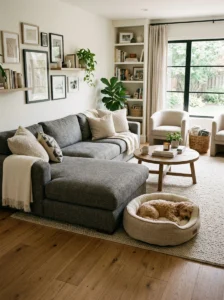
For families with pets, my sister’s family room specifically includes a designated dog bed positioned in a corner near the main sofa, along with furniture fabric choices durable enough to handle her dog’s presence on the furniture, acknowledging that pets are often genuinely part of the family’s daily togetherness in this specific shared space, not an afterthought to be managed separately elsewhere in the home.
This kind of intentional pet accommodation, rather than simply hoping pets stay off furniture or out of the main family space entirely, reflects a more realistic, honest approach to how many families actually use their family rooms day to day, with pets genuinely included as part of the household’s shared living and relaxing time together.
I’d recommend, for any family with pets planning a family room specifically, considering this kind of intentional accommodation early in the planning process, choosing furniture fabrics and floor coverings that can genuinely handle pet presence and shedding, rather than selecting materials that would require constantly excluding pets from a space where they’d otherwise naturally want to spend time alongside the rest of the family.
16. Balance Screen-Focused and Screen-Free Activity Zones
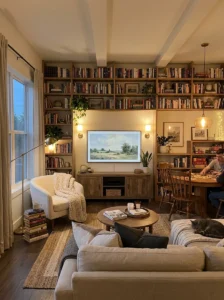
Beyond the TV and main seating area, my sister specifically included some screen-free elements within her family room, the reading nook, the game storage, a small activity table, ensuring the room supports genuine togetherness beyond just shared screen time, which, however valuable, isn’t the only kind of family connection worth designing a shared space around.
This balance reflects a broader intention she had throughout the whole planning process, creating a room that genuinely encourages varied kinds of family interaction, reading together, playing games, having conversations, in addition to shared television and movie viewing, rather than a room that, however comfortable, only really supports one specific type of shared family activity.
I’d recommend, for anyone planning a family room specifically, consciously considering this kind of activity variety during the planning process, rather than defaulting to a room designed almost entirely around television viewing simply because that tends to be the most commonly assumed primary function for this type of shared family space, when in practice, the most genuinely used and loved family rooms tend to support a considerably wider range of shared activities and interaction styles.
17. Plan for the Room to Evolve With Your Family
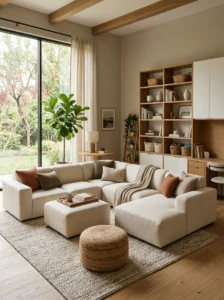
The final and perhaps most important lesson from helping with my sister’s family room, and from working on similar projects since, is that a genuinely successful family room needs to accommodate change over time, as young children grow into teenagers with different needs, interests, and space requirements than they had as toddlers.
My sister specifically chose furniture and storage solutions with some inherent flexibility, the modular sectional can be rearranged as her family’s specific seating needs change, the toy storage bench could eventually be repurposed for different storage needs as her kids outgrow the need for easily accessible toy bins, rather than committing entirely to a fixed setup designed exclusively around her children’s current, specific developmental stage.
I’d recommend, for anyone planning a family room specifically, considering this kind of longer-term flexibility during the initial planning process, since a family room genuinely well-designed for a family with young children will likely need some adjustment and evolution as those children grow older, and building in some inherent adaptability from the start makes that ongoing evolution considerably smoother than a completely fixed, single-purpose setup would allow for over the coming years of continued family use and growth.
Frequently Asked Questions
What’s the biggest difference between a family room and a living room? A family room typically prioritizes durability, comfort, and multi-generational functionality for daily use, while a living room often leans more formal and is sometimes reserved primarily for entertaining guests rather than everyday family activity.
How do I choose furniture that survives kids and pets? Prioritize performance fabrics designed to resist staining, choose furniture with rounded edges and sturdy construction, and select durable, low-pile rugs with patterns that help hide inevitable everyday wear and marks.
Can a family room still look stylish while being kid-friendly? Yes. Choosing a cohesive color palette, coordinating your practical, durable material choices thoughtfully, and personalizing the space with family photos and children’s artwork can create a room that’s both genuinely functional and visually appealing.
How much storage does a family room actually need? More than most people initially plan for. Dedicated, easily accessible storage for toys, games, and blankets genuinely reduces daily clutter and makes tidying up considerably easier for family members of all ages to participate in regularly.
Final Thoughts
Helping my sister plan her family room taught me that this particular space requires a genuinely different design approach than almost any other room in a home, balancing durability, multi-generational comfort, and enough flexibility to grow alongside an evolving family over the years ahead. The core lesson across all seventeen of these ideas is prioritizing genuine daily function and comfort for every family member, from toddlers to adults, over purely aesthetic considerations that might work well in a more single-purpose, adult-focused living space. Done well, a family room becomes the genuine heart of a home, not because it looks perfect, but because it actually gets used, together, every single day.