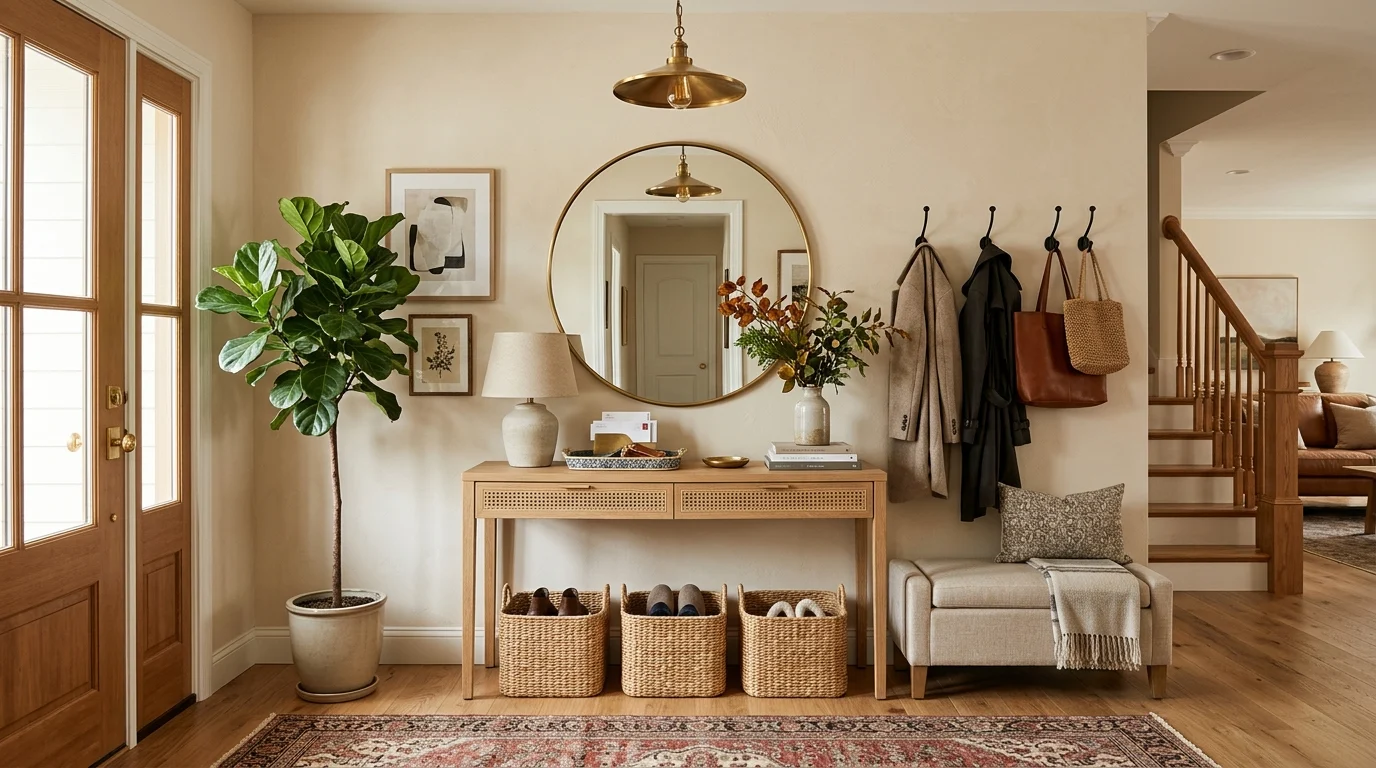
I still remember the first time a friend walked into my house and said, “Wait, your entryway looks like something out of a magazine.” I laughed, because just six months earlier that same little corner by my front door was a dumping ground — shoes everywhere, mail piling up on the floor, and a single bare bulb that made the whole space feel like an afterthought. It took some trial and error (and a few purchases I regret), but I finally figured out what actually makes an entryway feel intentional instead of accidental.
Your entryway is the first thing guests see and the last thing you see before you leave the house. It sets the tone for your entire home, yet it’s often the most neglected room. Below are 24 ideas I’ve either tried myself, seen work beautifully in friends’ homes, or picked up from design pros along the way. Pick a few that fit your space and budget — you don’t need to do all 24 at once.
1. Add a Statement Console Table
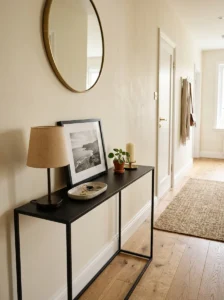
A console table is the anchor piece of almost every great entryway, and it’s usually the first thing I recommend to anyone starting from scratch. When I moved into my current place, I spent weeks without one, just dropping my bag and keys on the floor, and the difference once I finally got a table was night and day. Look for something narrow enough not to block the walkway — 12 to 16 inches deep is usually the sweet spot for a hallway entry.
Don’t feel like it has to be brand new or matchy-matchy with the rest of your home. Some of the best consoles I’ve seen were flea market finds with a little character — a scratch here, a slightly mismatched drawer pull there. That imperfection actually makes the space feel more lived-in and less like a showroom. I ended up refinishing an old table my aunt was getting rid of, sanding it down and giving it two coats of a soft matte black paint. It cost me about $15 in supplies and looks better than anything I could have bought.
Style it with a lamp, a small tray for keys, and one or two personal objects — a candle, a small plant, a framed photo. Resist the urge to fill every inch of surface space; an entryway table that’s too busy defeats the purpose of having a clean landing spot.
2. Layer a Vintage-Style Rug
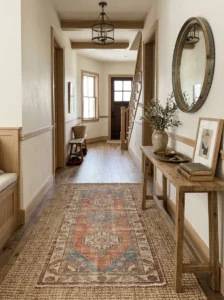
A worn-in, vintage-look rug does something a brand-new rug simply can’t — it makes a space feel like it’s always been there. I was skeptical about this at first because “vintage” rugs can look faded or dirty in photos, but in person the muted colors and subtle patterns are exactly what keep a busy entryway from feeling chaotic.
I bought mine secondhand from a local shop for a fraction of what a new designer version would cost, and honestly, the slight wear on the edges just adds to the character. If you’re worried about durability with muddy shoes and rainy days, go for a flat-weave or a rug specifically labeled for high-traffic areas rather than a plush pile that’ll show every footprint.
Layering works especially well here too — a smaller vintage rug on top of a jute or sisal base rug adds texture without overwhelming a narrow hallway. Just make sure whatever you choose has a non-slip pad underneath, especially if you’re placing it on hardwood or tile. I learned that lesson the hard way after nearly slipping on a rug that kept sliding every time the front door opened.
Color-wise, rugs with warm reds, blues, or terracotta tones tend to hide dirt better than anything too light, which matters a lot in a spot that takes the most foot traffic in your whole house.
3. Install a Bold Pendant or Chandelier
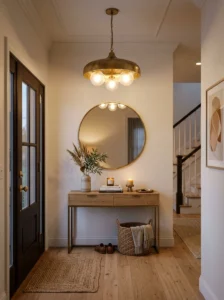
Overhead lighting in an entryway is so often an afterthought — a plain flush-mount fixture that came with the house and nobody ever thought to change. Swapping mine out for a small brass pendant was one of the cheapest updates I made (under $80) and it had the biggest visual impact of anything on this list.
You don’t need a giant chandelier if your entryway is compact. A single statement pendant, hung at roughly 7 feet from the floor, gives you drama without eating up headroom. If your entryway has higher ceilings, this is the place to go a little bigger and bolder than you might elsewhere in the house — nobody spends more than a few seconds standing directly under it, so you can take more risks with scale and shape.
I went with a woven rattan pendant because it added texture and warmth, but I’ve seen friends do everything from a sculptural glass fixture to a simple exposed-bulb design and each one completely transformed their space. If you’re renting and can’t do any hardwiring, plug-in pendants have come a long way — you can run the cord along the ceiling to an outlet and nobody notices unless they’re really looking.
Whatever you pick, make sure it’s on a dimmer if possible. Entryways benefit from softer light in the evening and brighter light for finding your keys in the morning rush.
4. Create a Drop Zone with Hooks and Baskets
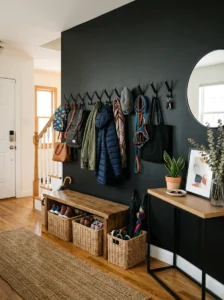
This is the idea that actually changed my daily life, not just the way my entryway looks. For years, coats ended up on the couch, bags ended up on the kitchen table, and dog leashes ended up… honestly, I still don’t know where half of them went. A simple row of hooks mounted at different heights solved almost all of it.
I installed a mix of hooks — a few lower ones for kids’ backpacks or dog leashes, and a higher row for coats and bags — and paired them with two woven baskets on the floor underneath for shoes and umbrellas. It sounds so basic, but having a designated “drop zone” means everyone in the house actually uses it instead of tossing things wherever’s convenient.
If you’re short on wall space, an over-the-door hook rack works surprisingly well and requires zero drilling, which is great for renters. Label each hook if you’ve got a family sharing the space — it sounds a little much, but it genuinely cuts down on the “whose jacket is this” chaos.
The trick to making this look intentional rather than cluttered is choosing hooks and baskets in a consistent material or finish. I went with matte black hooks and natural rattan baskets, and even with coats hanging and shoes tucked in, it still reads as styled rather than messy.
5. Hang a Large Mirror to Open the Space
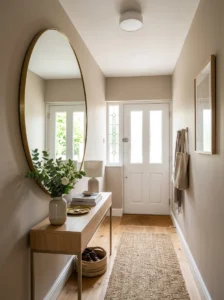
Most entryways are tight on square footage, and a large mirror is the single fastest way to make one feel bigger than it is. I hung an oversized round mirror directly across from my front door, and it bounces light from the sidelight windows all the way down the hall — the whole entry feels noticeably brighter, even on overcast days.
Beyond the visual trick, there’s a practical reason to love this one too: it’s the last check before you walk out the door. I can’t count how many mornings I’ve caught a stray piece of lint or realized my shirt was inside out thanks to that mirror.
Shape matters more than people expect. Round or arched mirrors soften a space that’s full of straight lines (doors, furniture edges, floorboards), while a rectangular mirror can help make a narrow hallway feel taller if hung vertically. I’d steer away from tiny decorative mirrors here — go bigger than feels comfortable. A mirror that’s at least 30 inches wide will do far more visual work than a small one, even in a compact entry.
If you’re nervous about hanging something heavy, look for lightweight versions with a metal or rattan frame rather than solid wood or thick glass — they give the same impact without needing reinforced anchors in the wall.
6. Paint the Door (or Wall) in a Bold Color
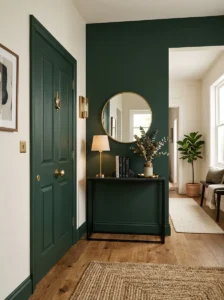
Nothing signals “someone lives here who cares about their space” quite like a bold-colored front door or accent wall. I went back and forth for months trying to decide, terrified of committing to a color I’d regret, before finally landing on a deep forest green for my interior front door. It’s still my favorite decision in the whole house.
If painting the actual door feels too permanent, try it on just the interior-facing wall of the entryway instead. This gives you a similar dramatic effect without touching the door itself, and it’s an easy repaint if you change your mind down the road. Deep jewel tones — emerald, navy, oxblood — tend to photograph beautifully and hide scuffs better than bright whites ever will in a high-traffic zone.
One thing I wish someone had told me earlier: use a paint finish with some sheen (satin or semi-gloss) rather than flat matte in an entryway. It’s the most touched, bumped, and scuffed wall in your house, and a little shine makes cleaning fingerprints and scuff marks so much easier.
Don’t feel pressured to match this color to the rest of your home’s palette perfectly. Entryways function almost like a “reset” space — a little contrast here from room to room actually reads as intentional rather than mismatched, especially since you only see this wall for a few seconds at a time.
7. Add a Bench for Function and Style
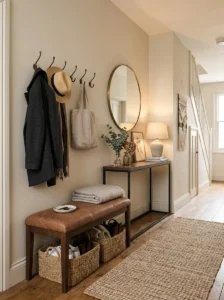
A bench sounds like a small addition, but it might be the single most-used piece of furniture I own. Between putting shoes on, taking them off, or just setting down groceries for a second while I find my keys, that bench earns its keep daily in a way my dining chairs never do.
I went with a narrow upholstered bench with a slightly worn leather look, mostly because I have two kids who track in mud constantly and I didn’t want to worry about staining a fabric one. If you’ve got the space, a bench with built-in storage underneath (cubbies or a lift-top seat) does double duty for shoes or seasonal accessories like scarves and gloves.
For narrower entries, a simple wooden bench without arms takes up minimal visual and physical space while still giving you somewhere to sit. I’ve also seen people repurpose an old piano bench or a vintage church pew for extra character — both add a story to the space that a store-bought piece can’t quite replicate.
Position it against the longest open wall if you can, ideally near the hooks and shoe storage so the whole “arrival routine” happens in one spot instead of scattered across the entryway. That little bit of ergonomic planning makes mornings noticeably smoother.
8. Use Wallpaper to Make a Statement
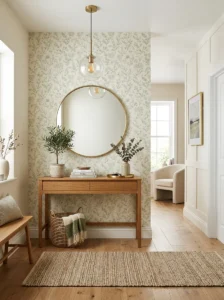
Entryways are one of the best rooms in the house to experiment with bold wallpaper, mostly because you’re not staring at it for hours the way you would in a bedroom or living room. I put a botanical print wallpaper on just the entryway’s back wall, and it’s become the backdrop for basically every photo taken near my front door since.
Peel-and-stick versions have gotten remarkably good in the last few years, which is exactly what I used since I wasn’t ready to commit to traditional paste-and-hang wallpaper. It took me about two hours on a Saturday afternoon, no professional help needed, and it’s held up through almost two years of daily door slams and humidity changes.
If you’re nervous about pattern, start with something subtle like a grasscloth texture or a tonal geometric print rather than jumping straight to a large floral. Smaller, tighter patterns also tend to read better in narrow entryways since they don’t visually shrink the space the way a large, busy print can.
One tip I picked up from a designer friend: wallpaper just the area between the door and the ceiling as a “cap,” leaving the lower half painted, if you want the drama without covering an entire wall. It’s a nice middle ground for anyone testing the waters before going all in.
9. Incorporate Fresh Greenery or a Faux Plant
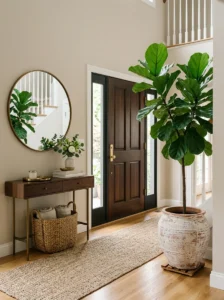
A plant by the front door does something psychological that’s hard to explain until you experience it — it makes the whole entrance feel alive and welcoming the second you walk in. I keep a tall fiddle leaf fig in the corner of mine, and even on days when the rest of the house is a mess, that one green thing makes the entry feel put-together.
If you don’t have a green thumb (I definitely don’t, most days), a high-quality faux plant does the job almost as well now that materials have improved so much. I have a mix of both — real plants that tolerate low light like a snake plant or pothos, and a couple of faux stems mixed into vases for height and fullness without the maintenance.
Scale is worth thinking about here. A tiny plant on a console table can look like an afterthought, while one substantial floor plant in the corner makes a real style statement. I’d rather see one large plant done well than five small ones scattered around competing for attention.
Consider the entryway’s light levels honestly before choosing. Most entries get limited natural light, especially if there’s no window near the door, so skip anything that needs direct sun and go for shade-tolerant varieties instead, or lean on faux greenery where real light just isn’t available.
10. Add Layered Lighting with Wall Sconces
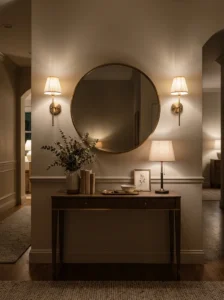
One overhead fixture rarely gives an entryway enough dimension, which is something I didn’t understand until I added a pair of wall sconces flanking my mirror. Suddenly the space had actual depth instead of just one flat pool of light in the middle of the room.
Sconces at roughly eye level (about 60 to 66 inches from the floor) cast a warm glow that’s flattering and functional at the same time — genuinely useful for checking your appearance in the mirror before you leave, and softer than an overhead bulb for evening arrivals. I chose brass sconces with fabric shades to soften the light even further, since bare bulbs tend to feel a little harsh in a small space.
If running new wiring isn’t in the budget, plug-in sconces have become a solid workaround. You lose a bit of the polished, hardwired look, but you gain flexibility, and most modern designs hide the cord well enough that it isn’t distracting.
Layering light sources — overhead, wall-mounted, and even a small lamp on your console table — means you can adjust the mood depending on the time of day. Mornings call for brighter, more functional light, while evenings feel nicer with just the sconces and a lamp glowing softly, especially if you’re coming home after dark.
11. Display a Gallery Wall of Personal Photos
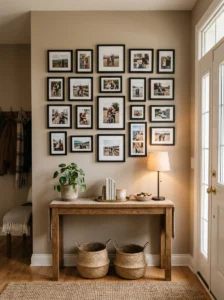
Nothing makes an entryway feel like “your” home rather than a showroom quite like personal photos. I put together a gallery wall of travel photos and family snapshots in mismatched frames, and it’s genuinely become my favorite thing to look at every time I walk through the door.
The key to making a gallery wall look designed instead of thrown together is picking one unifying element — either all black frames, all the same photo size, or a consistent color palette in the images themselves. I went with all black-and-white photos in a mix of frame sizes, which kept the collection feeling cohesive despite the different frame shapes.
Lay everything out on the floor first before you commit to a single nail hole. I taped paper templates to the wall to test the arrangement, which saved me from a wall full of unnecessary patch jobs when I inevitably changed my mind twice before settling on the final layout.
Don’t feel like every frame needs to hold a photo either. Mixing in a small piece of art, a mirror, or even a meaningful quote print among the photos breaks up the visual monotony and gives your eye somewhere to rest. This is also one of the cheapest updates on this whole list if you already have the photos — frames are the only real cost.
12. Use a Runner Instead of a Round Rug
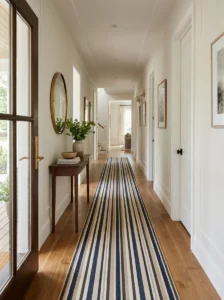
If your entryway is more of a long hallway than a square foyer, a runner rug does far more for the space than a round or square rug ever could. I switched to a long striped runner in my hallway entry, and it immediately made the space feel more intentional and directional, almost like it was guiding you further into the house.
Measure carefully before buying — you want a few inches of flooring visible on either side of the runner, and typically a couple of inches of clearance from the wall at each end. I made the mistake of buying one that was slightly too wide for my hallway on the first try, and it looked cramped rather than expansive.
Pattern is where a runner can really shine in a way a small rug can’t. A bold stripe or a repeating geometric pattern draws the eye down the length of the hall, making a narrow space feel more purposeful instead of like a leftover strip you didn’t know what to do with.
For durability, look for a flat-weave or a low-pile wool runner — anything with a thick pile will show foot traffic patterns quickly in a space that gets walked on constantly, and a natural fiber like wool handles moisture from wet shoes far better than synthetic options in my experience.
13. Add Built-In or Freestanding Shoe Storage
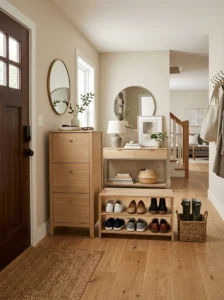
Shoes were the single biggest clutter culprit in my entryway before I finally addressed it head-on. Between my own shoes, my partner’s, and the kids’ constantly rotating sneaker sizes, we had a small mountain by the door at all times until I got a proper storage solution in place.
I went with an open shoe rack that slides under my console table, which keeps everything visible (so nobody’s hunting for a missing shoe) while still tucking it out of the main walking path. Closed cabinet-style shoe storage looks tidier if you prefer a cleaner aesthetic, but I’ve found open storage actually gets used more consistently in a busy household because there’s zero friction to putting shoes away.
If you’re really tight on space, a slim vertical shoe cabinet — some are as narrow as 6 inches deep — can slide into surprisingly small gaps, even beside a door or in a corner that would otherwise go completely unused. I added one of these in a thin gap next to my coat closet and it holds an entire extra row of shoes I didn’t have room for before.
Whatever option you choose, keep a small basket or tray nearby specifically for muddy or wet shoes on rainy days, separate from the main storage. It’s a small addition that’s saved my floors more times than I can count.
14. Bring in Textured Materials (Wood, Rattan, Stone)
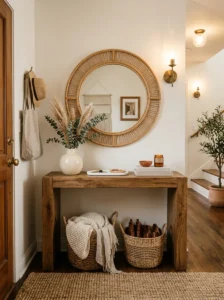
Texture is what elevates an entryway from “fine” to genuinely inviting, and it’s the piece of advice I give most often to friends redoing this space. My entryway leans heavily on natural materials — a rattan mirror frame, a wood console table, woven baskets, and a jute rug base — and the mix of textures does more visual work than color ever could on its own.
The trick is variety without chaos. I try to include at least three different textures in any small vignette: something smooth (a ceramic vase), something woven (a basket or rug), and something with grain (wood furniture). That combination keeps the eye interested without needing a ton of color or pattern to carry the space.
Stone is an underused texture in entryways specifically. A small stone tray for keys, or even a stone-look tile inset near the door, adds a grounded, substantial feel that plastic or glossy materials just don’t replicate. I picked up a small marble catchall tray secondhand, and it’s become the spot where my keys, sunglasses, and loose change all land every single day.
If your entryway currently feels flat or a little sterile, texture is almost always the missing ingredient rather than color. Adding a woven basket or a rattan-framed mirror can transform a space more than a fresh coat of paint alone.
15. Add a Small Accent Chair
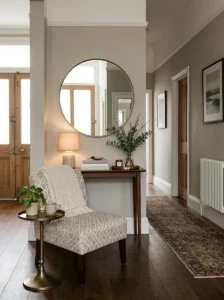
An accent chair might seem like an unnecessary addition to a space you only pass through for a few seconds, but I promise it earns its place. I added a small vintage slipper chair in the corner of my entry, mostly for style at first, and now it’s where I sit every single morning to put my shoes on rather than balancing awkwardly on one foot.
Size matters enormously here — you want something scaled down, not a full armchair that eats up your walking path. Look specifically for pieces labeled as “slipper chairs” or “accent chairs,” which tend to run smaller and lower to the ground than standard living room seating, and fit much more naturally into a tight footprint.
I chose a chair in a bold patterned fabric since it’s a low-commitment way to introduce color and pattern into a space I don’t spend long periods of time in — if I get sick of the print in a few years, reupholstering one small chair is a much smaller project than redoing a whole room.
If floor space genuinely doesn’t allow for a chair, even a simple stool tucked into a corner offers the same functional benefit at a fraction of the footprint, and it can double as an extra plant stand or side table when it’s not being used for shoes.
16. Use Vertical Storage for Small Entryways
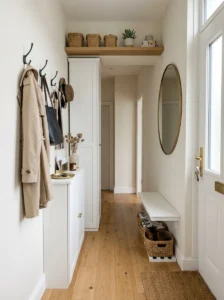
If you’re working with a genuinely tiny entryway — mine used to be barely three feet wide before I rearranged everything — going vertical is the only real solution. Floor space is precious, so I started stacking storage upward instead: a tall, narrow cabinet, hooks mounted higher on the wall, and a shelf above the door for out-of-season items.
A slim cabinet with multiple small drawers turned out to be one of my best purchases, holding everything from spare keys and sunglasses to dog treats and reusable shopping bags, all while taking up less floor space than my old shoe pile ever did. Look specifically for furniture labeled “hallway” or “entryway” cabinets — they’re designed to be shallow (often under 12 inches deep) while still offering real storage capacity.
Wall-mounted shelving above eye level is another underused trick. I added one floating shelf near the ceiling specifically for seasonal decor and extra baskets, which keeps that stuff accessible but completely out of the way during regular daily use.
Mirrors and light colors help a tight vertical space feel less claustrophobic too, so pair your vertical storage with a lighter paint color and a mirror if you can, rather than adding tall dark furniture that can make a narrow entry feel like it’s closing in on you.
17. Add a Decorative Tray for Keys and Mail
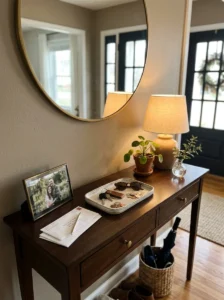
This is such a small addition, but it might have saved me more daily frustration than anything else on this entire list. Before I added a simple tray by the door, I was constantly hunting for my keys in the morning, digging through bags or checking three different rooms before finally leaving late.
I keep a small ceramic tray right on my console table now, exclusively for keys, my sunglasses, and whatever mail needs to go out that day. Having one single, non-negotiable landing spot means I genuinely never lose my keys anymore, which sounds like a tiny win but has changed my mornings completely.
Material-wise, I’d lean toward something with a slight lip or edge rather than a completely flat dish, just so smaller items like earrings or coins don’t slide right off when the door slams shut. Ceramic, marble, or a woven rattan tray all work well and add a bit of texture rather than looking purely utilitarian.
If your household has more than one person using the entryway, consider two trays side by side, or one tray with divided sections, so everyone has their own designated spot. It cuts down on the “have you seen my keys” conversation that used to happen at my house nearly every single morning.
18. Choose a Scented Candle or Diffuser
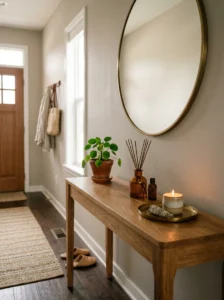
Scent is the most overlooked element of entryway design, and it’s the first thing guests notice even before they register the visuals. I keep a reed diffuser on my console table year-round and swap the scent seasonally — something warm and woodsy in the fall and winter, something lighter and citrusy in spring and summer.
The entryway is genuinely the best room in the house for this, since it’s the first impression guests get, and a consistent, pleasant scent (as long as it’s not overpowering) makes a space feel cared for in a way that’s hard to put your finger on. I’ve had multiple guests specifically comment on how nice my entry smells, which never happened when I relied solely on visual decor.
If open flames near a busy walkway make you nervous (understandably so, especially with kids or pets running through), a reed diffuser or a battery-operated flameless candle gives you the same ambient scent without the fire risk. I switched to a diffuser specifically for this reason and haven’t looked back.
Keep the scent subtle rather than overwhelming — you want something that registers pleasantly for a few seconds as people walk through, not something so strong it lingers uncomfortably. A little really does go a long way here.
19. Hang a Statement Piece of Art
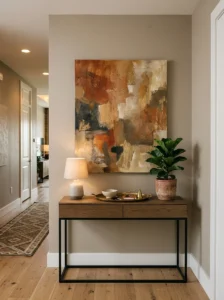
Art in an entryway gets overlooked constantly because people assume it belongs in living rooms or bedrooms instead. I hung one large abstract piece directly above my console table, and it’s become the anchor that ties the whole vignette together — the mirror, the lamp, and the art all work as one cohesive moment now instead of feeling like separate decisions.
Scale is everything here. A small piece of art on a large wall reads as an afterthought, while one substantial piece — even a print rather than an original — makes a real visual statement. As a rough guideline, art should take up roughly two-thirds the width of whatever furniture it’s hanging above, which is the ratio I used and it’s worked well in every space I’ve applied it to since.
You don’t need original artwork or anything expensive to pull this off. I’ve used affordable framed prints, and in one apartment, even a large tapestry hung with clips, and both looked intentional once properly scaled and framed to the wall.
If you’d rather do a gallery-style approach instead of one large piece, that’s covered separately, but for a true “statement,” one bold piece tends to have more impact in a small, quickly-passed-through space than a cluster of smaller ones competing for attention.
20. Add Seasonal Decor Touches
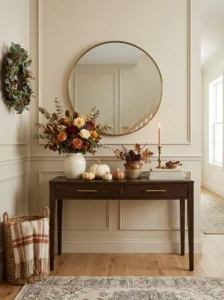
Rotating small decor elements with the seasons keeps an entryway feeling fresh without requiring a full redesign every few months. I keep a small rotating collection — pumpkins and warm-toned florals in fall, pinecones and evergreen sprigs in winter, fresh tulips in spring — all displayed in the same one or two vases so I’m not buying new containers each time.
This is one of the lowest-cost ways to keep a space feeling current, since you’re really only swapping out a few small, inexpensive items rather than overhauling furniture or paint. I spend maybe $20 to $30 per season on fresh touches, and it makes a noticeably bigger difference than I expected the first time I tried it.
A wreath on the interior side of the door (not just the exterior) is another simple seasonal swap that a lot of people don’t think to do. I keep a small collection of wreaths in a closet and rotate them roughly every two to three months, which takes less than five minutes each time.
Keep your “base” decor (console table, mirror, rug, lighting) neutral and consistent year-round, and let the seasonal pieces do all the color and personality work. That way the space always feels cohesive underneath, no matter what small seasonal touches you’re rotating in and out.
21. Use a Contrasting Ceiling Color or Wallpaper
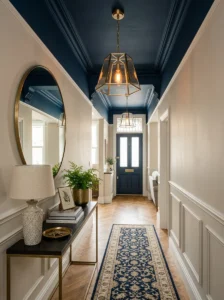
The ceiling is the most neglected surface in almost every home, and an entryway is the perfect low-commitment place to experiment with it since it’s a small, contained area. I painted my entryway ceiling a deep navy to match the accent wall below it, and the “wrapped” effect it creates makes the whole space feel intentionally designed rather than like an afterthought.
This trick works especially well in entryways with lower ceilings, counterintuitively. A darker or patterned ceiling can actually make a low ceiling feel more deliberate and cozy rather than cramped, since it stops your eye from immediately registering “this ceiling is close” the way a stark white ceiling against darker walls sometimes does.
Wallpaper on the ceiling is a bolder version of this same idea, and I’ve seen a friend do a small floral print overhead in her narrow entry that completely transformed the space into something that felt custom-designed rather than builder-basic.
If a full ceiling commitment feels like too much, even painting just the trim or the top few inches of wall where it meets the ceiling in a contrasting color gives a hint of the same effect without the full investment, and it’s an easy area to repaint if you change your mind.
22. Install a Coat Closet Organization System
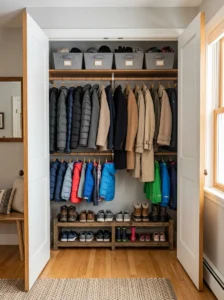
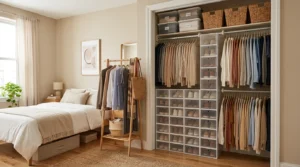
If you’re lucky enough to have an actual coat closet near your entryway, don’t waste it as just a place where things get shoved and the door gets forced shut. I redid mine with a simple system: double-hung rods for kids’ coats up top and adult coats below, a shoe rack on the floor, and a small shelf above for hats and gloves.
The transformation wasn’t expensive — I used tension rods and a few over-the-door organizers rather than a full custom closet system, and it took one weekend afternoon to completely redo. Being able to actually open the closet door without an avalanche of stuff falling out has been a genuinely underrated quality-of-life improvement in my house.
Labeled bins on any upper shelving help enormously if multiple people share the space, especially with kids who need visual cues rather than a vague “put it away” instruction. I use simple fabric bins labeled “hats,” “gloves,” and “scarves,” and it’s cut down on the seasonal digging-through-everything routine considerably.
If you don’t have a coat closet at all, a slim armoire or wardrobe placed against an entryway wall can serve the exact same function, especially in older homes that were built without dedicated hall closets in the first place.
23. Add a Personal Welcome Sign or Monogram
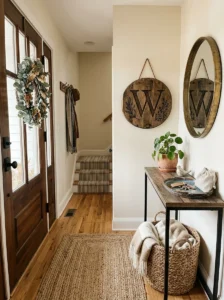
A small personal touch — a family name sign, a monogram, or even a hand-lettered “welcome” piece — is what makes an entryway feel like yours specifically, rather than a page pulled from a catalog. I have a small wooden sign with our family’s last initial hanging near the door, something my mother-in-law actually made for us, and it’s one of my favorite objects in the entire house.
This doesn’t need to be elaborate or expensive. Some of the nicest versions I’ve seen are simple: a piece of reclaimed wood with hand-painted lettering, or a small brass plaque with just an initial or a meaningful date. The sentimental value tends to matter far more than the price tag here.
If you want something with a bit more presence, a custom doormat with a monogram or a playful phrase adds the same personal touch right at the threshold, before guests have even stepped inside. I switched to a monogrammed mat a couple of years ago and it’s a small detail that guests notice and comment on more often than I expected.
Whatever you choose, this is the one category on this list where “store-bought and generic” tends to feel the least effective. A little imperfection or a handmade quality genuinely adds more warmth here than anything mass-produced could.
24. Keep It Clutter-Free with a “Landing Strip” Rule
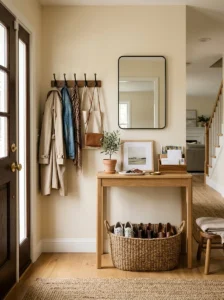
The final and honestly most important idea on this list isn’t a purchase at all — it’s a habit. I instituted what I jokingly call the “landing strip rule” in my house: everything has one designated spot (the tray for keys, the hooks for coats, the basket for shoes), and if it doesn’t have a spot, it doesn’t stay in the entryway.
This sounds obvious, but it’s the difference between a beautifully styled entryway that stays that way and one that looks great for a week before reverting to chaos. I do a quick 30-second reset every evening — putting shoes in the rack, hanging up coats, clearing the console of any stray mail — and it’s genuinely all it takes to keep the space functioning the way it’s designed to.
I’d encourage anyone doing an entryway overhaul to think through this system before buying anything decorative. Ask yourself where shoes, keys, mail, and coats will each specifically live, and only then start layering in the pretty stuff like art, plants, and lighting. Function first, decor second — I learned this the hard way after buying a gorgeous bench that ended up buried under junk within a month because I hadn’t solved the storage problem first.
At the end of the day, the best entryway isn’t necessarily the most expensive or the most photographed — it’s the one that actually works for how you and your family come and go every single day, while still making that first impression feel warm, considered, and unmistakably yours.