18 Bedroom Lighting Ideas to Set the Perfect Mood

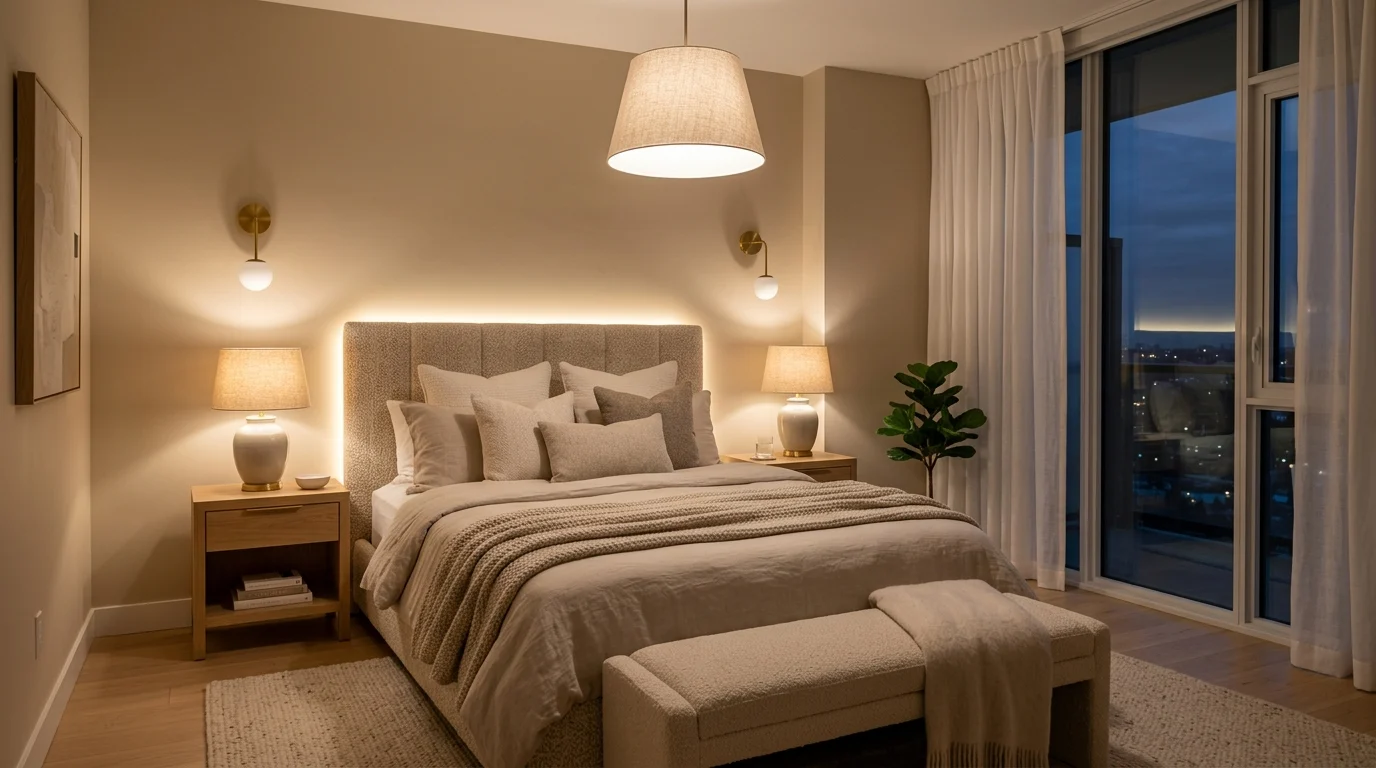
A beautifully designed modern cozy bedroom showcasing layered lighting, elegant bedside lamps, warm white ambient illumination, stylish wall sconces, a soft pendant light, subtle LED lighting behind the headboard, luxurious upholstered bed, neutral beige and cream color palette, natural wood nightstands, soft bedding, tasteful decorative pillows, large windows with sheer curtains, warm inviting evening atmosphere, realistic interior photography, sophisticated home decor magazine style, balanced composition, natural shadows, photorealistic, high-end interior design, no people, no text, no watermark, 16:9 landscape composition.

For years, our bedroom had exactly one light source, a single ceiling fixture with a bulb that was either fully on or fully off, nothing in between. I didn’t think much about it until a friend visited and mentioned how harsh the room felt in the evening, and once she said it, I genuinely couldn’t unsee it. That single, flat overhead light was making an otherwise nicely decorated room feel more like an office than somewhere meant for winding down. Fixing it wasn’t complicated or expensive, it just took understanding that a bedroom actually needs several different kinds of light working together, not one fixture trying to do everything at once.

Since that first small change, I’ve experimented with lighting in our own bedroom more than in any other room of the house, and helped a couple of friends rework theirs too. Below are 18 bedroom lighting ideas based on real setups I’ve lived with or helped install, focused on genuinely shaping mood rather than just brightening a room.

1. Layered Lighting at Three Different Heights

Bedroom with layered lighting at different heights

The single biggest shift in how our bedroom feels came from abandoning the idea that one overhead fixture could handle everything, and instead layering light at three distinct heights: low, from table lamps and floor lamps; mid, from wall sconces; and high, from the ceiling fixture itself. Each layer serves a different purpose, and having all three available, rather than relying on just the ceiling light, is what actually gives the room flexibility depending on the time of day and what we’re doing in it.

In practice, this means our ceiling light stays reserved almost entirely for cleaning or searching for something on the floor, genuinely bright, task-focused moments, while the lower and mid-level lights handle everything else, reading before bed, getting dressed in the morning, simply relaxing in the evening. I’d recommend thinking about your own daily bedroom routine specifically, and identifying which activities need brighter light and which ones would actually benefit from something softer, before deciding how many fixtures you genuinely need at each height.

This layered approach doesn’t require an expensive renovation to implement either. A couple of table lamps and a floor lamp, purchased gradually rather than all at once, can achieve most of this effect in almost any bedroom, regardless of whether you’re able to add hardwired sconces or not. The layering principle itself, not the specific fixtures, is what makes the real difference in how a bedroom actually feels once the sun goes down.

2. Dimmable Bedside Lamps

Dimmable bedside lamps creating a soft bedroom glow

Bedside lamps are probably the most frequently used light source in any bedroom, and yet I went years using ones with only a single, fixed brightness setting, either quite bright or completely off, with nothing genuinely comfortable in between for reading right before sleep. Switching to dimmable lamps, using simple plug-in dimmer switches rather than replacing the lamps entirely, made an immediate difference in how much more relaxing our evening routine felt.

The specific advantage of dimming, rather than just choosing a lower-wattage bulb from the start, is flexibility across different needs throughout the evening. I read with the lamp at a moderate brightness, but dim it down considerably in the final few minutes before turning it off entirely, which has genuinely made falling asleep feel like a smoother transition rather than an abrupt switch from bright light to total darkness.

I’d recommend a simple inline or plug-in dimmer if your existing lamps don’t have this feature built in already, since these are inexpensive and don’t require any electrical work, just plugging the lamp into the dimmer unit instead of directly into the wall outlet. Pairing dimmable lamps with warm-toned bulbs, rather than cool or daylight bulbs, matters considerably here too, since a dimmed cool bulb can still feel somewhat harsh, while a dimmed warm bulb genuinely achieves that soft, cozy quality most people are after for bedside reading.

3. Wall-Mounted Sconces Beside the Bed

Wall-mounted sconces beside a bed for bedroom lighting

Wall-mounted sconces, positioned on either side of the bed at roughly shoulder height when seated upright, free up valuable nightstand space while also providing more consistent, evenly positioned light than a table lamp that might shift or get bumped over time. We switched to sconces in our own bedroom a couple of years ago, and beyond the practical space savings, the light itself felt noticeably more considered and intentional once it was coming from a fixed, properly positioned point rather than wherever our lamps happened to be sitting at any given moment.

Swing-arm sconces specifically offer an added layer of flexibility, letting you adjust the exact angle and reach of the light depending on whether you’re reading, simply relaxing, or reaching for something in a dimmer corner of the room. I’d recommend this style specifically if you read regularly in bed, since being able to pull the light closer to your book, then push it back out of the way afterward, is a genuinely useful feature that fixed sconces don’t offer.

Installation requires either hardwiring, which is best handled by an electrician, particularly if you don’t already have wiring in that specific wall location, or choosing a plug-in sconce style that mounts on the wall but connects via a standard cord to a nearby outlet, avoiding the need for any electrical work at all. I’d suggest the plug-in option specifically for renters or anyone not ready to commit to a more permanent electrical installation.

4. Warm White Bulbs Throughout

Bedroom illuminated with warm white lighting

The color temperature of your bulbs affects a bedroom’s overall mood more significantly than almost any other single lighting decision, and it’s a detail I underestimated for years before actually comparing warm and cool bulbs side by side in the same fixtures. Switching every bulb in our bedroom to a consistent warm white, generally in the 2700K range, made the whole room feel noticeably cozier and more relaxing almost immediately, without changing a single fixture or piece of furniture.

Cooler, more blue-toned light, closer to daylight in temperature, tends to feel more alert and energizing, which is genuinely useful in a workspace or kitchen, but works against the relaxed, restful quality most people want in a bedroom specifically. I’d recommend checking the Kelvin rating on any bulbs you’re currently using, this is usually printed directly on the packaging, and replacing anything above roughly 3000K with a warmer alternative if your bedroom currently feels colder or more clinical than you’d like.

Consistency across all your bedroom’s fixtures matters here too, mixing warm and cool bulbs within the same room, even in different fixtures, tends to look mismatched and slightly off rather than intentional. I’d suggest doing a full bulb swap throughout the room at once, rather than gradually replacing bulbs individually as they burn out, so you get the full benefit of a consistent warm glow immediately rather than a slow, inconsistent transition over many months.

5. Fairy Lights or String Lighting

Warm fairy lights behind a bedroom headboard

A simple strand of warm white fairy lights, tucked behind a headboard, wound loosely around a mirror frame, or draped along a shelf, adds a soft, gentle glow that works beautifully as a low-level accent light without needing any electrical installation at all. I added a strand behind our headboard years ago, initially thinking of it as a temporary, inexpensive fix, and it’s remained in place ever since simply because the soft, ambient quality it adds in the evening has never felt like something worth replacing with anything more elaborate.

The key detail here, as with warm bulbs throughout, is choosing warm white lights specifically rather than cool white or multicolor options, since warm tones integrate far more naturally into a relaxing bedroom atmosphere. I’d recommend battery-operated or USB-powered strands with a built-in timer function if you don’t want to remember to switch them on and off manually each evening, a small convenience that’s genuinely made me use ours consistently rather than letting the novelty wear off after the first few weeks.

Beyond a headboard, fairy lights work nicely woven through a dried flower arrangement, tucked into a bookshelf among other objects, or draped along the top of a canopy bed frame, adding small pockets of soft light scattered throughout the room rather than concentrated in just one spot. This is one of the most affordable ideas on this entire list, and genuinely one of the easiest to try without any commitment to a bigger lighting change.

6. A Statement Pendant Light

Statement pendant light above a modern bedroom bed

While overhead lighting shouldn’t carry a bedroom’s entire mood on its own, as discussed earlier, the actual fixture you choose for that overhead position still matters, and a genuinely striking pendant light can serve as both functional ambient lighting and a real design focal point for the room. We replaced a plain, builder-grade flush mount fixture with a woven rattan pendant a while back, and even though it’s not the light source we rely on most in the evenings, it’s become one of the most visually appealing details in the entire room.

I’d recommend choosing a pendant scaled appropriately to your specific room and ceiling height, a fixture that’s too small can look lost and insufficient, particularly in a room with higher ceilings, while an oversized pendant can feel overwhelming in a more modest, standard-height bedroom. Hanging height matters too, if positioned directly above the bed, I’d suggest keeping the fixture high enough that it doesn’t interfere with anyone sitting up in bed or feel like it’s looming too closely overhead.

A dimmer switch paired with your pendant light lets you use it as genuine ambient lighting on lower settings, rather than only as a bright, functional overhead light, extending its usefulness well beyond just those moments when you need the room fully illuminated. This pairing, a beautiful fixture plus the flexibility of dimming, is what lets a statement pendant genuinely contribute to mood rather than just serving as a striking but rarely-used decorative object.

7. Under-Bed LED Strip Lighting


LED strips installed beneath the bed frame create a soft, subtle glow along the floor that’s particularly useful for nighttime bathroom trips or simply as a gentle, ambient accent that doesn’t require turning on brighter overhead or bedside lights at all. I added a warm white LED strip beneath our bed frame specifically for those middle-of-the-night moments when I don’t want to fully wake myself up with brighter lighting just to find my way across the room.

Motion-sensor LED strips specifically add real practical value here, automatically switching on when they detect movement near the bed and turning off again after a set period, meaning you never need to fumble for a switch in the dark or worry about the lights staying on and disturbing your partner’s sleep. I’d recommend this motion-activated feature specifically over a manually switched strip, given how much more genuinely useful it is for its primary purpose of safe, low-disruption nighttime navigation.

Installation is generally straightforward, most under-bed LED strips use adhesive backing and either battery power or a simple plug-in connection, meaning this is an accessible upgrade even without any electrical experience or professional installation. I’d suggest positioning the strip along the inside edge of the bed frame, angled slightly downward toward the floor, so the light illuminates the immediate area around the bed without shining directly outward into the rest of the room or into anyone’s eyes while lying down.

8. A Reading Nook Floor Lamp

Bedroom reading nook with an adjustable floor lamp


For anyone with a dedicated reading chair or a small nook within their bedroom, a properly positioned floor lamp, adjustable arm styles work particularly well, provides focused, comfortable light specifically for that activity without needing to rely on the room’s broader ambient lighting. I set one up beside a small armchair in the corner of our bedroom specifically for evening reading, and having light positioned exactly where I need it has made a genuine difference in how often I actually use that corner of the room rather than defaulting to reading in bed under less ideal lighting.

I’d recommend positioning the lamp just behind and slightly to the side of the chair, rather than directly overhead, since this angle reduces glare on the page while still providing genuinely adequate light for extended reading sessions. An adjustable arm or swivel head adds valuable flexibility here too, letting you fine-tune the exact angle and reach of the light depending on your specific seating position and the size of whatever you happen to be reading.

Bulb brightness matters more for this specific fixture than for some of the more purely ambient lighting ideas on this list, since the whole point is genuinely functional task lighting for reading, rather than just a soft, decorative glow. I’d suggest a slightly brighter bulb than you might choose for a bedside lamp specifically, paired with a dimmer if you want the flexibility to lower it for more relaxed, non-reading moments spent in the same chair.

9. Candles for Genuine Ambient Warmth

Bedroom with candles creating warm ambient lighting


Real candles bring a quality of warm, flickering light that no electric bulb genuinely replicates, and a small, thoughtfully arranged candle display, on a dresser, a windowsill, or a dedicated small shelf, adds a distinctly cozy, calming element to a bedroom’s evening atmosphere. I keep a small cluster of pillar candles on a narrow shelf in our bedroom, and lighting them in the evening has become a small, genuinely enjoyable part of winding down before bed, distinct from simply flipping a light switch.

Safety is worth addressing directly here, since it genuinely matters in a bedroom setting specifically. Keep any candle display well clear of curtains, bedding, or anything else flammable, and never leave candles burning unattended, especially if you might fall asleep before extinguishing them. I switched to flameless LED candles for the pieces I don’t actively light every single evening, keeping only a couple of real candles for evenings when I’m genuinely present and attentive in the room, which lets me enjoy the aesthetic regularly while still being properly careful about fire safety.

I’d recommend varying candle heights and types within a small grouping, a couple of taller taper candles alongside a shorter, wider pillar candle, rather than a uniform row of identical candles, since this variation creates more visual interest and a softer, more natural-looking arrangement of flickering light once everything is lit in the evening.

10. A Salt Lamp or Amber Glass Accent Light

Amber accent lamp providing warm bedroom lighting


A Himalayan salt lamp, or any small accent light with an amber or warm-toned glass shade, casts a genuinely distinctive, soft orange glow that works beautifully as a low-level accent light, particularly appealing for anyone sensitive to brighter lighting in the evening or specifically looking for something calming to keep on through the night. I keep a small salt lamp on our dresser, and its gentle, warm glow has become something I genuinely look forward to switching on as part of our evening routine, well before it’s time for any brighter lighting to come on at all.

I’d recommend positioning this kind of accent light somewhere you’ll actually notice and appreciate its glow regularly, a dresser, a nightstand, a windowsill, rather than tucked into a corner where its specific, distinctive quality of light gets lost or goes largely unnoticed. Because these lamps generally produce fairly low, ambient light rather than genuine task lighting, I’d suggest treating this as a complement to your other lighting sources, discussed elsewhere in this list, rather than something meant to replace your bedside or reading lamps entirely.

Salt lamps specifically do require some care, they can sweat or develop moisture in humid conditions, and generally benefit from staying on for extended periods, which helps keep them dry, rather than being switched on and off frequently throughout the day. If humidity is a genuine concern in your specific climate or bedroom, a simple amber or warm-glass table lamp achieves a fairly similar warm, glowing quality without this particular maintenance consideration.

11. Backlit Headboard Lighting

Backlit headboard creating a soft bedroom glow


LED strips installed behind the headboard itself, whether built into a custom headboard design or simply adhered to the back of an existing one, create a soft, indirect glow that spills gently around the edges of the headboard without being a direct light source shining into the room. We had this feature built into a custom headboard a couple of years ago, and the effect, a subtle halo of warm light framing the bed, has become one of the details most visitors comment on when they see our bedroom for the first time.

I’d recommend warm white LEDs specifically for this application, and positioning the strip close enough to the headboard’s edge that the light spills outward in a soft, diffused glow, rather than being directly visible as a distinct, harsh line of individual LED points. Testing the strip’s positioning before fully committing to adhesive placement is worth the extra care here, since repositioning after the strip is firmly stuck down can sometimes damage the finish of your headboard, depending on the specific material.

For those without a custom headboard, or not ready to modify an existing one, a simpler alternative involves running an LED strip along the wall directly behind where the headboard sits, achieving a similar backlit glow effect without needing to attach anything directly to the headboard itself. This alternative approach also offers more flexibility if you rearrange your bedroom furniture or change your headboard down the line, since the lighting remains a separate, independent element from the furniture piece itself.

12. A Dressing Table with Vanity Lighting

Bedroom vanity with side lighting around the mirror


For anyone who gets ready in their bedroom regularly, applying makeup, styling hair, dedicated vanity lighting, positioned specifically around a mirror rather than relying on the room’s general ambient lighting, makes a genuinely significant difference in how accurately you can see what you’re doing. I added simple LED strip lighting on either side of my dressing table mirror a while back, and the difference compared to relying on our bedroom’s regular overhead light was immediate and considerably more useful for actually getting ready each morning.

Side lighting specifically, positioned vertically along both sides of the mirror rather than only above it, reduces harsh shadows across the face far more effectively than overhead lighting alone, which tends to cast shadows downward in a way that makes it genuinely difficult to judge makeup application or overall appearance accurately. I’d recommend this side-lit approach specifically over a single light positioned only above the mirror, even though the overhead-only option is more common in less carefully considered dressing table setups.

Warm white bulbs remain the right choice here too, for consistency with your skin tone as it will actually appear under most everyday indoor lighting, rather than the sometimes unflattering cast that cooler bulbs can create. I’d suggest a dimmable option for this specific fixture as well, since the brightness needed for detailed makeup application differs from what you might want for simply checking your overall outfit or hairstyle in a quicker glance before leaving the room.

13. Recessed Ceiling Lights on a Dimmer

Modern bedroom with recessed ceiling lighting


For a cleaner, more minimal look than a visible overhead fixture, recessed ceiling lights, sometimes called can lights, installed on a dimmer switch offer flexible ambient lighting without any visible fixture taking up visual space on the ceiling itself. We installed a small cluster of recessed lights during a bedroom renovation, replacing a single central fixture, and the resulting even, adjustable illumination throughout the room, without any single visually dominant light fixture, suited our specific preference for a more streamlined, uncluttered ceiling.

I’d recommend this option specifically for anyone renovating or building a bedroom from scratch, since installing recessed lighting after a ceiling is already finished is considerably more disruptive and costly than including it during initial construction or a more significant renovation project. If you’re not undertaking that level of work, a similar clean, ceiling-level look is more accessible through a simple flush-mount fixture instead, though this won’t achieve quite the same completely unobtrusive, built-in quality that true recessed lighting provides.

A dimmer switch is genuinely essential for this specific lighting choice, since recessed lights without dimming capability tend to feel fairly flat and utilitarian on their own, lacking the visual interest of a more decorative fixture to compensate for their otherwise unobtrusive design. I’d suggest pairing dimmable recessed lighting with at least one or two of the more decorative, lower-level lighting ideas discussed elsewhere in this list, since recessed lighting alone, however well executed, tends to feel somewhat impersonal without additional layers of warmer, more characterful light throughout the room.

14. A Canopy Bed with Draped Fairy Lights

Canopy bed decorated with warm fairy lights

Combining a four-poster or canopy bed frame with fairy lights woven through the draped fabric creates a genuinely dreamy, romantic quality of light that neither element quite achieves on its own. A friend styled her canopy bed this way, weaving warm white fairy lights through sheer fabric draped across the top of the frame, and the resulting soft, glowing effect has remained one of the most consistently admired features of her entire bedroom since she first set it up.

I’d recommend using battery-operated fairy lights specifically for this application, rather than needing to run a cord down one of the bedposts to a nearby outlet, since this keeps the whole setup considerably cleaner and more flexible, particularly if you want to reposition the draped fabric or lights occasionally. Weaving the lights loosely through the fabric, rather than in a tight, uniform pattern, tends to create a more natural, softly glowing effect, closer to scattered starlight than an obviously deliberate, evenly spaced arrangement.

This combination works particularly well as a purely ambient, evening accent rather than genuine functional lighting, meaning I’d suggest pairing it with one of the more practical bedside or reading lighting ideas discussed elsewhere in this list, so you’re not relying on the softer, more atmospheric canopy lighting alone for tasks like reading or getting ready in the room.

15. A Smart Lighting System with Scene Presets

Smart bedroom lighting with multiple adjustable light sources

For genuinely flexible control over a bedroom’s mood throughout the day, a smart lighting system, connecting your various bulbs and fixtures to an app or voice control, lets you save specific lighting “scenes” and switch between them instantly, rather than manually adjusting several individual lamps and switches each time your needs change. We set up a smart system in our own bedroom a couple of years ago, with distinct presets for morning, reading, and a very dim, warm setting for right before sleep, and being able to switch between these with a single voice command has made adjusting our lighting mood considerably more convenient than it used to be with everything controlled manually.

I’d recommend starting with just your most frequently used fixtures if the cost of converting your entire bedroom to smart lighting all at once feels like too significant an investment, your bedside lamps and one or two other key fixtures are often enough to achieve most of the practical benefit, without needing every single light source connected to the system from the very beginning.

Compatibility matters when choosing a specific system, I’d suggest researching which smart lighting ecosystem works with any other smart home devices you already own or plan to add in the future, since sticking within a single compatible ecosystem tends to be considerably more convenient than mixing several different systems that don’t communicate well with each other. This is a more significant upfront investment than most other ideas on this list, but the ongoing convenience of genuinely one-touch mood adjustment has made it one of the changes I’d be most reluctant to give up at this point.

16. Uplighting Behind Furniture or Plants

Bedroom plant highlighted with subtle uplighting

Positioning a small, discreet light fixture behind a piece of furniture or a large plant, angled to shine upward against the wall, creates dramatic shadow and silhouette effects that add genuine visual depth and interest to a bedroom without the light source itself being directly visible. I placed a small uplight behind a large potted plant in the corner of our bedroom, and the resulting shadow pattern cast on the wall and ceiling above adds a subtle, ever-so-slightly dramatic quality to that corner of the room in the evening that a standard lamp simply wouldn’t achieve.

This technique works particularly well behind furniture or plants with interesting silhouettes or textures, since the whole visual appeal comes from the shadow and light pattern created, meaning a plant with distinctive, varied leaf shapes or a piece of furniture with an interesting outline tends to produce a more visually compelling result than something with a very plain, simple form.

I’d recommend a small, low-profile uplight fixture specifically for this purpose, positioned close enough to the wall that the light shines directly upward rather than spreading too broadly outward into the room, which would diminish the intended dramatic, focused shadow effect. This is one of the more subtle, understated ideas on this list, genuinely more about the interplay of light and shadow than about the fixture itself being a visible decorative object, and it works best as a smaller accent detail rather than a primary source of light within the room.

17. A Nightlight for Safe, Gentle Illumination

Warm nightlight providing gentle bedroom illumination

A simple, dim nightlight, plugged into an outlet near the door or bathroom, provides just enough gentle illumination for safe nighttime navigation without needing to switch on brighter lighting that can genuinely disrupt sleep, both your own and any partner sharing the room. We added a small, warm-toned nightlight near our bedroom door years ago, initially thinking of it as a fairly minor, practical addition, but it’s proven genuinely useful for late-night trips to the bathroom or a quick check on a restless pet without needing to fully wake up under brighter light.

I’d recommend a nightlight with a genuinely dim, warm glow specifically, rather than anything bright or cool-toned, since the whole purpose is providing just enough light to navigate safely without significantly disrupting your eyes’ adjustment to darkness or your body’s natural preparation for sleep. Some nightlight models include a built-in light sensor, automatically switching on only once the room reaches a certain level of darkness, which is a genuinely convenient feature that avoids the light running unnecessarily during brighter parts of the day.

Positioning matters too, I’d suggest placing a nightlight along the most direct path between your bed and the bathroom or door, rather than in a corner that doesn’t actually correspond to how you move through the room at night, ensuring the light is genuinely useful for its intended safety purpose rather than just a decorative addition that happens to also emit a small amount of light.

18. Layered Light Control with Multiple Switches

Bedroom with independently controlled layered lighting

Beyond the specific fixtures themselves, having independent switches, or smart controls, for each distinct lighting layer in your bedroom, rather than a single switch controlling everything at once, is what actually makes all the other ideas on this list genuinely usable day to day. We had our bedroom rewired during a renovation specifically to separate our overhead light, our bedside lamps, and our accent lighting onto independent switches, and this single change made a bigger practical difference in how we actually use our various lights than almost any individual fixture we’ve added since.

Without this kind of independent control, even a beautifully layered lighting setup, multiple lamps, sconces, accent lights, can end up feeling more cumbersome than genuinely useful, if every light needs to be switched on or off individually at the fixture itself, or worse, if everything is tied to a single switch that forces an all-or-nothing approach regardless of what specific mood or activity you actually need lighting for at any given moment.

If a full rewiring project isn’t practical for your specific situation, smart plugs offer a more accessible alternative, letting you control individual lamps via an app or voice command without any actual electrical work required. I’d recommend this specifically for anyone renting or not ready for a bigger renovation project, since it achieves much of the same practical benefit, genuine independent control over each lighting layer, without the cost and disruption of rewiring your bedroom’s actual electrical switches.

Final Thoughts

Looking back at every lighting change we’ve made in our own bedroom over the years, the improvements that actually mattered day to day were rarely about a single striking fixture, and almost always about how well the different light sources worked together and how easily we could actually control them for whatever we happened to be doing at any given moment. A beautiful lamp on a single, all-or-nothing switch is far less useful in practice than a simpler fixture that’s genuinely easy to dim and adjust exactly when you need it.

Before adding anything from this list to your own bedroom, I’d suggest thinking honestly about your actual evening routine, when you read, when you get ready, when you simply want to relax, and building your lighting layers around those genuine daily habits rather than purely toward what looks most striking in a single photo. That approach, more than any specific fixture, is what actually turns a bedroom’s lighting into something that genuinely sets the mood you’re after, night after night.

More Interesting Posts

Leave a Reply

Your email address will not be published. Required fields are marked *

More Interesting Posts

The Author: Zunair

I am M. Zunair, a home decor expert with a focus on modern interior design and efficient space styling. I share practical, experience-driven insights to help design functional and aesthetically refined living spaces.

Subscribe to My Newsletter

Subscribe to my weekly newsletter. I don’t send any spam email ever!