Modern bathroom design is built on a simple principle: every element should earn its place. Clean lines, uncluttered surfaces, and a restrained palette turn even an ordinary bathroom into a calm, spa-like retreat — whether the project is a compact powder room or a generous primary suite.
The strongest contemporary bathrooms balance sleek minimalism with warmth. Natural oak softens matte black fixtures. Layered lighting warms large-format stone tile. A single sculptural mirror becomes art against a quiet neutral wall. The result feels luxurious yet functions flawlessly on busy mornings.
This guide presents 16 modern bathroom design ideas that deliver clean lines without sacrificing comfort. Each idea includes specific materials, measurements, and practical execution details — useful whether planning a full renovation or a focused refresh.
What Defines Modern Bathroom Design?
“Modern” is not one fixed look. It is a set of decisions about line, material, and light that distinguish contemporary bathrooms from traditional ones.
Clean geometric lines come first. Modern bathrooms favor straight edges, right angles, and smooth planes over ornate moldings and fussy profiles. Rectangular vessel sinks, linear drains, frameless glass panels, and flat-front cabinetry all reinforce the same quiet geometry.
A restrained palette keeps the eye calm. Most modern bathrooms build on neutrals — white, warm gray, greige, soft black — and create depth through texture rather than color. One deliberate accent, such as brushed brass hardware or a deep green tile, carries more weight than a shelf of competing accessories.
Concealed function is the quiet luxury of modern design. Recessed niches replace protruding shelves. Wall-hung toilets hide their tanks inside the wall. Integrated storage keeps counters clear. When everyday items have a designated hidden home, the room reads as serene rather than busy.
Layered light and honest materials finish the picture. Modern bathrooms combine task, ambient, and accent lighting instead of relying on a single harsh overhead. They let stone, wood, glass, and metal speak for themselves rather than burying them under pattern.
16 Modern Bathroom Design Ideas with Clean Lines
1. Embrace a Minimalist Bathroom Layout
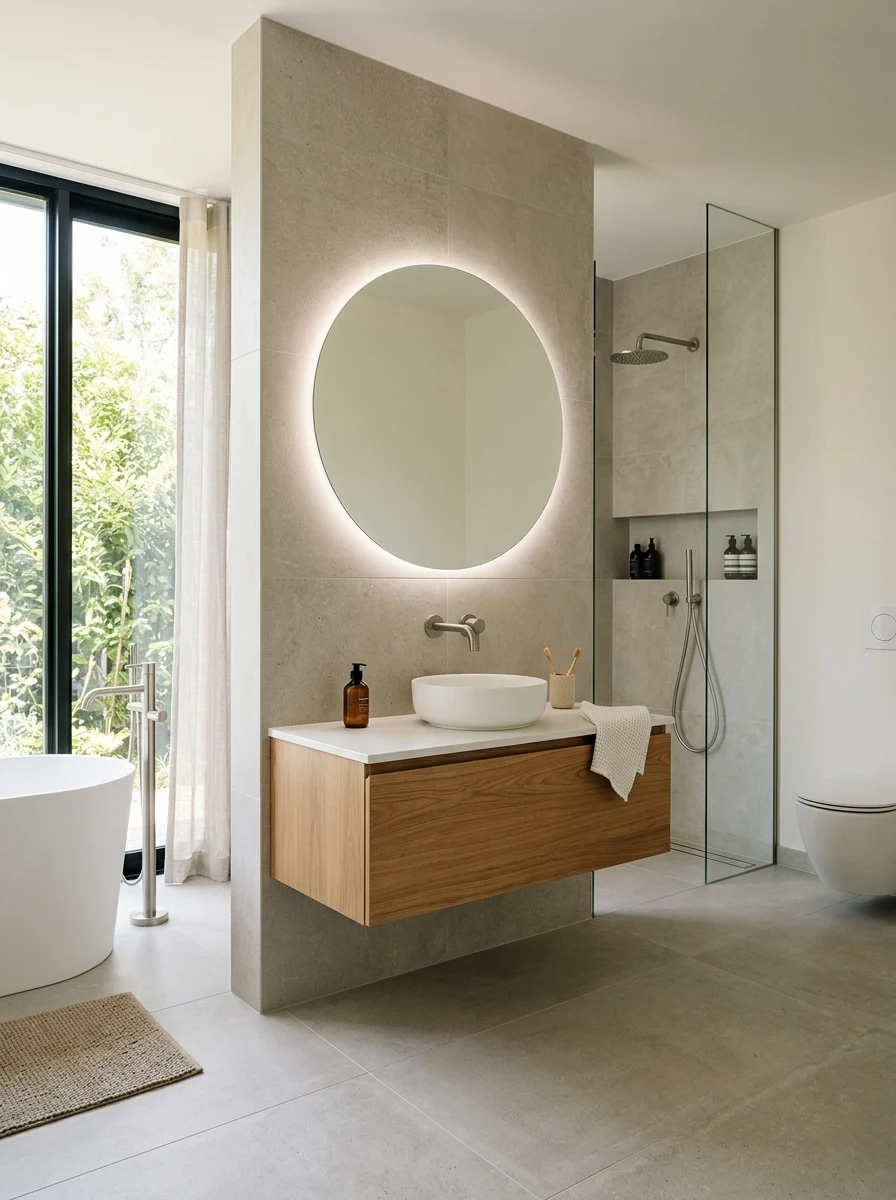
The most transformative move in a modern bathroom is subtraction. A minimalist layout — fewer objects, clearer sightlines, deliberate negative space — makes any bathroom feel larger, calmer, and more refined.
Start with the floor plan. Keep the wet zone visually open to the rest of the room with frameless glass rather than a walled enclosure. Choose a vanity that floats or sits on slim legs so the flooring continues underneath. Select a skirted one-piece toilet or a wall-hung model to eliminate visual clutter at floor level.
Then edit surfaces ruthlessly. Decant shampoo into matching dispensers, corral small items in a lidded ceramic canister, and limit the countertop to a soap dispenser, a small tray, and one living element such as an orchid or a sprig of eucalyptus.
- Conceal: mirrored medicine cabinets, drawer organizers, recessed shower niches
- Reveal: one sculptural faucet, one statement mirror, one natural texture
- Maintain: a five-minute nightly reset — wipe counters, hang towels, empty the bin
2. Use Neutral Color Palettes
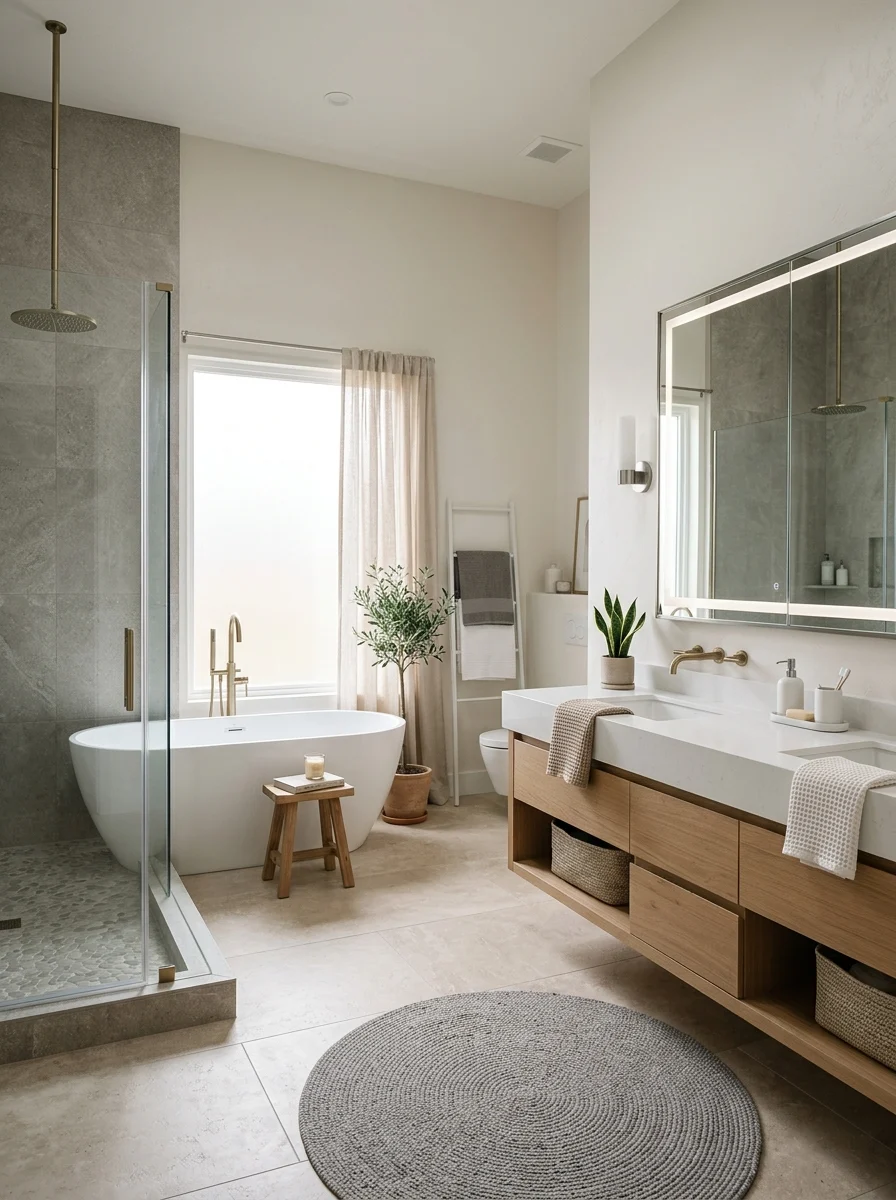
Neutral palettes are the backbone of modern bathroom design. Whites, warm grays, greige, taupe, and soft black create a timeless foundation that makes the room feel brighter, cleaner, and more spacious.
The key to keeping neutrals interesting is layering tones and textures rather than painting everything one flat white. Pair a warm white wall with a greige floor tile, a light oak vanity, and brushed nickel fixtures. The subtle shifts between tones create depth while the overall impression stays calm.
Texture does the heavy lifting in a neutral scheme. Honed marble, tumbled stone, ribbed glass, and woven baskets each catch light differently, preventing the room from feeling flat. Aim for at least three distinct textures in every neutral bathroom.
- Walls: warm white or light greige in satin or eggshell (satin resists moisture better than flat paint)
- Floor: large-format tile in a mid-tone neutral to ground the space
- Accents: natural wood, matte black metal, or brushed brass — pick one metal and repeat it throughout
3. Install Floating Vanities
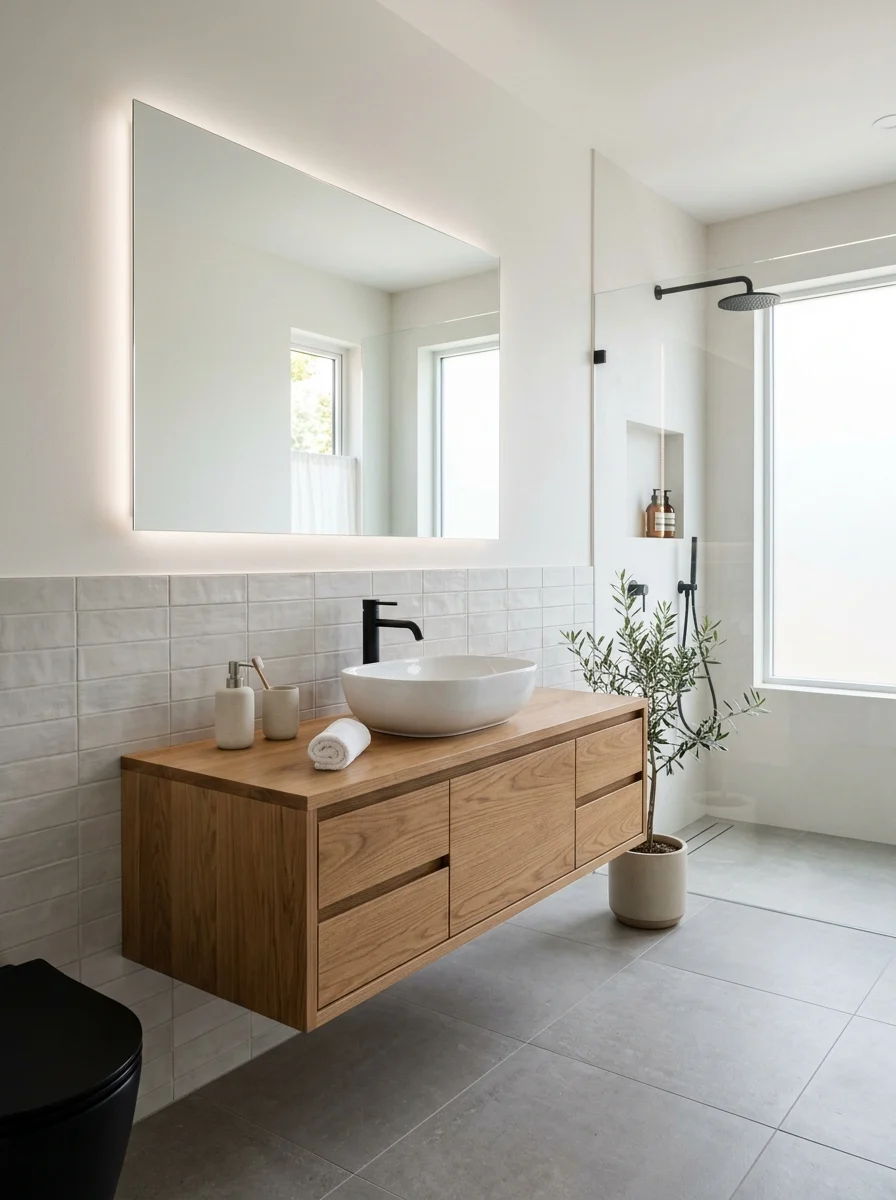
A floating vanity — wall-mounted with open floor beneath — is one of the fastest ways to make a bathroom read as modern. The visible floor underneath creates an unbroken sightline that makes the room feel larger, and the crisp horizontal line of the cabinet reinforces clean geometry.
Standard mounting height places the top of the vanity at 32–36 inches from the floor (excluding vessel sinks), with the cabinet typically 18–24 inches deep. Leave at least 10–12 inches of clear space beneath for easy cleaning and a light, airy feel.
Look for flat-front drawers with push-to-open or slim bar pulls, soft-close hardware, and a moisture-resistant finish such as thermofoil, lacquer, or sealed wood veneer. An integrated LED strip under the cabinet adds a soft floating glow at night and doubles as a nightlight.
- Best for: small bathrooms and modern or Scandinavian schemes
- Pair with: wall-mounted faucets, backlit mirrors, large-format floor tile
- Avoid: mounting too high, which strains the back, or choosing a depth under 18 inches, which sacrifices usable storage
4. Add Frameless Glass Shower Doors
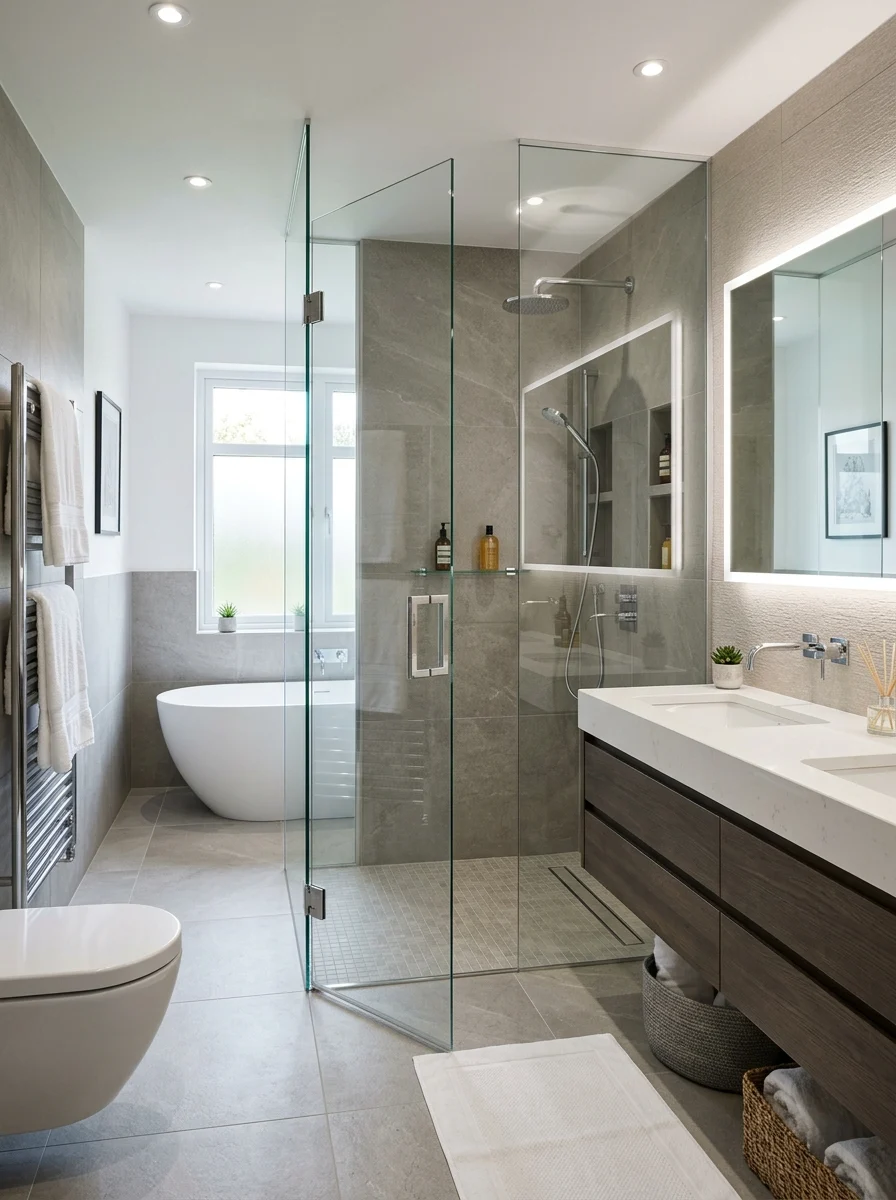
Frameless glass shower enclosures remove the visual bulk of metal framing, letting tile and stone run uninterrupted. The result is a seamless, open feeling that makes even modest bathrooms feel larger and brighter.
Use 3/8-inch or 1/2-inch tempered glass for a rigid, premium feel with minimal hardware — typically just discreet clips or a slim U-channel. A single fixed panel with an open entry (no door) is the cleanest look and works well in showers at least 60 inches long, where splash stays contained.
Keep glass clearer for longer with a protective coating (factory-applied or aftermarket) and a daily squeegee habit. In hard-water areas, this two-minute routine prevents the mineral haze that dulls uncoated glass within months.
- Glass: low-iron (starphire) glass for the clearest, least green-tinted view of the tile behind it
- Hardware: match the finish to faucets — matte black, brushed nickel, or brushed brass
- Layout tip: align the glass edge with a grout line or tile edge for a tailored, intentional look
5. Use Large-Format Tiles
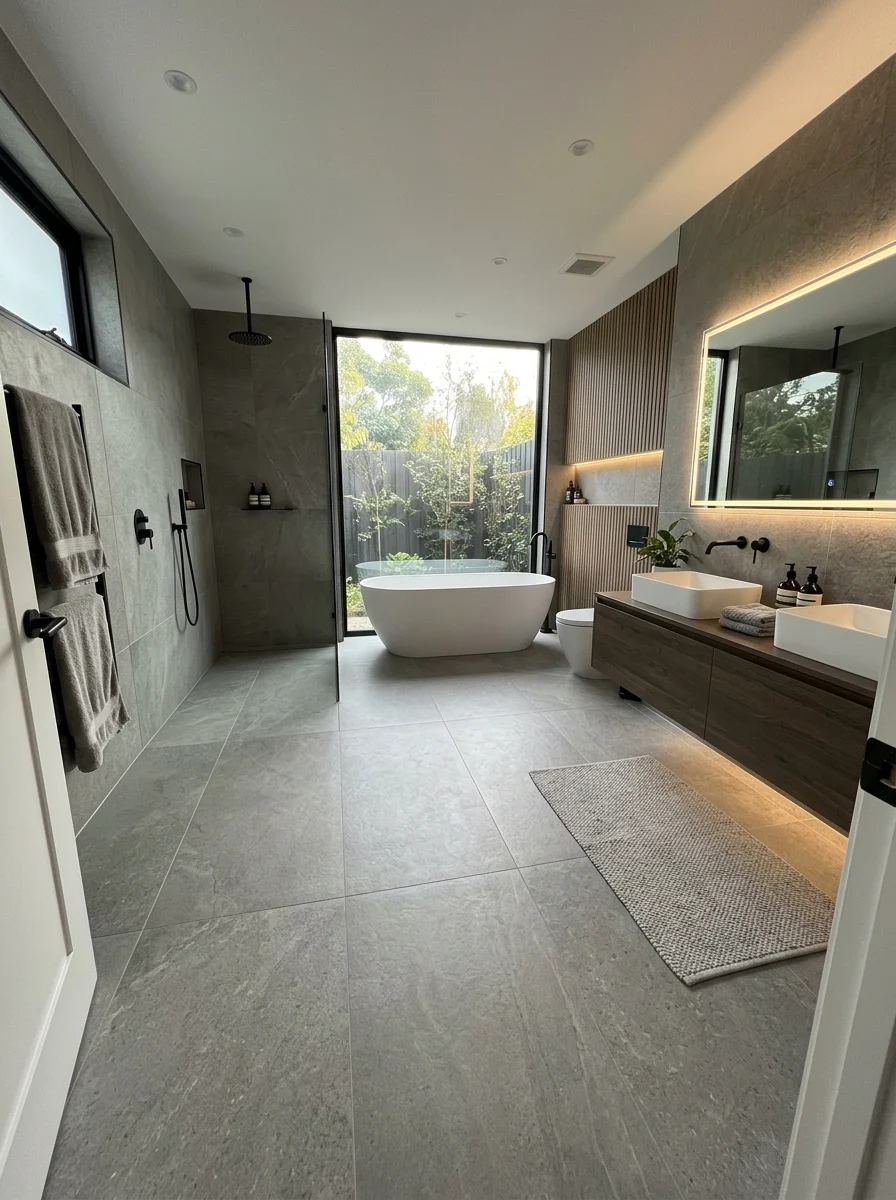
Large-format tiles — typically 24×24 inches and up — create the smooth, uninterrupted surfaces that define modern bathrooms. Fewer grout lines mean less visual noise, easier cleaning, and a more expansive feel.
Porcelain is the workhorse: marble-look, concrete-look, and stone-look porcelains deliver high-end visuals with near-zero maintenance. Rectified edges allow tight 1/16-inch grout joints that nearly disappear. For walls, consider 24×48-inch panels run vertically to draw the eye upward.
Running the same tile from floor to wall (or even across the shower) erases boundaries and makes the room feel carved from a single material. If full continuity is too bold, use the large tile on floors and a coordinating smaller format inside the shower niche for subtle contrast.
- Finish: matte or honed for floors (better slip resistance); polished sparingly for accent walls
- Grout: a color matched closely to the tile keeps the surface monolithic
- Slip safety: choose floor tile rated DCOF ≥0.42 for wet areas
6. Incorporate Matte Black Fixtures
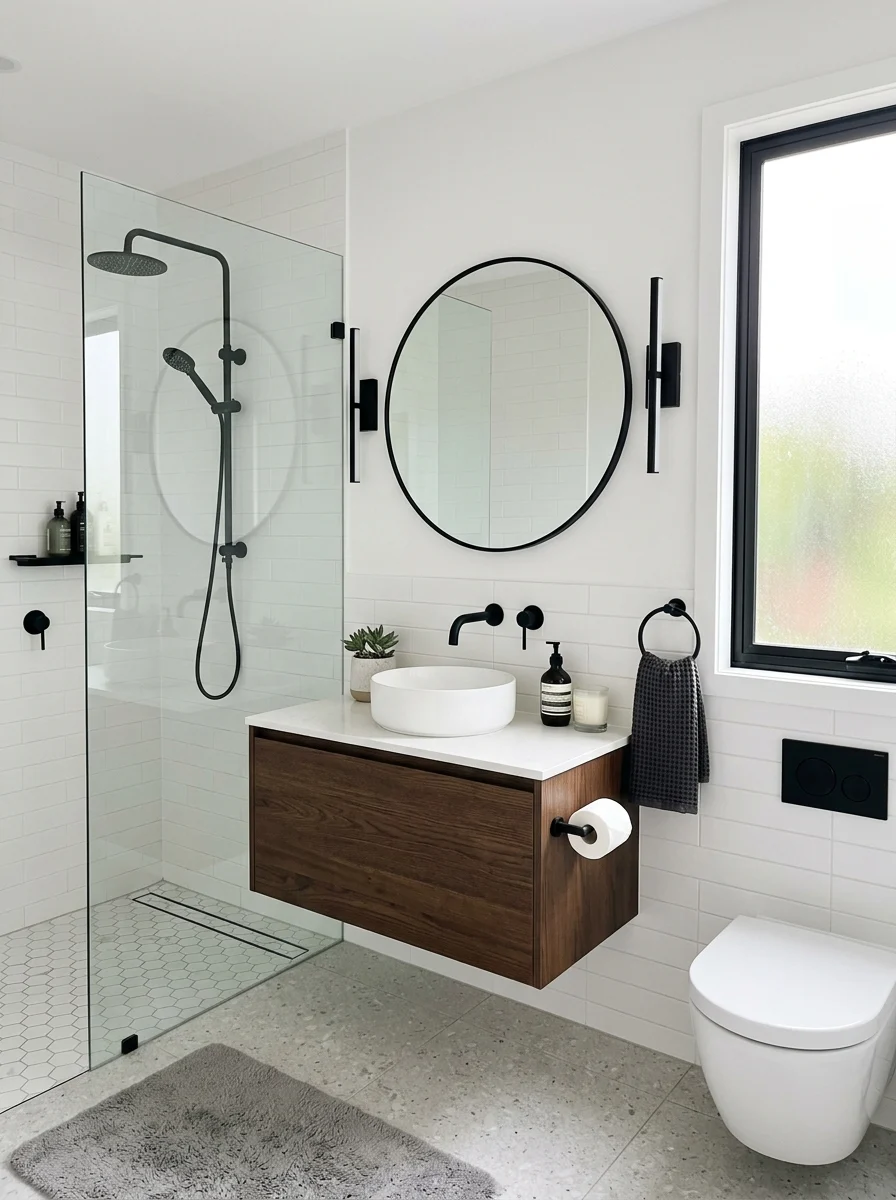
Matte black fixtures act like eyeliner for the bathroom — they define edges, add contrast, and sharpen the whole composition. Against white tile or warm neutrals, black faucets, shower trim, and hardware create the crisp graphic lines modern design loves.
The finish is also practical: matte black hides water spots and fingerprints far better than polished chrome. Choose physical vapor deposition (PVD) or powder-coated finishes from reputable brands, which resist chipping and fading far longer than cheap spray coatings.
Restraint matters. Limit black to two or three elements — for example, the faucet, shower frame, and mirror frame — and keep the remaining metals consistent. An all-black-everything bathroom can feel heavy; black works best as punctuation, not prose.
- Apply to: faucets, showerheads, towel bars, cabinet pulls, mirror frames
- Balance with: warm wood, soft white tile, or brushed brass lighting to avoid a cold feel
- Maintenance: wipe with a soft damp cloth; avoid abrasive cleaners that dull the coating
7. Add Backlit Mirrors
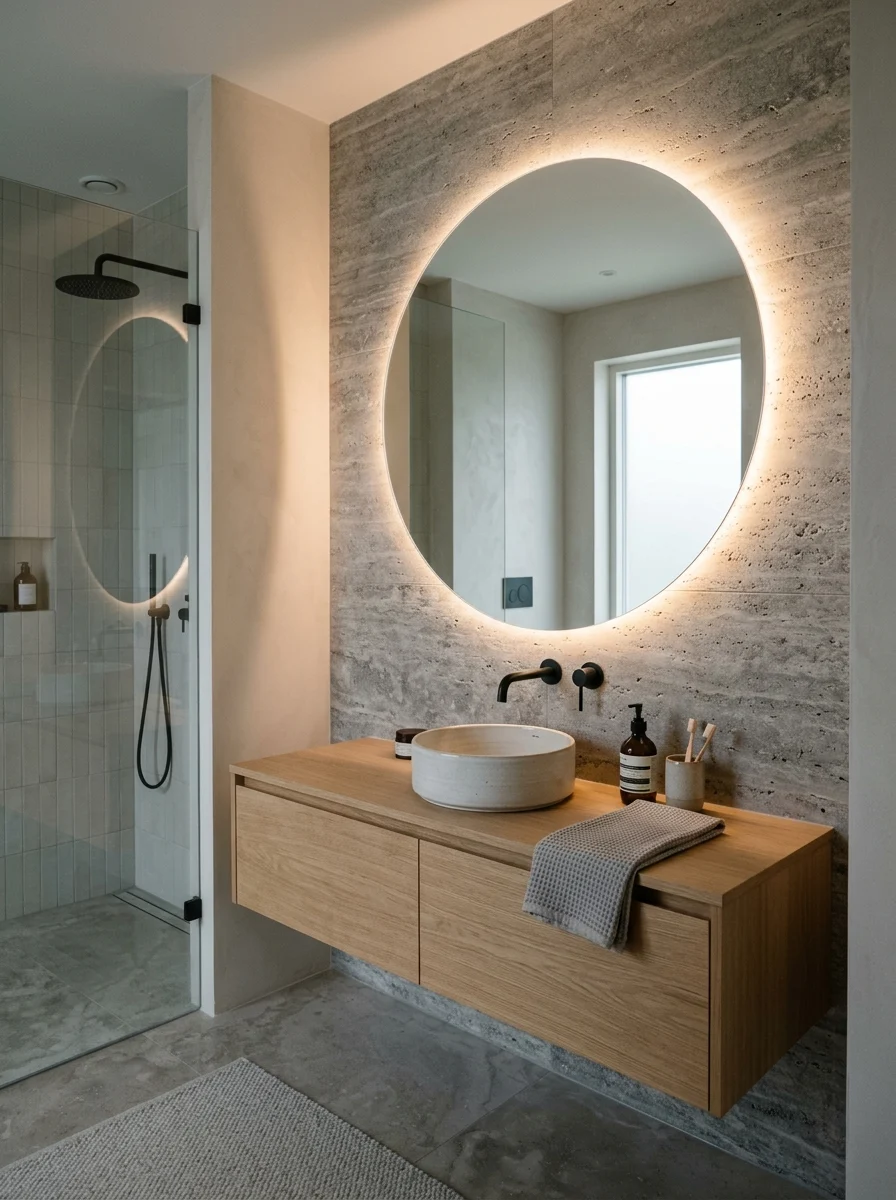
Backlit (halo) mirrors float a soft glow around the mirror’s perimeter, washing the wall with light. The effect is both flattering and architectural — the mirror appears to hover, and the bathroom gains a layer of ambient light with zero visible fixtures.
For grooming, front-facing or perimeter light beats a single overhead every time. Position the mirror so its center sits at average eye level (about 60–65 inches from the floor) and choose 2700K–3000K LEDs for a warm, skin-flattering tone. Dimmable drivers let the same mirror shift from bright morning task light to a soft evening glow.
Many modern backlit mirrors add anti-fog demisters, touch sensors, and color-temperature adjustment. A demister pad — a heated zone behind the glass — keeps the mirror clear after hot showers and is worth specifying in humid climates.
- Shapes: round mirrors soften rectilinear rooms; pill/capsule shapes suit double vanities
- Sizing: mirror width 70–80% of the vanity width keeps proportions balanced
- Wiring: plan a switched outlet or hardwired connection behind the mirror during rough-in
8. Use Natural Materials for Warmth
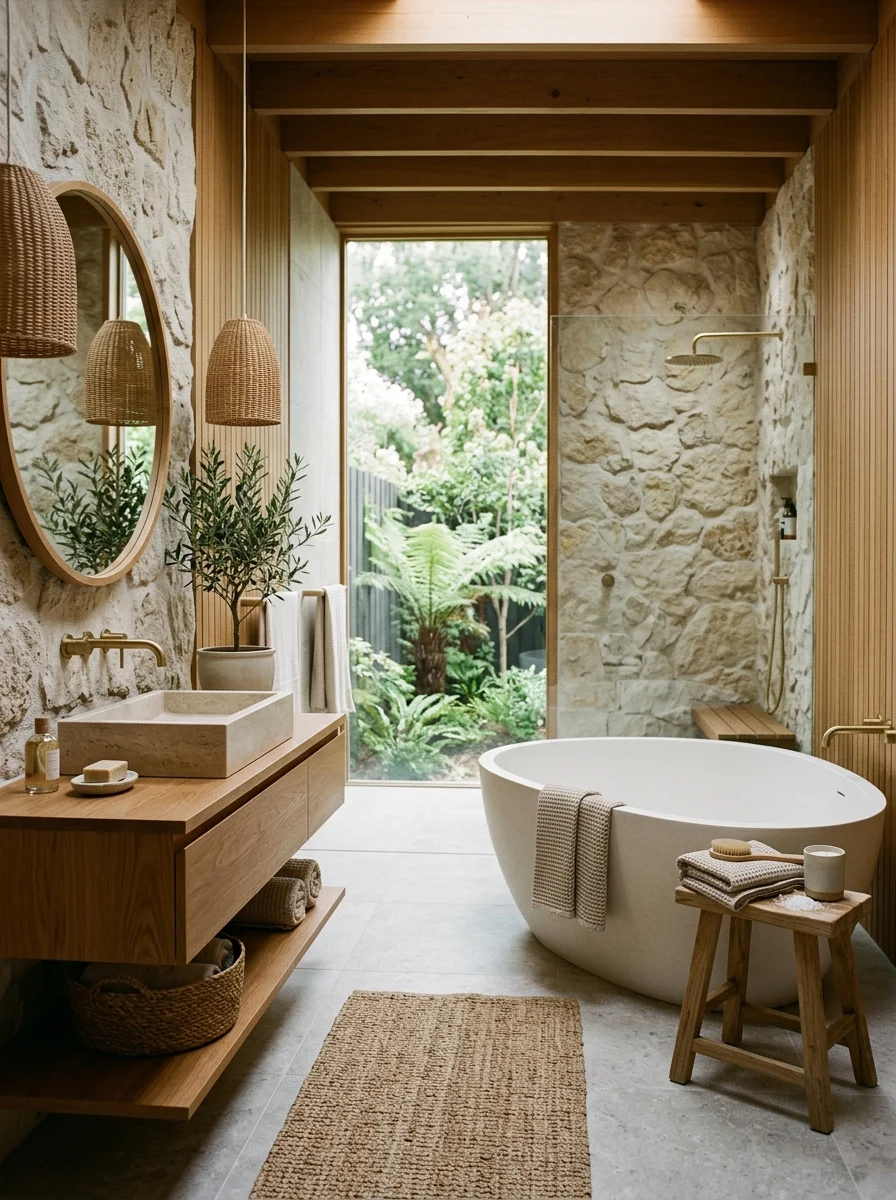
All-white, all-gloss bathrooms can feel clinical. Natural materials — white oak, honed marble, travertine, rattan, linen — introduce organic variation that keeps modern design warm and livable.
Wood needs protection in wet zones. Use it for vanities, mirror frames, and open shelving (sealed with marine-grade or conversion varnish), but keep it out of direct shower spray. Teak and white oak handle humidity better than softer species. For floors near water, wood-look porcelain gives the warmth without the maintenance.
Stone brings the spa feeling. A honed marble threshold, a travertine-look shower wall, or a pebble mosaic shower floor adds tactile richness. Seal natural stone annually — modern penetrating sealers are invisible and preserve the matte look.
- Wood: white oak vanity, teak bath mat or stool, oak-framed mirror
- Stone: honed marble counter, travertine tile, river-rock shower floor
- Soft goods: washed linen towels, a low-pile wool or cotton bath rug, woven storage baskets
9. Install Wall-Mounted Faucets
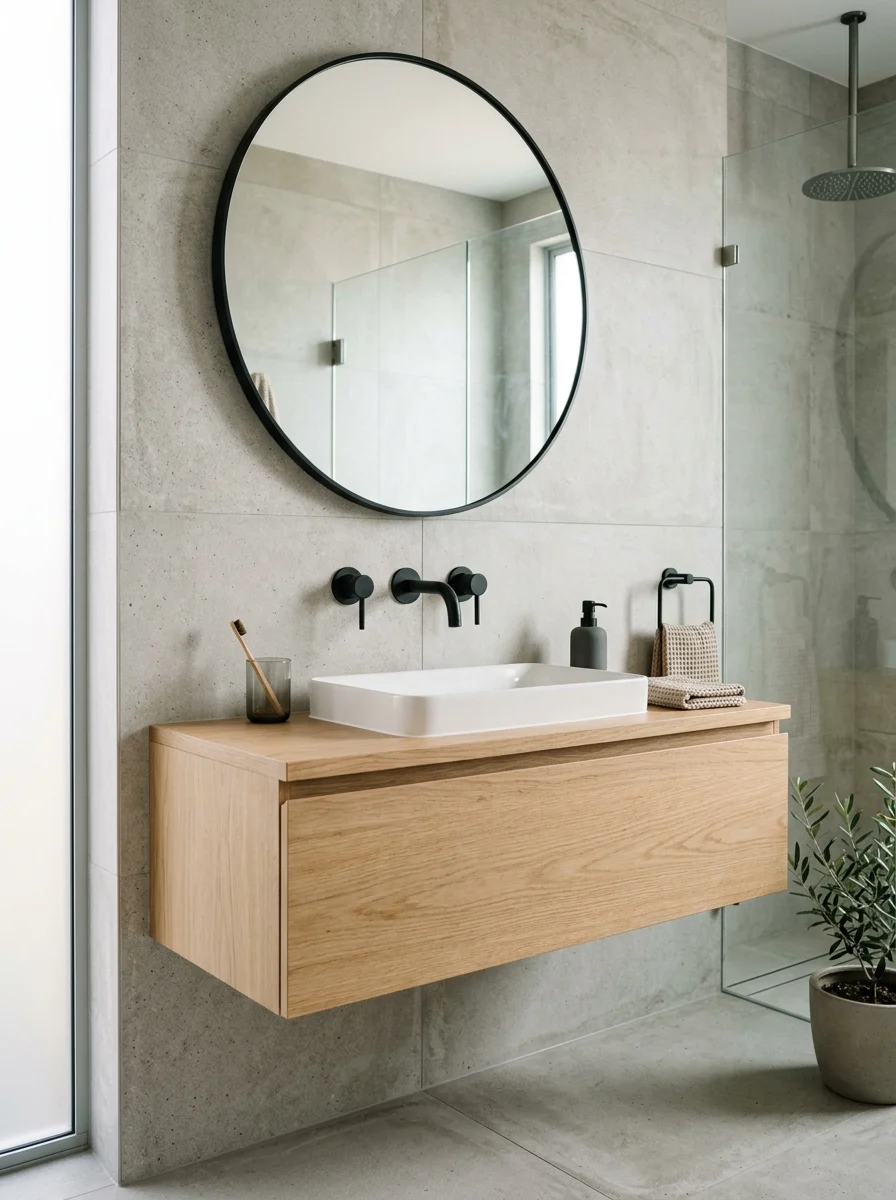
Wall-mounted faucets free the countertop entirely — no base plate, no grime-collecting crevices, just a clean spout emerging from the wall. The look is unmistakably modern and makes small vanities feel significantly more spacious.
Planning is everything. The rough-in valve must be set during framing, with the spout typically 6–8 inches above the sink rim and the spout reach matched to the basin (a vessel sink needs a longer reach than an undermount). Verify measurements against the actual sink before walls close.
Pair wall-mount faucets with vessel or semi-recessed sinks for the most dramatic effect, and keep the wall finish simple — large tile or sealed plaster — so the faucet reads as sculpture. Choose models with ceramic disc cartridges for drip-free longevity.
- Rough-in: confirm spout height, reach, and handle clearance before tiling
- Access: specify a faucet with front-serviceable parts or an access panel behind the wall
- Style match: echo the faucet’s finish in the shower trim and accessories
10. Create a Walk-In Shower
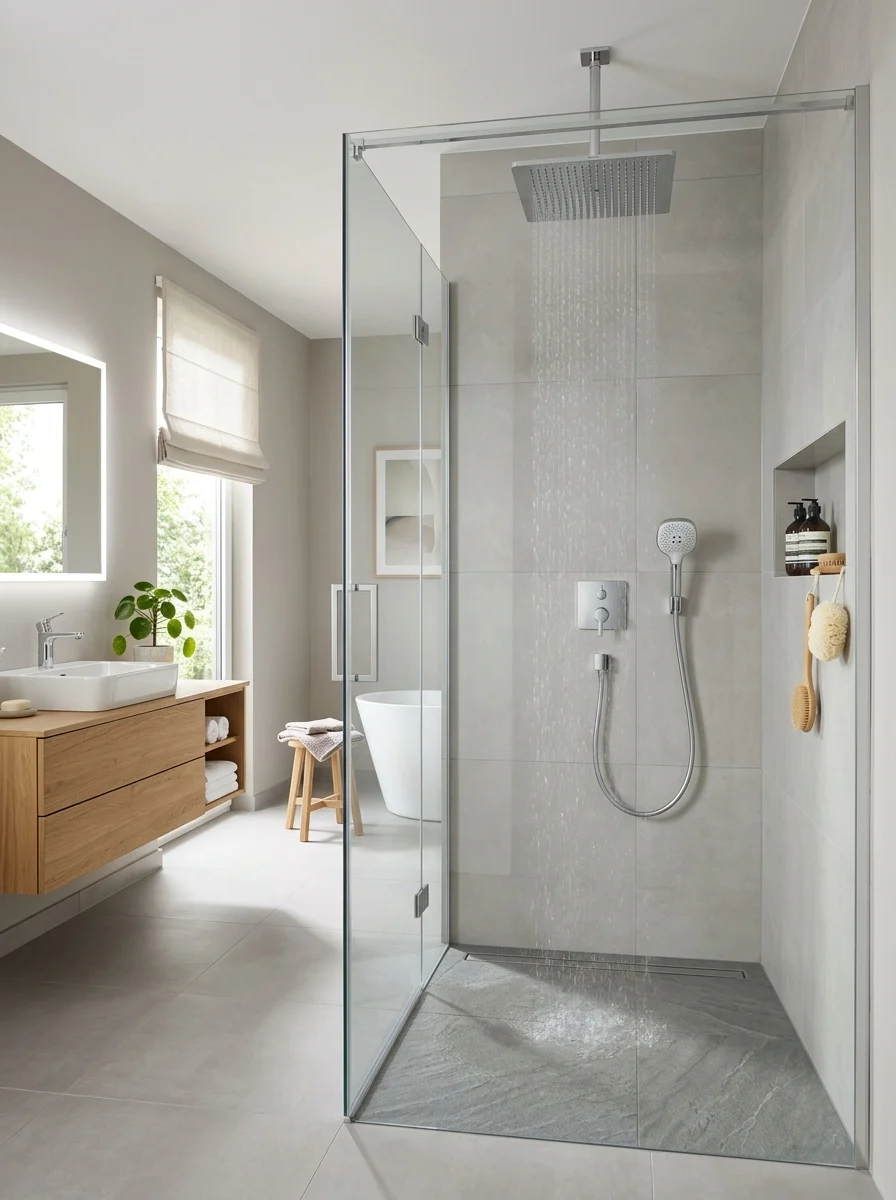
Walk-in showers — curbless, doorless, and visually continuous with the bathroom floor — are the signature move of modern bathroom design. Without thresholds or doors breaking the plane, the whole room reads as one generous space.
A true curbless shower needs the floor recessed or ramped so water flows to the drain; a linear drain along one edge handles this elegantly with a single-direction slope. Minimum comfortable dimensions are 36×60 inches, but 42×72 inches allows a bench and a rainfall head without crowding.
Detail the wet zone for longevity: a waterproofing membrane (not just water-resistant backer board), sloped shower floor at 1/4 inch per foot, and a frameless glass panel only where splash control demands it. A built-in tiled bench or corner footrest adds spa function without visual clutter.
- Drain: linear drain at the entry edge or along the back wall for a single-plane slope
- Glass: one fixed panel, 24–36 inches wide, on the splash side only
- Niche: a recessed tiled niche (12×24 inches is versatile) keeps bottles off the floor
11. Add Layered Lighting
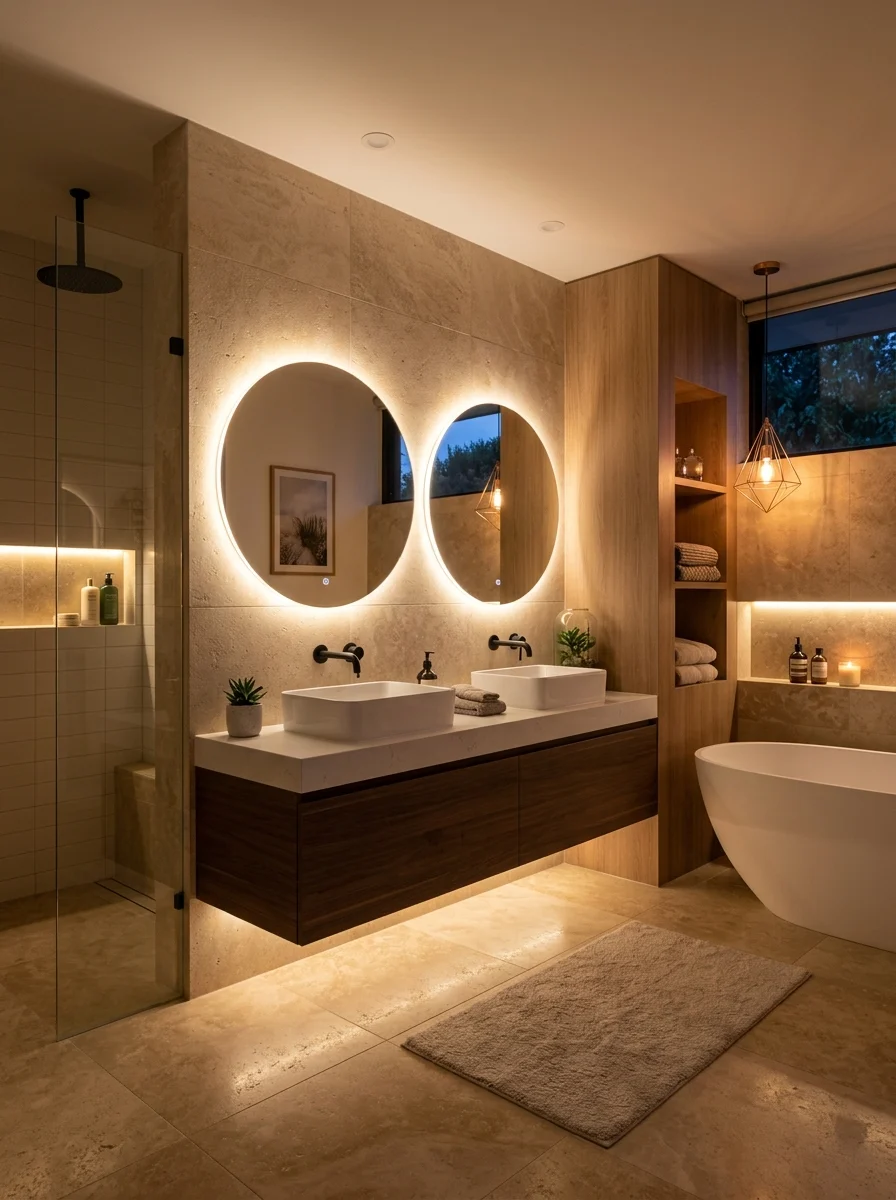
One overhead light flattens a bathroom and casts unflattering shadows. Layered lighting — ambient, task, and accent working together — gives modern bathrooms their warm, dimensional glow.
Build the layers: recessed ceiling lights or a flush mount for ambient fill; sconces or a backlit mirror at face height for shadow-free grooming; and accent light — an LED strip under a floating vanity, inside a niche, or along a toe-kick — for evening atmosphere. Put each layer on its own dimmer.
Color temperature shapes mood more than brightness does. Keep all bathroom LEDs between 2700K and 3000K (warm white) so skin looks natural and tile reads rich rather than icy. Avoid mixing temperatures — a 5000K recessed can next to a 2700K sconce looks unintentionally mismatched.
- Ambient: dimmable recessed LEDs, spaced 4–6 feet apart
- Task: sconces at eye level flanking the mirror, or vertical LED channels
- Accent: under-vanity strips, niche lighting, or a small pendant over a freestanding tub
12. Use Smart Bathroom Technology
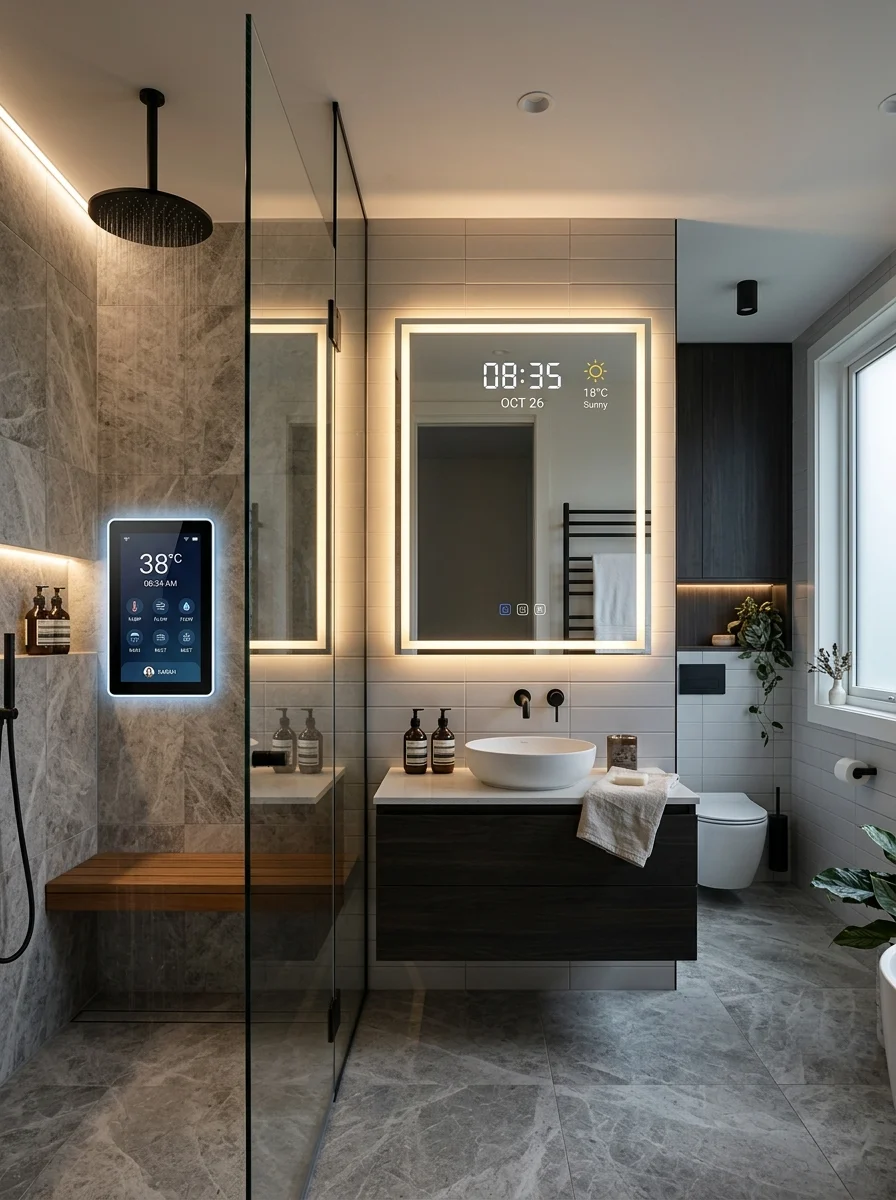
Smart features earn their place in modern bathrooms when they disappear into the design — no visible gadgets, just quiet convenience. The best upgrades improve comfort, hygiene, or efficiency without adding visual noise.
Start with high-impact, low-intrusion options: a heated floor (electric mats under tile, programmable by schedule), a humidity-sensing exhaust fan that runs until moisture clears, and motion-activated night lighting under the vanity. Each works invisibly in the background.
At the luxury end, digital shower controls allow preset temperatures and timed warm-up from outside the shower, while smart mirrors combine anti-fog, dimmable light, and even weather displays. Choose systems from established brands with local (non-cloud-dependent) basic function so the bathroom still works if Wi-Fi drops.
- Comfort: radiant floor heat, heated towel rails, anti-fog mirrors
- Efficiency: humidity-sensing fans, touchless faucets, dual-flush or smart toilets
- Control: digital shower valves, dimmable smart lighting, voice or app scenes
13. Keep Decor Simple and Intentional
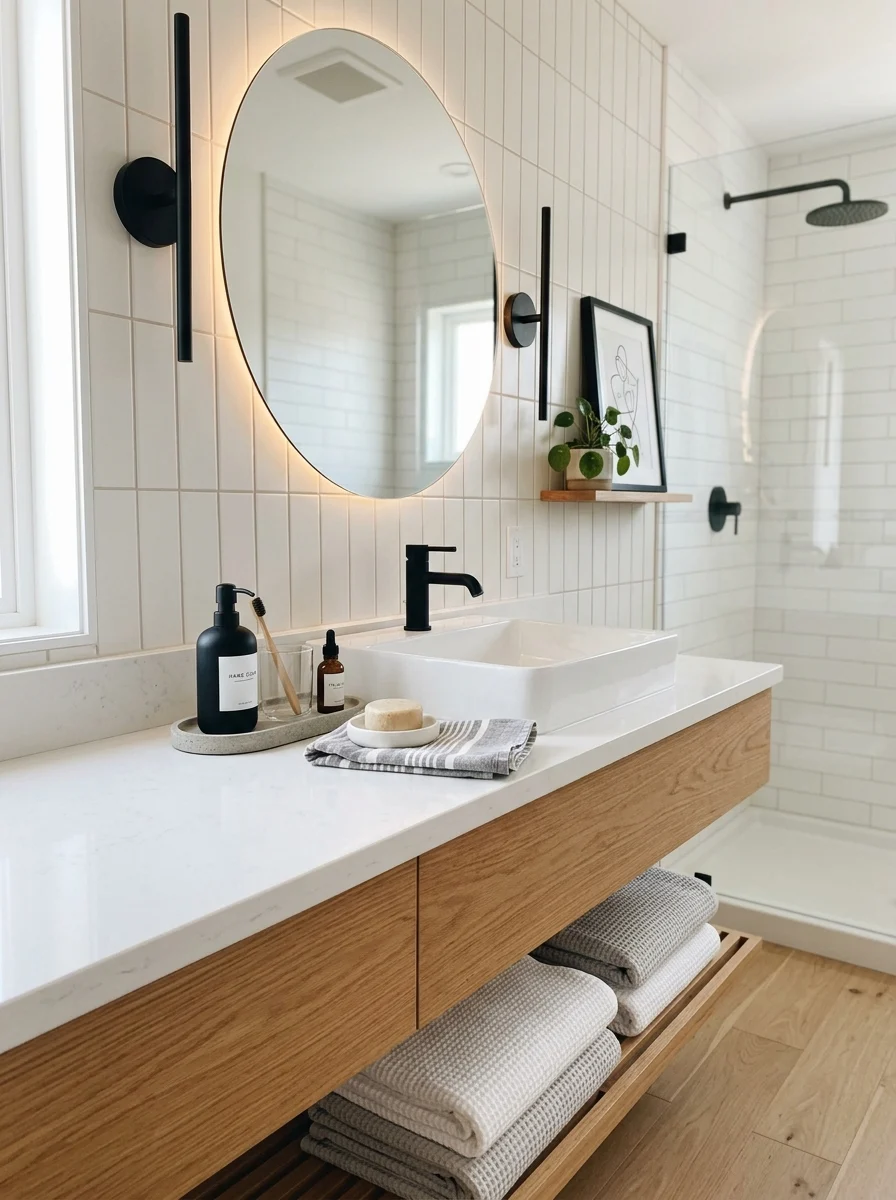
In modern bathrooms, restraint is the decoration. A few well-chosen objects — in a tight, tonal palette — have more impact than crowded shelves. Let architecture and materials carry the room; decor should only punctuate.
Follow a simple formula: something living (an orchid, a fern, eucalyptus stems), something textural (folded Turkish towels, a woven basket, a stone tray), and something sculptural (a ceramic vase, a candle, a piece of bath art). Keep everything within two or three tones drawn from the room’s palette.
Corral ruthlessly. A tray on the vanity, a basket for towels, a lidded canister for cotton rounds — containers turn loose items into composed vignettes. If it doesn’t fit the tray, it lives behind a closed door.
- Living: orchids, ferns, pothos, or dried eucalyptus (all tolerate humidity)
- Textural: stone or wood tray, woven baskets, washed-linen towels
- Sculptural: one ceramic vessel, a single candle, or one framed print
14. Use Linear Drains for Seamless Flooring
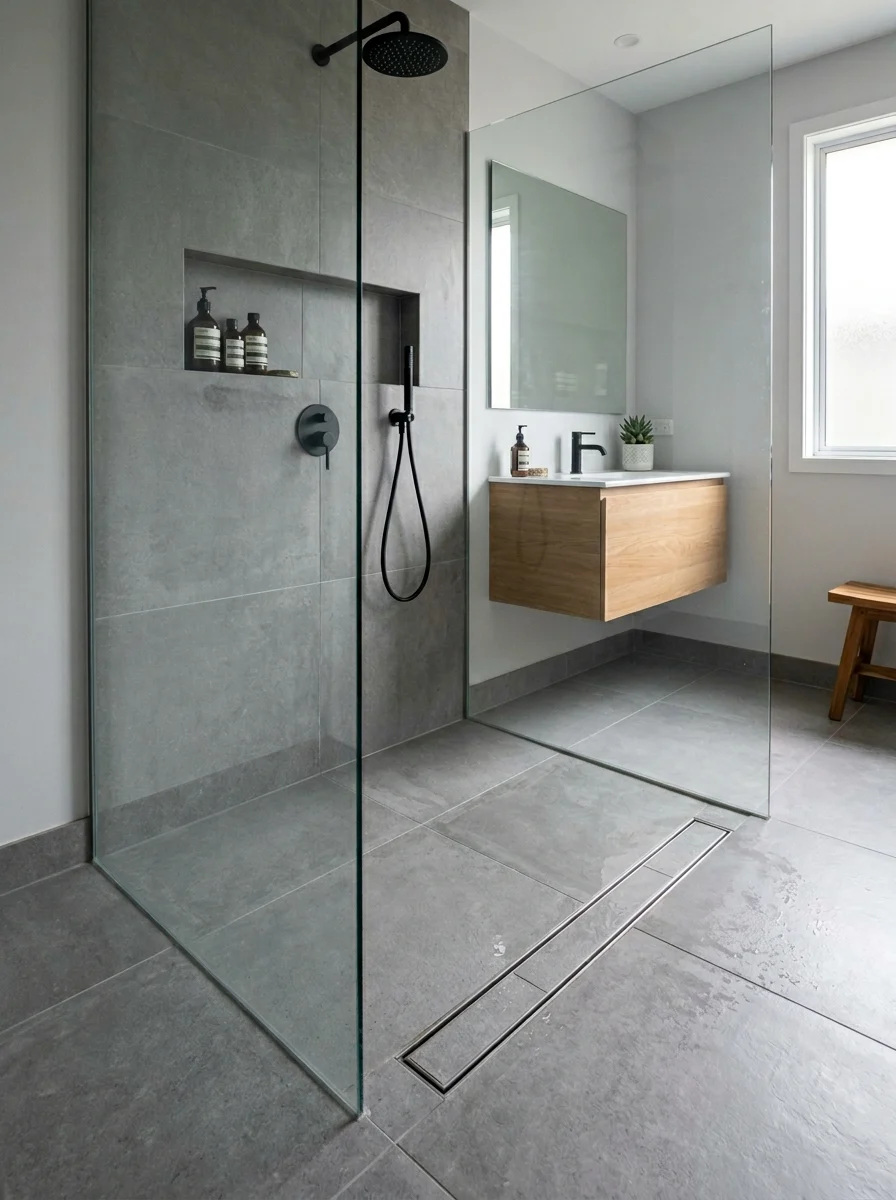
A linear drain — a slim slot, usually 24–36 inches long — lets shower floors slope in a single plane instead of four directions toward a center drain. Large tiles can run straight through without awkward diagonal cuts, which is exactly the seamless look modern bathrooms want.
Place the drain along the shower’s back wall or at the entry edge, and finish the grate to disappear: tile-in covers accept a strip of the floor tile so only a shadow line shows. Stainless grates in a matching finish are the lower-maintenance alternative.
Beyond looks, linear drains improve accessibility — the single gentle slope suits curbless entries and aging-in-place designs — and they handle high-flow rainfall heads better than small round drains. Size the drain to the shower: 24 inches suits compact showers, 32–36 inches for generous ones.
- Placement: back wall or entry edge; avoid the center walkway
- Cover: tile-in for invisibility, or metal matched to the fixtures
- Waterproofing: use a bonded-flange drain integrated with the membrane system
15. Incorporate Built-In Storage
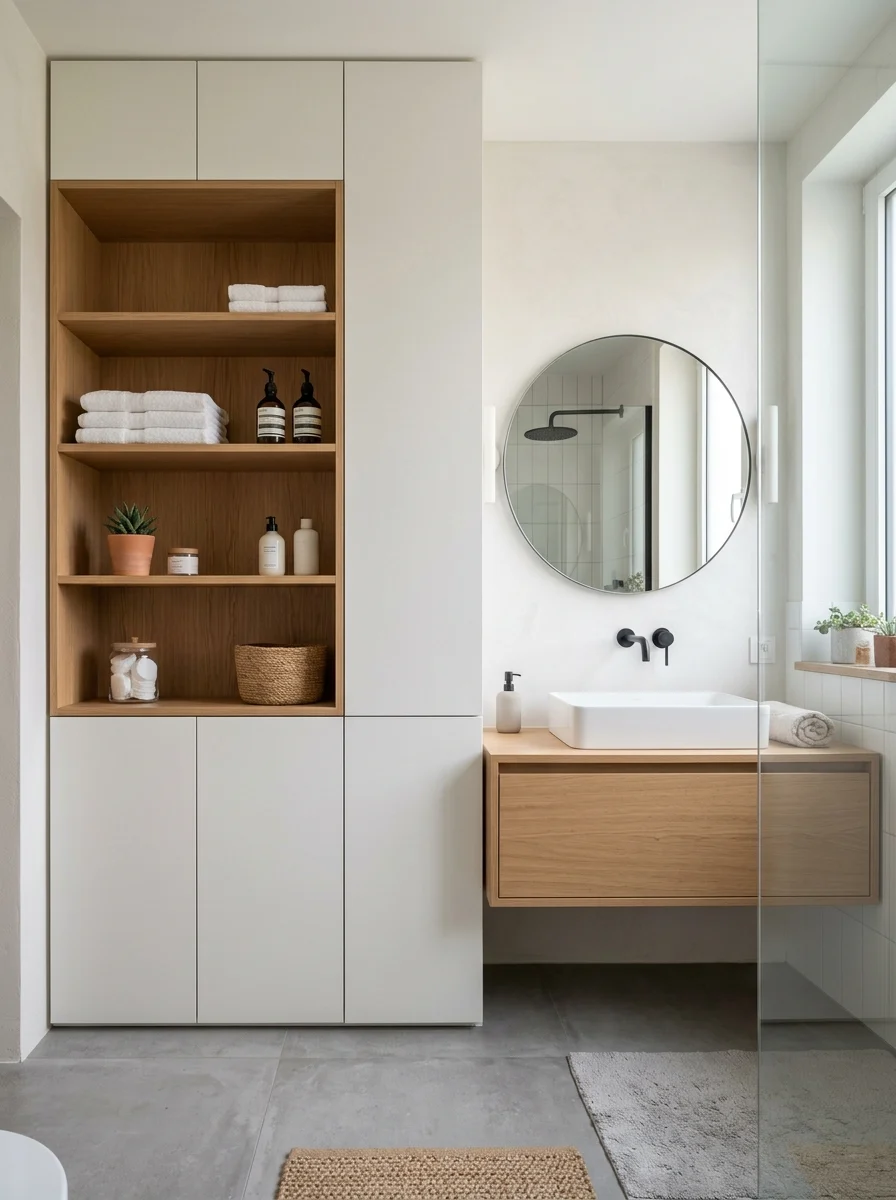
Built-in storage keeps the modern bathroom’s clean lines intact because it borrows space from inside walls and vanities instead of protruding into the room. Everything has a home; nothing sits out.
The shower niche is the essential built-in: recess it between studs (a 12×24-inch niche fits most stud bays), tile it in the field tile or a mosaic accent, and slope its sill slightly so water drains. Add a second niche at foot height for shaving, or a full-height niche column in a primary shower.
Beyond the shower, think vertically and invisibly: a recessed medicine cabinet with mirrored front, deep vanity drawers with organizers instead of doors, and a tall pull-out tower for linens. In the water closet area, a shallow recessed cabinet above the toilet uses dead space gracefully.
- Shower: recessed niches (sill sloped 1/8 inch), corner shelves only as a last resort
- Vanity: deep drawers with dividers beat doors and under-sink dead space
- Walls: recessed medicine cabinets and over-toilet niches reclaim hidden inches
16. Personalize with Statement Details
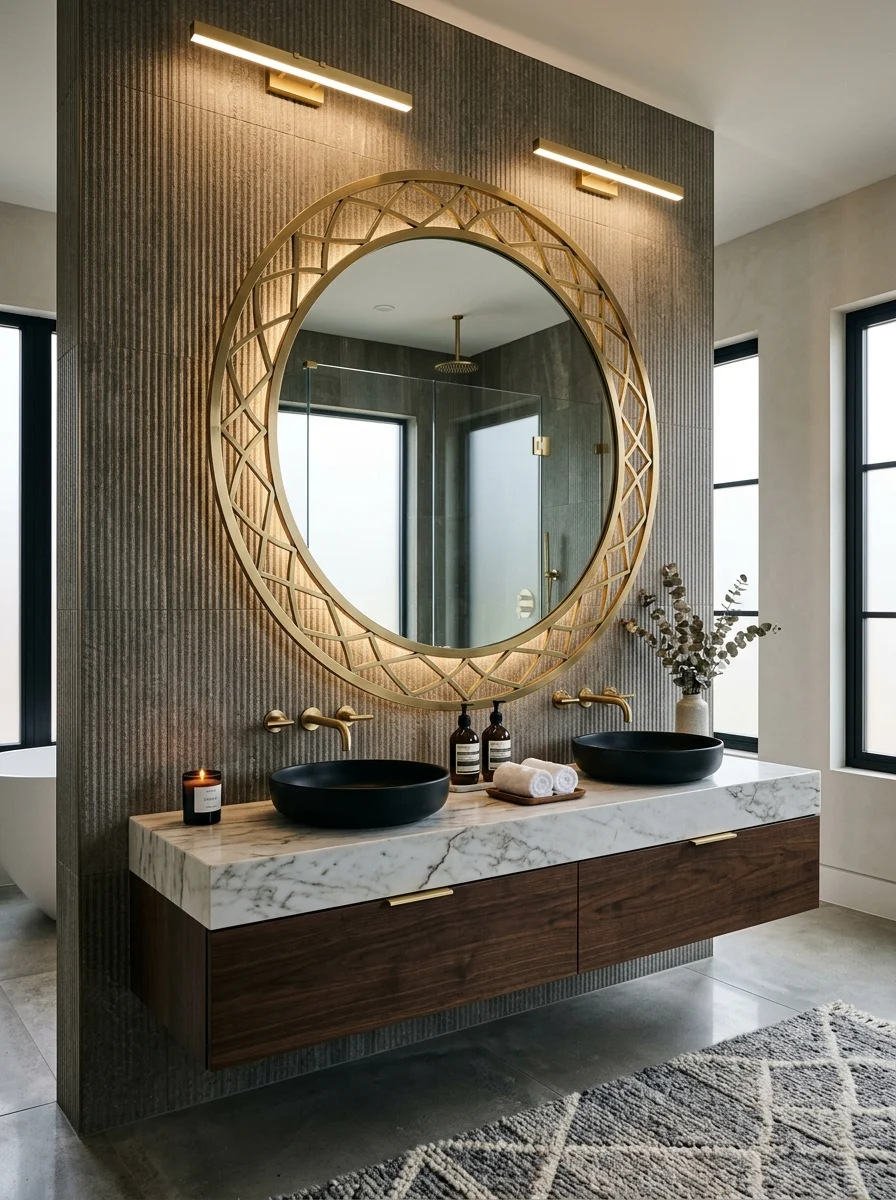
Minimalism needs a pulse. One or two statement details — a sculptural light, a dramatic mirror, an artistic basin — give a modern bathroom personality while the quiet envelope keeps it serene. The rule: make it bold, then give it room to breathe.
Choose statements that respect clean lines rather than fighting them. An oversized round mirror with a thin brass frame, a fluted stone pedestal sink, a pair of globe pendants over the vanity, or a single wall of zellige tile behind the tub — each adds character through form or texture, not clutter.
Placement decides impact. Center the statement on the room’s focal wall (usually the vanity or tub wall), keep surrounding surfaces calm, and light it deliberately — a picture light, a directed recessed can, or the glow of the fixture itself.
- Lighting: sculptural pendants, an oversized backlit round mirror
- Fixtures: a fluted or carved stone basin, a matte colored tub
- Surfaces: one feature wall in zellige, fluted tile, or book-matched marble
5 Modern Bathroom Mistakes to Avoid
1. Mixing too many metal finishes. Chrome faucets, black shower trim, brass lighting, and nickel pulls in one room read as indecision. Choose one dominant metal and allow one deliberate accent at most.
2. Undersizing the mirror and rug. A postage-stamp mirror over a wide vanity looks lost; size mirrors to 70–80% of vanity width. Likewise, a tiny bath mat floating in the middle of the floor breaks the room’s flow — choose one large enough to anchor the vanity zone.
3. Lighting only from above. A single ceiling fixture casts shadows under brows and chins. Always add face-height light at the mirror — sconces, vertical channels, or a backlit mirror — for grooming that actually works.
4. Ignoring the “wet” in wet room. Wood vanities need sealed finishes, natural stone needs annual sealing, and every shower needs a true waterproofing membrane — not just cement board. Moisture detailing is invisible when done right and catastrophic when skipped.
5. Designing for photos, not mornings. Open shelving with rolled towels looks beautiful until daily use turns it chaotic. Be honest about maintenance: closed storage for the everyday, open display only for what stays beautiful with zero effort.
Modern Bathroom Design FAQs
What is the most timeless modern bathroom style?
A neutral palette (warm white, greige, soft black) with natural stone or wood accents and matte fixtures. It avoids trend-dependent colors and ornate details, so it looks current for a decade or more with only soft-good updates.
How can a small bathroom look modern?
Prioritize visual continuity: large-format tile, a floating vanity, frameless glass, and a wall-hung toilet. Keep the palette light and the surfaces clear. A backlit mirror and layered lighting add depth that makes compact rooms feel larger.
Are matte black fixtures hard to maintain?
Quality PVD or powder-coated matte black hides water spots and fingerprints better than chrome. Wipe with a soft damp cloth and avoid abrasive cleaners. Cheap spray-coated versions can chip — invest in reputable brands for fixtures touched daily.
What tile size is best for a modern bathroom?
24×24 inches or larger for floors, and 12×24 inches or larger for walls. Larger tiles mean fewer grout lines, which reads as calmer and more seamless — the core modern effect. Match grout closely to the tile color.
How much does a modern bathroom renovation cost?
Costs vary widely by region and scope, but a mid-range full bathroom renovation typically runs $15,000–$30,000+, with luxury primary suites going higher. Fixtures, tile, and labor are the big three; keeping the existing layout controls costs significantly.
The Bottom Line
Modern bathroom design with clean lines is less about buying a particular “look” and more about disciplined decisions: fewer objects, quieter geometry, honest materials, and light in layers. Start with the highest-impact moves — declutter the layout, simplify the palette, upgrade the lighting — and add the architectural details (floating vanity, frameless glass, linear drain) as budget allows.
Done well, a modern bathroom feels calm at 6 a.m. and luxurious at 9 p.m. — a hardworking room that never shouts. Use these sixteen ideas as a checklist, adapt them to the room’s size and the household’s habits, and the result will feel both current and enduring.