Some gallery walls look effortlessly collected, while others somehow feel chaotic even with beautiful frames. Usually the difference comes down to spacing, balance, and choosing pieces that actually work together naturally. The good news is you really don’t need perfect design skills to make one feel polished.
A few simple layout tricks and softer styling choices honestly make the whole process much easier.
And once a gallery wall finally comes together, the room suddenly feels more personal and finished.
1. Start with a Clear Color Palette First

One of the easiest ways to make a gallery wall feel cohesive is choosing a soft consistent color palette before hanging anything. Warm neutrals, black and white photography, muted earthy tones, or vintage sepia prints usually blend together beautifully without overwhelming the room. Mixing too many bold colors can quickly make walls feel busy instead of layered and calm. Light oak frames, matte black borders, or warm brass accents help tie everything together naturally too. And honestly, gallery walls almost always feel more timeless when the colors quietly connect rather than compete. Soft linen curtains, textured rugs, and warm wood furniture nearby also help the arrangement feel grounded within the rest of the space.
2. Lay Everything on the Floor Before Hanging

Planning the arrangement on the floor first saves so many unnecessary wall holes later. Spread the frames out beneath the wall and slowly move pieces around until the spacing feels balanced naturally. Start with the largest artwork first, then build outward using smaller pieces around it. Slightly uneven layouts often feel warmer and more collected than perfectly symmetrical grids too. And honestly, stepping back every few minutes helps more than anything because small spacing mistakes become obvious from farther away. Warm natural lighting during the daytime also makes it easier to see whether the layout feels visually balanced overall.
3. Mix Frame Sizes for a More Relaxed Look

Gallery walls usually feel more interesting when frame sizes vary slightly instead of matching perfectly. Combining medium artwork with a few smaller prints and one larger statement piece creates movement that feels collected over time rather than overly staged. Thin black frames mixed with natural wood textures work especially beautifully in modern homes because the contrast still feels soft and warm. Leave enough breathing room between each piece though. Tight crowded layouts can quickly feel heavy, especially in smaller rooms. And honestly, slight size variation keeps the eye moving naturally across the wall without making the arrangement chaotic.
4. Keep Spacing Consistent Between Frames

Even relaxed gallery walls need some structure to feel intentional. Keeping similar spacing between frames helps everything feel calmer visually, even when the artwork styles vary slightly. Around two to three inches between each frame usually feels balanced in most living rooms or hallways. Smaller gaps can feel cluttered while overly wide spacing makes the collection feel disconnected. Soft cream walls and warm lighting help frame arrangements stand out gently too. And honestly, consistent spacing is often what quietly makes gallery walls feel polished without people realizing exactly why.
5. Use Personal Pieces Alongside Artwork

Gallery walls instantly feel warmer when they include personal touches alongside traditional artwork. Family photos, handwritten notes, vintage postcards, travel sketches, or old black and white snapshots all help the arrangement feel lived in and meaningful. Mixing personal pieces with abstract art or landscape photography creates balance so the wall doesn’t feel overly formal. And honestly, the most memorable gallery walls usually tell a quiet story about the people living there. Slight imperfections in older frames or faded prints often add even more charm naturally.
6. Add Texture Beyond Just Framed Art

Gallery walls don’t need to include only artwork. Woven baskets, small mirrors, textile pieces, vintage sconces, or wood carvings help add texture and depth so the arrangement feels softer and more layered. This works especially beautifully in neutral homes where the palette already feels calm and organic. Light wood textures mixed with matte black frames create beautiful contrast without overwhelming the wall visually. And honestly, adding non-frame elements often makes gallery walls feel less rigid and more collected naturally over time.
7. Anchor the Arrangement Around Furniture

Gallery walls usually feel best when they connect visually to furniture underneath instead of floating awkwardly on empty walls. Center the arrangement above sofas, sideboards, beds, or console tables so everything feels tied together naturally. Leave enough space between the furniture and the lowest frame too. Around six to eight inches usually creates comfortable balance visually. Warm table lamps, stacked books, and textured decor underneath help soften the arrangement even more. And honestly, anchored gallery walls always feel calmer because the room already has a natural focal point supporting them.
8. Use Matching Frames for a Cleaner Style

If you want a gallery wall that feels modern and minimal, matching frames usually work beautifully. Thin matte black frames, warm oak borders, or soft brass finishes create consistency that helps the arrangement feel clean and organized even with different artwork styles inside. Neutral artwork and black-and-white photography especially suit this approach because the overall wall stays visually calm. And honestly, matching frames make gallery walls feel much easier to style since the consistency already creates structure automatically.
9. Don’t Hang Everything Too High

One of the most common gallery wall mistakes is hanging frames much higher than eye level. Artwork usually feels more connected to the room when the center of the arrangement sits closer to natural viewing height. Lower gallery walls instantly feel warmer and more inviting because they connect visually with furniture and decor nearby. And honestly, slightly lower arrangements often make rooms feel cozier overall. Use painter’s tape or paper templates first if the wall feels difficult to visualize before committing to nails.
10. Let the Arrangement Grow Over Time

The nicest gallery walls usually aren’t finished all at once. Adding new prints, vintage finds, or personal photos slowly over time helps the wall feel authentic and collected naturally. Empty space is completely okay in the beginning too. Sometimes slightly unfinished walls feel softer and more realistic than perfectly packed arrangements immediately. Warm sunlight, textured frames, layered neutral tones, and small meaningful details eventually bring everything together quietly. And honestly, gallery walls often become more beautiful as they slowly evolve with the home itself.
11. Build the Wall Around the Television
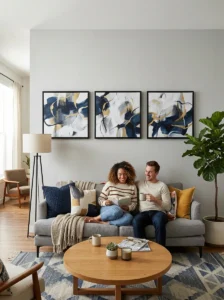 A television on its own is a black rectangle the room has to apologise for. Treat the screen as the largest frame in a gallery group and the problem mostly solves itself. Hang art around it — above, beside, and below if a low unit allows — keeping the same gaps you would leave between frames, and the television stops being an interruption and becomes part of the composition, on or off.
Start by measuring the screen and sketching it as one rectangle in your floor layout, exactly as you would the biggest print. Balance its visual weight: a large dark screen needs one substantial piece near it, not six small ones nibbling at the edges. Keep frames in a single colour family so the group holds together, and leave the soundbar and boxes out of the arrangement’s outline. The mistake to avoid is hanging art only above the screen, which builds a shelf of pictures over a void. Wrap at least one side and the wall starts to make sense. Personal pieces work especially well here, as the photo wall decor ideas in this collection show.
12. Go Floor to Ceiling on the Narrow Wall Nobody Uses
 Most gallery advice assumes a wide wall above a sofa. The narrow wall at the end of a hallway, beside a staircase, or between two doors often suits a gallery better — if you use all of it. A floor-to-ceiling arrangement, salon style, turns a leftover strip into the most talked-about wall in the house, and it is the one place where a dense, edge-to-edge hang looks deliberate instead of crowded.
Work from the middle outwards and from the centre line up and down, keeping your usual even gaps so the density reads as confidence, not clutter. Mix sizes freely here, but hold one thing steady — frame colour, mount colour, or a repeated subject — or the tall column turns into visual noise. Mind the practical edges: leave pieces clear of light switches, door swings and the skirting, and put nothing fragile at elbow height in a hallway. Anchor the bottom row a little above the floor rather than resting on it, or mopping day will rearrange your art for you. More collected, object-mixed walls live in our wall art ideas hub.
13. Keep a Rotation: Same Frames, Fresh Prints Twice a Year
 A gallery wall does not have to be a final decision. If you standardise on two or three frame sizes, you can swap the prints inside them whenever the room needs a lift — brighter pieces for spring, heavier, darker ones for winter — without one new hole in the wall. The frames and the layout stay; only the mood changes. It is also the cheapest refresh in decorating: a handful of new prints costs less than a cushion.
Build the rotation from the start. Keep a flat folder or a spare frame box with the off-season prints stored in size order, each in a sleeve so edges survive storage. When you swap, change about two-thirds of the pieces and keep a few anchors — the photograph everyone loves, the big central print — so the wall stays recognisably yours. Note which print came from which frame on a slip of paper in the folder; future you will be grateful. Readers who like making the prints themselves will find plenty to rotate in our DIY wall decor ideas.
The Step-Back Habit That Saves My Walls
Every gallery wall I have hung has passed through a stage where it looked wrong and I could not say why. What fixed it was never a new frame. It was stepping back — out of the room, through the doorway, phone camera in hand — and looking at the wall the way a visitor does. From the doorway, the faults announce themselves: the group drifts left, one frame sits a fraction high, the largest piece is not where the eye lands first. I now tape, step back, adjust, and only then hang, and I leave the wall alone overnight before the final piece goes up. Morning light is a sterner critic than evening enthusiasm, which is worth remembering for bedroom walls too — the bedroom wall decor ideas here get judged at exactly that hour.
Gallery Wall Questions, Answered
How do I start a gallery wall if I own only three pieces?
Hang the three as a tight group at eye level, not spread thin to fake a bigger wall, and leave planned space around them to grow into. A small, confident cluster looks intentional. Buy or make the fourth and fifth pieces as you find them — a grown wall nearly always beats a bought-in-one-go wall.
Should all the art face the same way — portrait or landscape?
No. A mix of orientations is what makes a gallery wall feel collected, as long as the outer edge of the group forms a calm shape and the gaps stay even. If a layout feels restless, check the mix: walls that are nearly all portrait can look like a corridor of doorways.
How do I hang a gallery wall on plaster or brick?
On old plaster, drill slowly and use proper wall plugs, or choose a picture rail and cables so the holes go once into solid material near the ceiling. On brick, drill into the mortar joints where you can — they are easier to fill invisibly later — and use masonry fixings for anything heavy.
Can a gallery wall work in a small room?
Yes, and it can help. A well-filled wall reads as one considered surface rather than many small interruptions, which calms a small room. Keep the palette tight, the frames slim, and group the pieces over furniture instead of scattering them across every wall.